What's cooking? Unsafe air if the stove runs on gas. (Photo by Mykola Makhlai from Unsplash)
Gas Ranges Push 22 Million Americans Over NO₂ Guideline; Electric Adds None
In A Nutshell
- 22 million Americans would drop below WHO nitrogen dioxide safety limits if they switched from gas to electric cooking, according to the first nationwide study mapping both indoor and outdoor NO₂ exposure.
- Gas stoves account for roughly 25% of total residential nitrogen dioxide exposure for people who use them—and more than half the exposure for households that cook most intensely.
- Electric stoves emit zero nitrogen dioxide because they generate heat without combustion, eliminating this indoor pollution source entirely.
- Gas stoves cause 7-15 days per year when household air exceeds WHO’s hourly NO₂ guideline, while outdoor sources virtually never create such spikes (fewer than 1 in 100,000 EPA measurements exceeded the threshold).
Switching from gas to electric cooking would bring 22 million Americans below the World Health Organization’s long-term nitrogen dioxide guideline, according to the first nationwide study to map nitrogen dioxide exposure from both indoor and outdoor sources.
Electric stoves emit no nitrogen dioxide. Gas and propane stoves, by contrast, generate enough of the lung irritant to account for roughly a quarter of total residential exposure for people who use them (and more than half the exposure for households that cook most intensely).
The gap matters for public health. Nitrogen dioxide triggers asthma attacks, worsens chronic lung disease, and has been linked to preterm births and other health problems. While outdoor concentrations from vehicle exhaust and power plants get tracked nationwide through satellites and ground monitors, the pollution people generate inside their own kitchens has remained largely invisible to researchers and regulators.
22 Million Americans Breathing Unsafe Air From Cooking
Stanford University scientists created ZIP code-level maps showing how gas stoves push millions of Americans over the World Health Organization’s long-term exposure guideline of 5.2 parts per billion, which applies to both indoor and outdoor environments globally.
Around 77% of Americans already exceed that guideline from outdoor sources alone. Gas stoves push an additional 22 million people over the threshold (cases where outdoor pollution by itself would leave them in the safe zone).
Kashtan and colleagues estimate that among roughly 27 million Americans who would be under the WHO nitrogen dioxide guideline based on outdoor air alone but who own a gas stove, using that stove pushes about 22 million above the guideline.
For nitrogen dioxide specifically, electric stoves sidestep this problem completely. Because they generate heat through electrical resistance rather than combustion, they produce no nitrogen dioxide emissions during cooking. People who cook with electric stoves experience only the outdoor-sourced NO₂ that infiltrates their homes naturally.
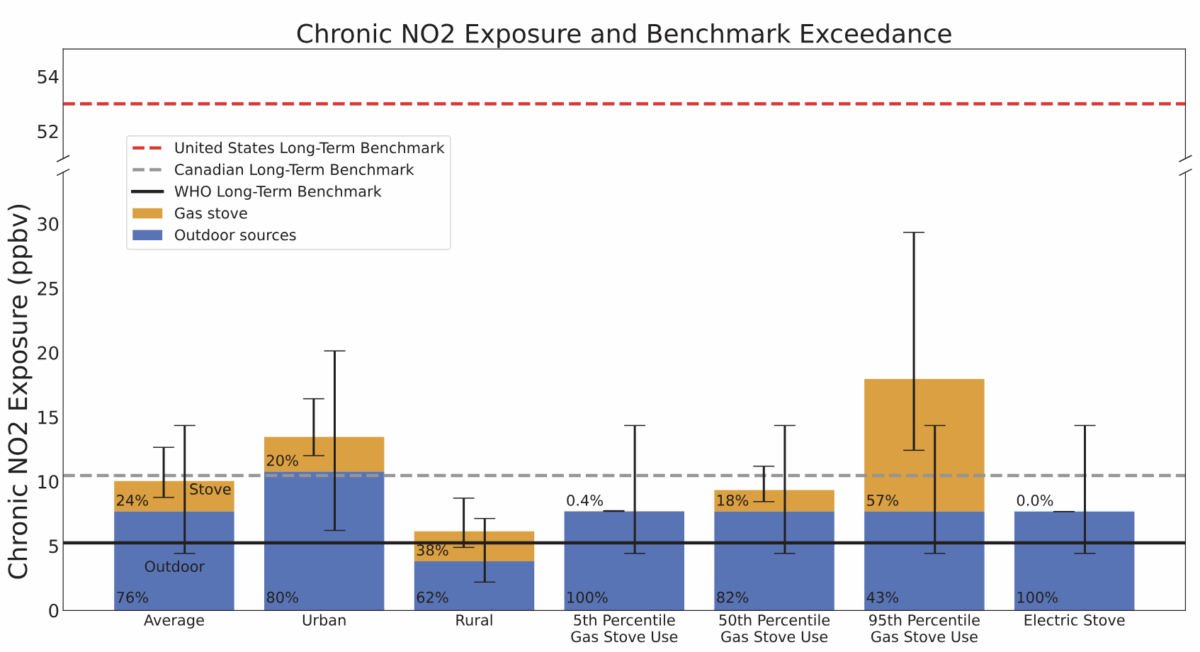
Gas Stoves Contribute a Quarter of Nitrogen Dioxide Exposure
The research team analyzed 133 million residential dwellings nationwide, combining direct measurements from gas stove testing in more than 15 cities with housing data and outdoor pollution monitoring.
People with gas or propane stoves face an average residential nitrogen dioxide exposure of 10.1 parts per billion. Gas stoves account for 2.4 ppb of that total, while outdoor sources contribute 7.7 ppb. Electric stove owners experience only the 7.7 ppb from outdoor pollution.
The disparity grows for people who cook more often or at higher heat. Households in the top 5% of gas use while cooking experience around 10.3 ppb of additional exposure just from their stove. Combined with outdoor sources, gas stoves become responsible for 57% of these heavy cookers’ total nitrogen dioxide exposure.
Geography and housing characteristics affect these numbers. Population-dense urban areas showed higher indoor exposure from gas stoves, partly because apartments tend to have smaller kitchens where pollution concentrates more quickly. ZIP code-level exposure from gas stoves ranged from 1.69 ppb to 4.16 ppb depending on factors including residence size, ventilation rates, and climate.
Hourly Air Quality Violations Happen During Cooking
Gas stoves also create brief but intense pollution spikes that electric stoves never produce. The Stanford analysis found that households with gas stoves exceeded the WHO’s hourly exposure guideline of 100 ppb on 7 to 15 days per year on average. These short-term violations happened almost exclusively during and immediately after cooking.
Outdoor sources alone virtually never cause such hourly spikes. Between 2019 and 2022, EPA’s nationwide network of over 450 real-time nitrogen dioxide monitors detected hourly outdoor concentrations above 100 ppb in fewer than one measurement out of 100,000.
Electric stoves produce none of these nitrogen dioxide spikes. Whether someone’s cooking a quick breakfast or simmering sauce for hours, an electric stove adds no combustion-related NO₂ to the room air.
How Scientists Measured Kitchen Air Pollution
For the study, published in PNAS Nexus, the Stanford team used a computer model called CONTAM to simulate how pollution moves through 24 different representative home layouts. Each simulation accounted for range hood use, cooking intensity, time spent in various rooms, window opening patterns, and local weather.
They measured nitrogen dioxide emission rates directly from gas stoves and validated their models against concentrations measured in 18 actual test houses. The team then applied these models across all US ZIP codes, adjusting for local housing characteristics from Census data.
The researchers paired 2016 outdoor nitrogen dioxide concentrations from satellite monitoring with ground-level measurements from EPA’s sensor network. They incorporated data on gas stove prevalence and housing types from the End-Use Load Profiles database, which models roughly 550,000 buildings representing America’s 133.2 million residential units.
Previous studies from 2000 to 2016 estimated higher indoor contributions, likely because continuously burning pilot lights were more common then and because outdoor pollution has declined substantially over the past two decades.
For the roughly 40% of US households currently cooking with gas or propane, these results quantify a source of air pollution that existing monitoring systems don’t capture. Satellite imagery and outdoor sensors can track nitrogen dioxide from power plants and traffic, but they can’t see what’s happening inside American kitchens. Electric cooking eliminates that blind spot entirely for nitrogen dioxide (no combustion means no NO₂). For 22 million Americans, that difference could mean breathing air that meets the WHO nitrogen dioxide guideline instead of exceeding it.
Disclaimer: This article reports on peer-reviewed research published in PNAS Nexus. The study examined nitrogen dioxide exposure specifically, not all pollutants that may be present during cooking. Readers should consult qualified professionals for personalized advice about home air quality and appliance choices.
Paper Summary
Study Limitations
The researchers note several limitations to their exposure estimates. First, the study focused exclusively on gas and propane stoves as indoor nitrogen dioxide sources, not accounting for other potential contributors like ventless space heaters, cigarettes, or improperly vented gas water heaters and furnaces. Second, the model relies on a 1989 national survey and more recent California and Canadian surveys for range hood prevalence and usage rates; a current nationwide survey would improve accuracy. Third, the analysis excluded nitrogen dioxide exposure at workplaces or inside vehicles, meaning actual total exposure for many people exceeds the residential estimates reported here. Fourth, the study covers only the contiguous United States; extending the methodology internationally would require similar housing, climate, and behavioral data from other countries.
Funding and Disclosures
This work was supported by the Stanford Doerr School of Sustainability and Earth System Science Department as well as Stanford’s Knight-Hennessy Scholars Program. The research did not receive funding from any specific grant. The authors declared no competing interests. Kashtan has an affiliation with PSE Healthy Energy, a nonprofit research institute focused on energy and public health.
Publication Information
The study “Integrating indoor and outdoor nitrogen dioxide exposures in US homes nationally by ZIP code” was authored by Yannai Kashtan (Stanford University Earth System Science Department and PSE Healthy Energy), Chenghao Wang (University of Oklahoma School of Meteorology and Department of Geography and Environmental Sustainability), Kari C. Nadeau (Harvard T.H. Chan School of Public Health), and Robert B. Jackson (Stanford University Earth System Science Department, Woods Institute for the Environment, and Precourt Institute for Energy). The paper was published in PNAS Nexus, volume 4, issue 12, article pgaf341, with advance online publication on December 2, 2025. DOI: 10.1093/pnasnexus/pgaf341.


