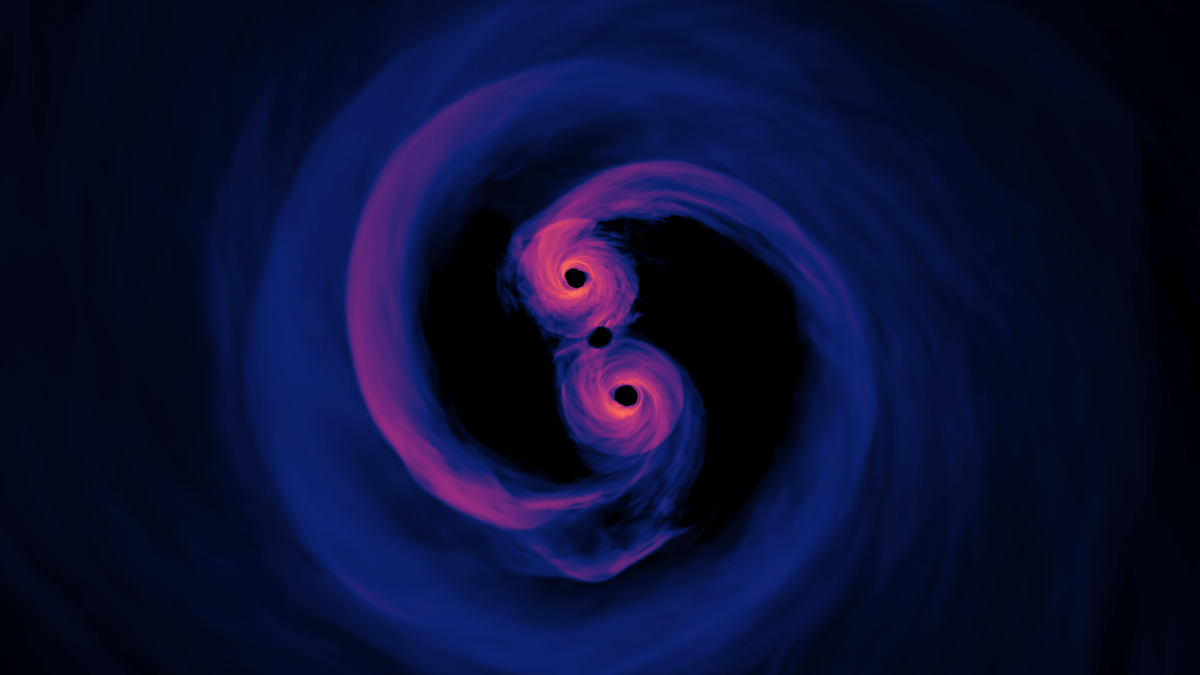
Simulation of the light emitted by a supermassive black hole binary system where the surrounding gas is optically thin (transparent). Viewed from 0 degrees inclination, or directly above the plane of the disk. The emitted light represents all wavelengths. (Credit: NASA's Goddard Space Flight Center/Scott Noble; simulation data, d'Ascoli et al. 2018)
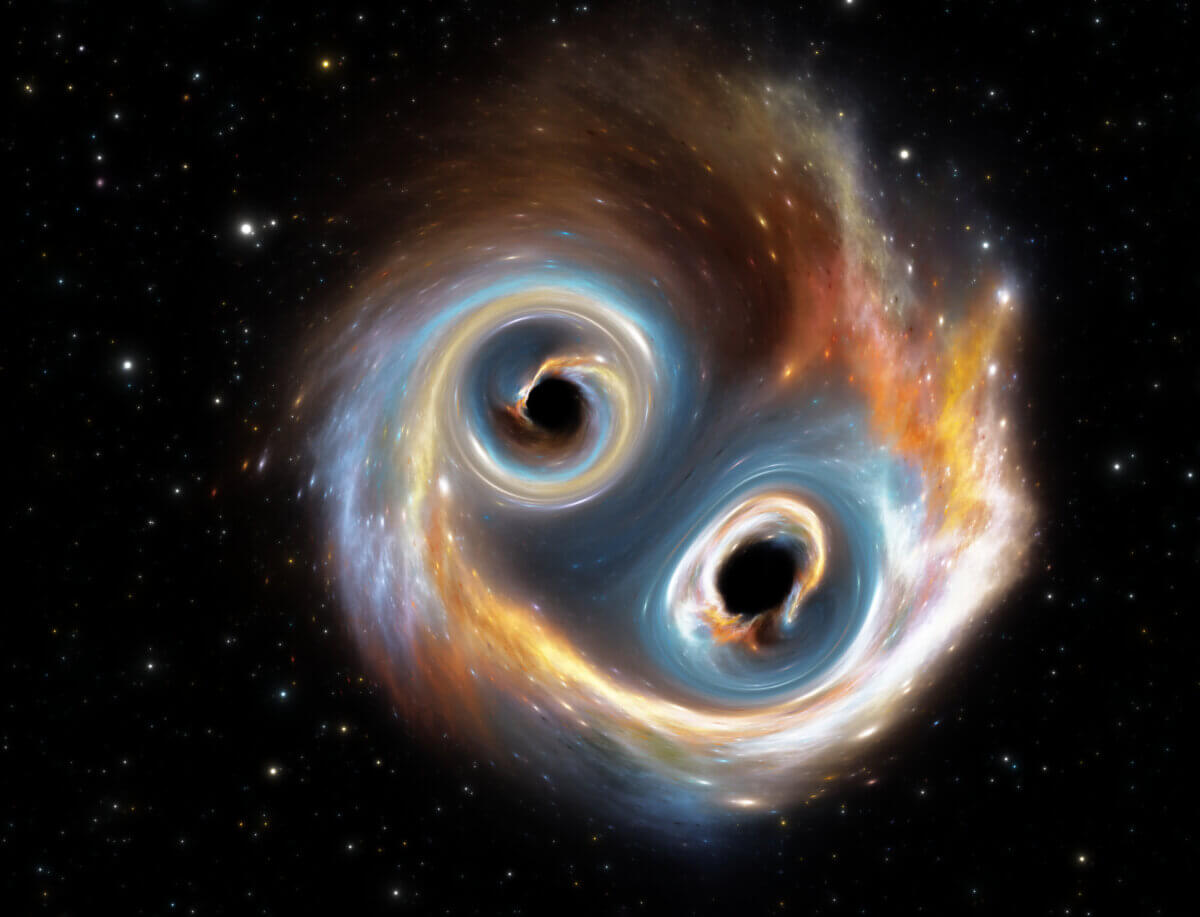
In the depths of space, an extraordinary cosmic waltz is taking place. Supermassive black holes, each weighing billions of times more than our Sun, are slowly spiraling towards each other in a gravitational embrace. As they draw closer, these cosmic giants should emit ripples in the fabric of spacetime – gravitational waves that we can detect here on Earth. But there’s a problem: according to our current understanding, many of these black hole pairs should never complete their dance. They should get stuck, eternally circling each other at a distance of about one parsec (roughly 3.26 light-years), unable to move close enough to merge.
This “final parsec problem” has puzzled astronomers for decades. Now, a team of researchers led by Gonzalo Alonso-Álvarez from the University of Toronto and McGill University may have found an unexpected solution: dark matter with a secret social life.
“We show that including the previously overlooked effect of dark matter can help supermassive black holes overcome this final parsec of separation and coalesce,” says Alonso-Álvarez in a statement. “Our calculations explain how that can occur, in contrast to what was previously thought.”
Dark matter is the mysterious substance that makes up about 85% of the matter in our universe. We can’t see it directly, but we know it’s there because of its gravitational effects on visible matter. Traditionally, scientists have thought of dark matter as a passive, non-interacting substance. But what if it’s not?
The researchers propose that if dark matter particles can interact with each other – a property known as self-interaction – it could provide the extra push needed to bring supermassive black holes together. This “self-interacting dark matter” (SIDM) acts like a cosmic lubricant, smoothing the way for black hole mergers.
Here’s how it works: As two galaxies collide and their central black holes begin to orbit each other, they plow through a dense concentration of dark matter called a “spike.” If the dark matter is non-interacting, this spike gets disrupted by the black holes’ motion, like a sandcastle washed away by waves. But if the dark matter particles can bounce off each other, they can maintain the spike’s structure. This persistent dark matter spike creates drag on the black holes, sapping their orbital energy and allowing them to spiral inward.
“The possibility that dark matter particles interact with each other is an assumption that we made, an extra ingredient that not all dark matter models contain,” says Alonso-Álvarez. “Our argument is that only models with that ingredient can solve the final parsec problem.”
The beauty of this solution is that it not only solves the final parsec problem but also potentially explains another cosmic mystery. In 2023, astrophysicists announced the detection of a background “hum” of gravitational waves, likely produced by many merging supermassive black holes across the universe. The shape of this gravitational wave signal doesn’t quite match what we’d expect from simple models. But the researchers found that their self-interacting dark matter model can produce a gravitational wave spectrum that better fits the observations.
James Cline, a co-author of the study from McGill University and CERN, explains: “A prediction of our proposal is that the spectrum of gravitational waves observed by pulsar timing arrays should be softened at low frequencies. The current data already hint at this behavior, and new data may be able to confirm it in the next few years.”
This connection between the microscopic properties of dark matter and the cosmic dance of black holes is a stunning example of how the universe’s biggest mysteries might be interconnected. If confirmed, it would be a double breakthrough, simultaneously advancing our understanding of dark matter and black hole mergers.
The implications of this research extend beyond just these two puzzles. The properties of self-interacting dark matter that solve the final parsec problem are similar to those proposed to explain other cosmic conundrums, such as why small galaxies have less dense cores than expected. This consistency across different scales and phenomena is exactly what scientists look for in a good theory.
“We found that the final parsec problem can only be solved if dark matter particles interact at a rate that can alter the distribution of dark matter on galactic scales,” says Alonso-Álvarez. “This was unexpected since the physical scales at which the processes occur are three or more orders of magnitude apart. That’s exciting.”
Moreover, this work highlights the potential of gravitational wave astronomy as a new tool for probing the nature of dark matter. As our gravitational wave detectors become more sensitive, we may be able to “listen” to the cosmic static of black hole mergers and decode the whispers of dark matter’s hidden properties.
“Our work is a new way to help us understand the particle nature of dark matter,” says Alonso-Álvarez. “We found that the evolution of black hole orbits is very sensitive to the microphysics of dark matter and that means we can use observations of supermassive black hole mergers to better understand these particles.”
While more work is needed to confirm this exciting possibility, the idea that the social life of dark matter particles could be orchestrating the grandest mergers in the cosmos is a testament to the interconnectedness and wonder of our universe. It reminds us that in the cosmic dance, every partner – even the invisible ones – plays a crucial role.
Paper Summary
Methodology
The researchers used a combination of analytical calculations and numerical simulations to model the behavior of dark matter around merging supermassive black holes. They considered different scenarios: traditional non-interacting cold dark matter, and several models of self-interacting dark matter with varying interaction strengths and velocity dependences. For each model, they calculated how the dark matter distribution would evolve as the black holes orbit each other, and how this would affect the merger process. They then used these results to predict the gravitational wave signals that would be produced by a population of merging black holes across cosmic history.
Results
The study found that traditional cold dark matter can’t solve the final parsec problem because the energy transferred from the black holes to the dark matter spike disrupts it too quickly. However, self-interacting dark matter with a cross-section (a measure of how likely particles are to interact) of about 1-10 square centimeters per gram can maintain a stable spike that efficiently brings the black holes together. The best-fitting model involved dark matter interactions mediated by a massive particle, which produces a velocity-dependent cross-section. This model not only solves the final parsec problem but also produces a gravitational wave spectrum that matches current observations better than simpler models.
Limitations
The study relies on several simplifying assumptions, such as circular orbits for the black holes and instantaneous mergers on cosmic timescales. More detailed modeling of the merger process and the surrounding galactic environment could refine the results. Additionally, the study focuses on dark matter effects and doesn’t account for other potential influences on black hole mergers, such as interactions with stars or gas. The gravitational wave data used is also still relatively limited, and future observations could change the picture.
Discussion and Takeaways
This research suggests a fascinating connection between the microscopic properties of dark matter and the cosmic-scale process of black hole mergers. If confirmed, it would provide strong evidence for self-interacting dark matter and help explain how supermassive black holes can merge efficiently. The consistency between the dark matter properties needed to solve the final parsec problem and those suggested by small-scale galaxy observations is particularly intriguing. This work also demonstrates the potential of gravitational wave astronomy as a new way to probe fundamental physics.
Funding and Disclosures
The study was supported by the Natural Sciences and Engineering Research Council (NSERC) of Canada. The authors declare no competing interests. The research was carried out at the University of Toronto, McGill University, and CERN.


