
Billions of disposable face masks were used during the pandemic. Today, most have either been burnt or buried in landfills. (Photo by Anton on Unsplash)
LUND, Sweden — Face mask policies and mandates are among the most debated consequences of the coronavirus pandemic. Scientists in Sweden report that such laws really do make a difference. Mask-wearing not only limits the spread of SARS-CoV-2 (the virus that causes COVID-19 infection), but new research suggests it also prevents death.
The international study reveals that the rate of COVID-19 related deaths was significantly slower in countries with face mask mandates than those that did not.
“The large sample of culturally diverse countries in this retrospective study covers a large population, giving us more evidence towards the life-saving potential of masks during the COVID-19 pandemic,” says first author Dr. Sahar Motallebi, from Lund University in Sweden, in a statement.
The research team collected data from the United Nations Development Programme Human Development Index, which reports on the top 50 countries for life expectancy, education, and standard of living.
New Zealand, Australia, Chile, and Argentina were excluded from the final analysis to lower bias for potential seasonality characteristics. Additionally, the United States and Canada were excluded because states, rather than a federal level, dictated mask-wearing policies.
A total of 27 countries with national policies for face masks and 17 countries without face masks were included in the study. The combined population for all studied countries was approximately one billion. Across all countries, there were 2,167,664 deaths. About 1.2 million people lived in countries without face mask mandates, and approximately 900,000 people lived in countries with mandates.
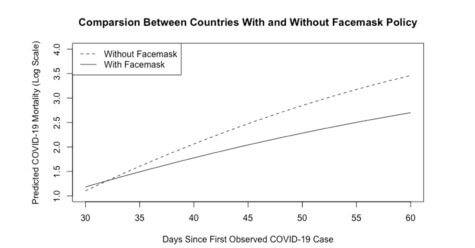
There were significantly higher rates of COVID-19 related deaths in countries without mask mandates than those who had them. The average COVID-19 mortality per million population was 48.40 in countries with mask mandates. In contrast, countries without mask mandates had an average 288.54 deaths per million.
The countries without a mask mandate initially had fewer COVID-19 deaths daily than countries with current face mask policies. However, the mortality rate sped up rapidly in countries without mask mandates — surpassing those with laws in place.
The findings give another reason to wear masks before and after vaccination, as it provides an extra layer of protection for lowering COVID-19 mortality rates.
“Across variants, vaccines may reduce mortality but not necessarily morbidity, and face masks continue to protect against both. So, we don’t have to choose between these two good policies of vaccination and face masks or substitute one for the other when we can and must do both in parallel,” Dr. Motallebi explains.
The study is published in the American Journal of Preventative Medicine.


