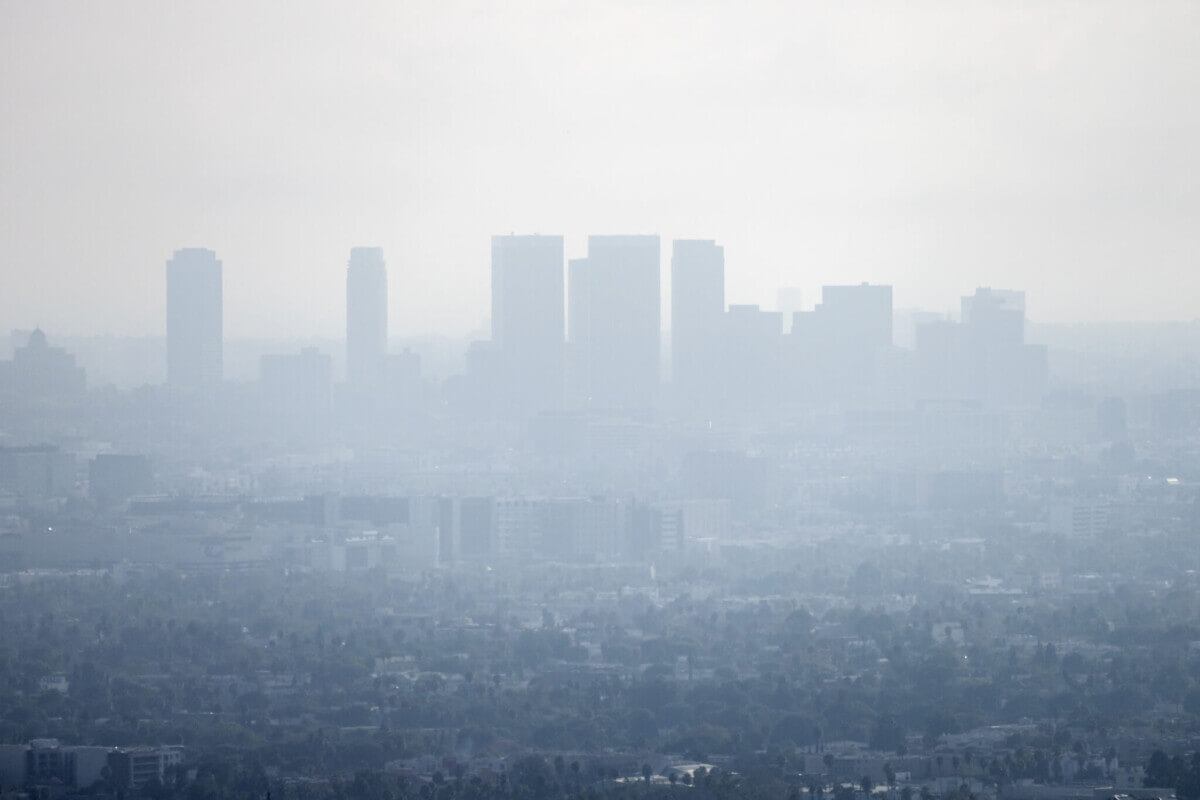
Afternoon summer smog obsuring office towers of Century City and Beverly Hills in Los Angeles. (© trekandphoto - stock.adobe.com)
AARHUS, Denmark — Smog, or excessive air pollution, is a major problem in many areas of the world. Just recently New Delhi, India has been making headlines due to its incredibly high, suffocating levels of constant air pollution. Sydney, Australia has also been dealing with a great deal of smog because of the bushfires currently wreaking havoc on the country. From a physical health perspective, smog is especially harmful to children and the elderly, and now a new study has identified yet another alarming effect smog can have on exposed children. However, it’s probably not a consequence you would have expected.
Researchers from Aarhus University have concluded that adolescents exposed to high levels of air pollution are at an increased risk of developing schizophrenia decades down the line as an adult.
“The study shows that the higher the level of air pollution, the higher the risk of schizophrenia. For each 10 μg/m3 (concentration of air pollution per cubic metre) increase in the daily average, the risk of schizophrenia increases by approximately twenty per cent. Children who are exposed to an average daily level above 25 μg/m3 have an approx. sixty per cent greater risk of developing schizophrenia compared to those who are exposed to less than 10 μg/m3,” explains Senior Researcher Henriette Thisted Horsdal in a release.
For perhaps a better understanding of what those statistics mean, consider this: the average lifetime risk of developing schizophrenia for a generally healthy person is roughly a flat 2%, which works out to two out of every 100 people suffering from schizophrenia. According to this research, individuals exposed to the lowest possible levels of air pollution as a child see that risk drop to below 2%, while children exposed to high levels of air pollution have a 3% risk of developing schizophrenia as an adult. While one percentage point may seem small at first consideration, it is actually quite significant when applied to large populations.
The study’s authors utilized data collected for iPSYCH, a country-wide Danish psychiatry project, in combination with information provided by the Department of Environmental Science. All in all, 23,355 people were included in the research, and of that group, 3,531 actually developed schizophrenia.
“The risk of developing schizophrenia is also higher if you have a higher genetic liability for the disease. Our data shows that these associations are independent of each other. The association between air pollution and schizophrenia cannot be explained by a higher genetic liability in people who grow up in areas with high levels of air pollution,” says Horsdal.
In summation, while the results of the study clearly indicate that air pollution exposure as a child increases one’s lifetime schizophrenia risk, researchers say that additional research is necessary in order to determine the causation behind this association.
The study is published in JAMA Network Open.


