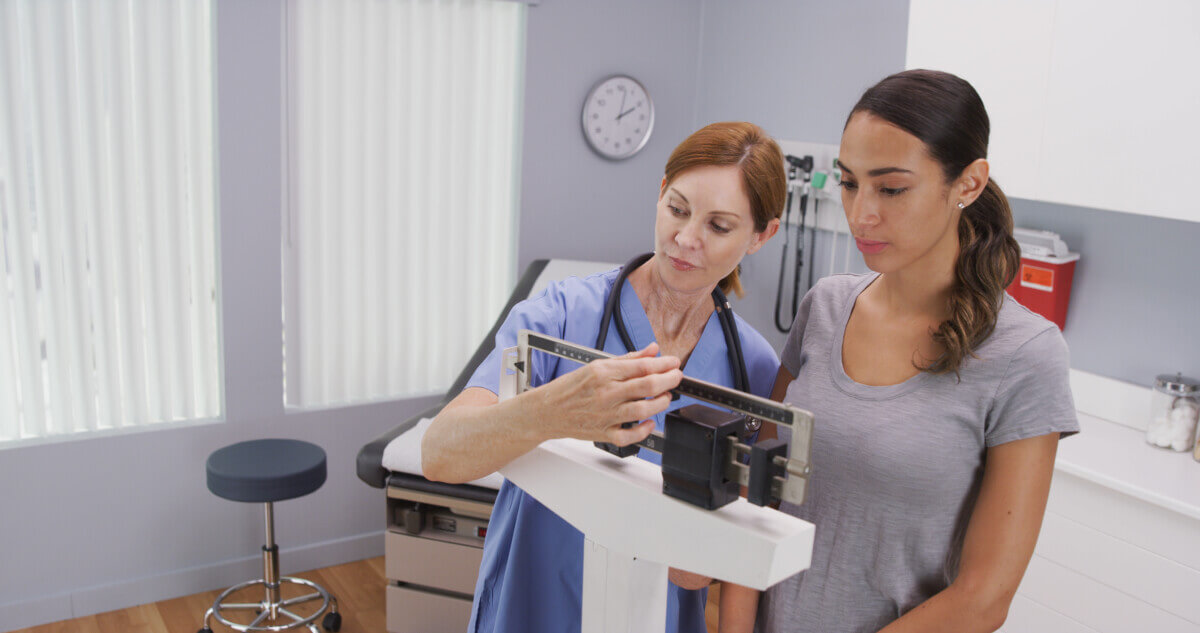
Nurse weighing female patient (© rocketclips - stock.adobe.com)
BOCA RATON, Fla. — An alarming new study reveals the difficulties in estimating a patient’s weight during emergency medical situations. The findings from Florida Atlantic University researchers are particularly important because accurate weight measurement is essential for administering certain medications effectively and safely.
In many emergency department (ED) scenarios, such as resuscitative care, measuring a patient’s weight is often impractical, if not impossible. This poses a significant problem since several medications, including thrombolytics (used to dissolve blood clots) and anticoagulants (blood thinners), require dosage adjustments based on the patient’s weight. Incorrect estimations can lead to underdosing or overdosing, both of which can be harmful.

Researchers carried out a systematic review to evaluate the accuracy of different methods used for emergency weight estimation in adults. Their review included a total of 95 studies, encompassing 27 different weight estimation methods, with 42 studies included in the meta-analysis.
The findings revealed that the most accurate methods for emergency weight estimation included 3D camera system estimates (88.8% accuracy), patient self-estimates (88.7% accuracy), the Lorenz method (measuring hip and abdominal circumferences, 77.5% accuracy), and family member estimates (75% accuracy). However, each method had its limitations in an emergency context. For instance, many patients might be unable to provide self-estimates due to confusion or unresponsiveness, a situation encountered in 70 to 85 percent of cases in some studies.
“Patient self-estimations of weight were generally very accurate and should be the method of choice during emergency care, when possible,” says study senior author Dr. Mike Wells, a research assistant professor in the Department of Emergency Medicine at the FAU Schmidt College of Medicine, in a university release. “However, since alternative estimation methods must be available when confused, or otherwise incapacitated, patients are unable to provide an estimate, alternative strategies of weight estimation also should be available.”

The study also assessed other weight estimation methods, including health care provider estimates, which were found to be generally unreliable. The authors suggest that while some methods like 3D camera systems show great promise, an ideal method for emergency situations still needs to be determined through future research.
“Many of the methods of weight estimation we reviewed had potential for failure or reduced accuracy during emergency care, and the ideal method for use during emergencies still needs to be determined in future prospective studies,” explains Dr. Wells. “The significance of our research lies in its provision of the currently available information on this topic with the aim to offer guidance to clinicians and researchers in this matter of important patient safety.”
The study is published in The American Journal of Emergency Medicine.


