
Detailed Earth Spain and the Mediterranean Sea (© Anton Balazh - stock.adobe.com)
ALBANY, Calif. — A pioneering seismic study has unveiled a remarkable geological phenomenon beneath the western Mediterranean Sea, challenging previous understandings of tectonic movements. Researchers analyzing seismic data from a 2010 earthquake beneath Spain stumbled upon evidence of a subducted oceanic slab that has completely overturned — a discovery that could redefine our knowledge of Earth’s deep structures.
Researchers from the University of Science and Technology of China and Australian National University focused on the complex tectonic interactions within the Rif-Betic-Alboran region, an area where the African and Eurasian plates converge, forming the Betic and Rif mountain ranges and the Alboran Sea basin.
The unusual seismic wave patterns observed following a magnitude 6.3 earthquake below Granada in April 2010 were key to this discovery. The earthquake’s coda waves, which are residual vibrations that appear at the end of a seismic event, exhibited an unexpectedly long duration, especially in recordings from Morocco. Additionally, the researchers identified an “extra” phase of P-waves (primary waves that are the fastest kind of seismic wave and the first to arrive at a seismic station after an earthquake), which were not accounted for by conventional models.
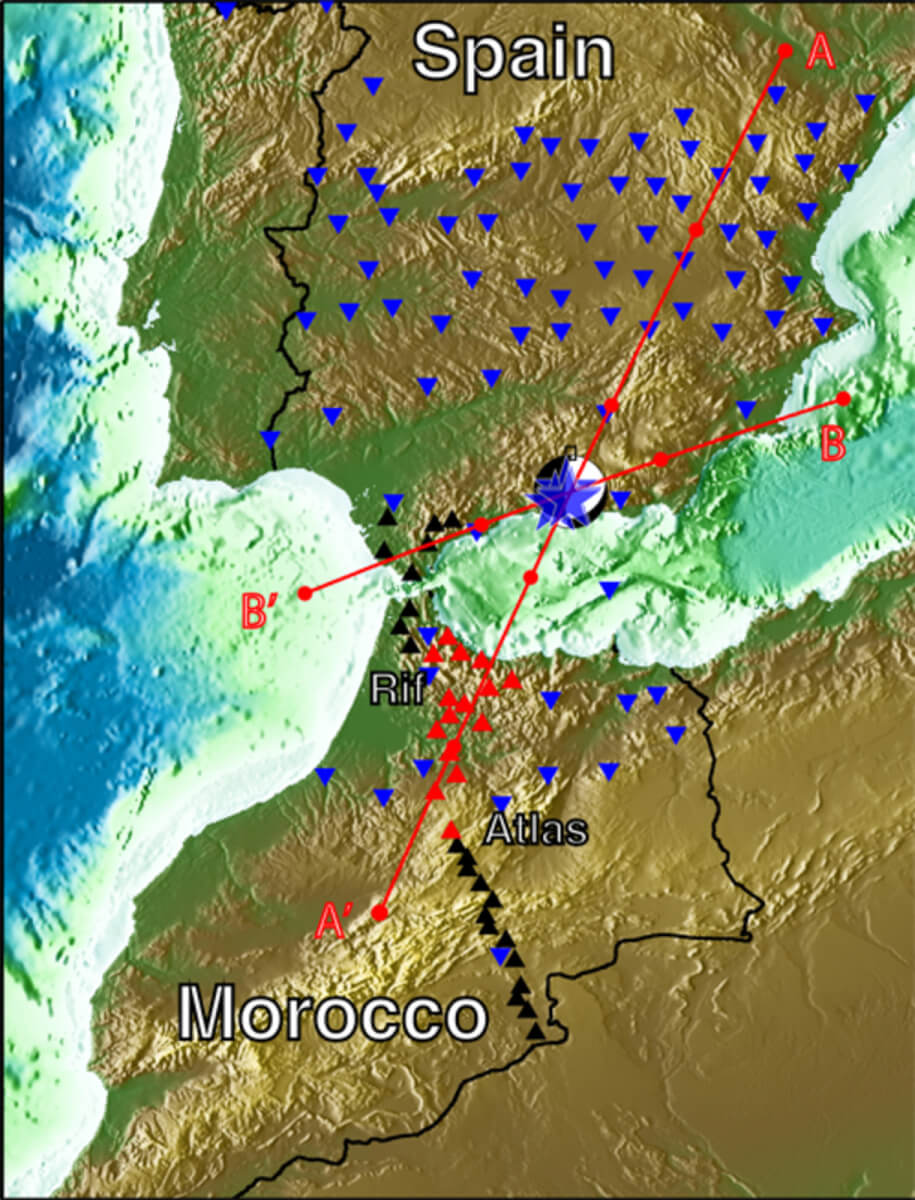
“Initially, we were not aiming to better understand the deep earthquake mechanisms, as several prior studies have studied the source nicely. Our intent was merely to plot the waveforms out of curiosity, since there is so much to learn from individual waveforms when one takes the time to look at them closely,” says study author Daoyuan Sun, professor at the University of Science and Technology of China, in a media release. “Upon examination, we observed these strange arrivals, including the long coda and extra phase.”
The key to understanding these unusual seismic signatures was the identification of a low-velocity layer at the base of the subducting Alboran slab. In geology, subduction refers to the process by which one tectonic plate moves under another, descending into the Earth’s mantle. Low-velocity layers are regions where seismic waves slow down, typically indicating the presence of molten or partially molten material.
Subducted slabs are known to carry water into the mantle, usually retaining a low-velocity layer on their surface. However, the study’s detailed waveform modeling indicated that the Alboran slab’s low-velocity layer was positioned underneath the slab, suggesting it had flipped over during its descent. This overturned position means that water, initially on the slab’s surface, is now trapped beneath it.

Researchers proposed that the presence of this low-velocity layer could explain the occurrence of rare and deep earthquakes in southern Spain. These deep seismic events, occurring at depths greater than 600 kilometers (372.8 miles), might be triggered by the dehydration of hydrous magnesium silicates — minerals that carry water deep into the mantle. As these minerals release water, they become more brittle and susceptible to causing earthquakes.
Moreover, the study sheds light on the speed of the slab’s subduction. The presence of hydrous silicates suggests a significant amount of water has been transported to the mantle transition zone.
“Considering a relatively young sea floor age in the western Mediterranean, for the slab to remain cool, the subduction speed must be quite fast, such as a moderate speed of about 70 millimeters per year,” notes Sun. “In other words, we think our study could offer a reasonable lower bound of the speed of subduction in this region.”
This groundbreaking discovery not only provides valuable insights into the complex tectonic structure of the western Mediterranean but also opens up new avenues for investigating deep earthquake mechanisms in other regions of the world. However, scientists explain that such research would require densely placed seismic stations directly above the earthquake zones, similar to the circumstances of the 2010 Spain earthquake study.
The study is published in the journal The Seismic Record.


