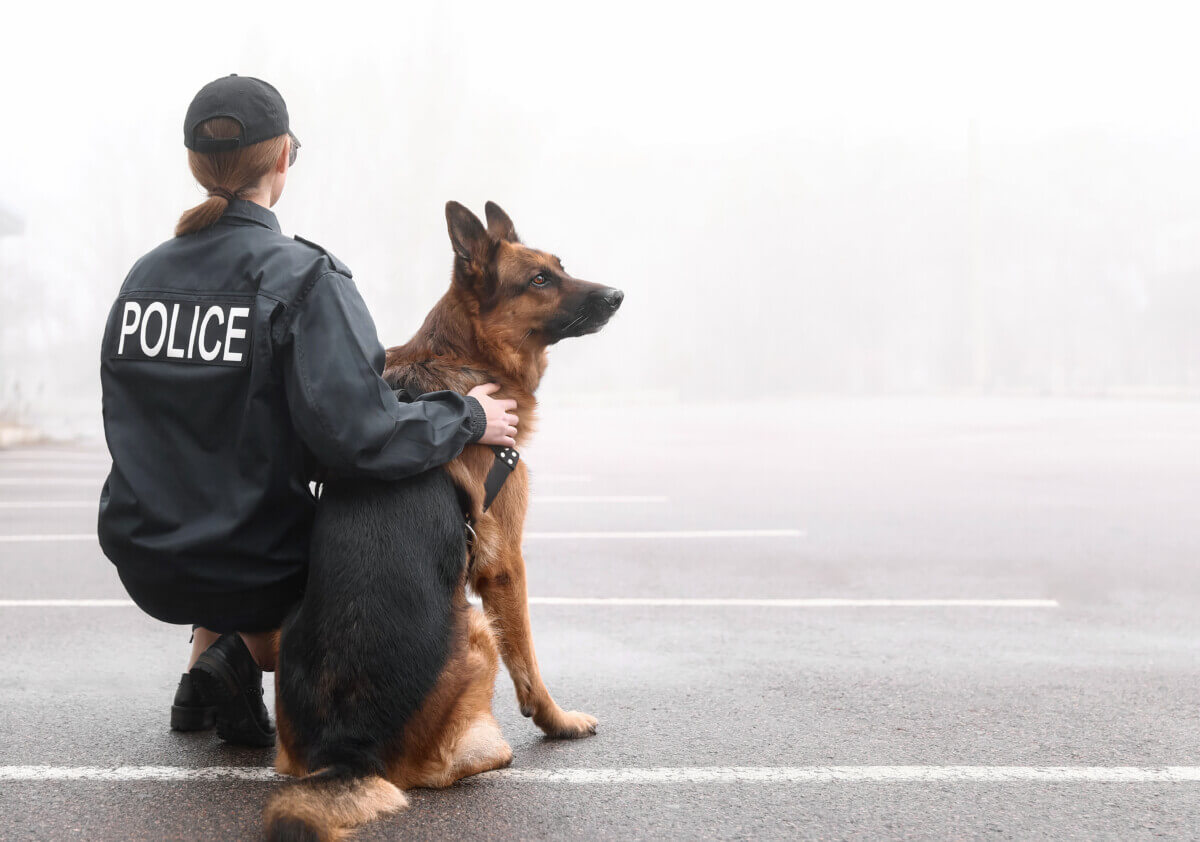
Female police officer with dog patrolling city street (© Pixel-Shot - stock.adobe.com)
Does The Legal Standard For Police Dogs Rest On Outdated Assumptions?
In A Nutshell
- In the analyses the author cites from Australia and the United States, along with Canadian court records, police dog alerts led to drugs somewhere between roughly 25 and 60 percent of the time, depending on the dataset.
- A well-known 2011 experiment found dogs were twice as likely to give a false alert in areas where handlers had been led to expect drugs, indicating that handlers’ expectations can influence outcomes and may contribute to false alerts.
- The paper argues that Canadian police should need “reasonable and probable grounds,” a higher bar than the current “reasonable suspicion,” before using a sniffer dog.
- The article is a legal analysis that pulls together existing studies, court records, and news reports rather than a new experiment, and the underlying data come from different dogs, places, and years.
A 2006 review of more than 10,000 police dog alerts in Australia found that actual drugs turned up only 26 percent of the time, meaning roughly three out of every four alerts led to a search that found nothing. Similar patterns appear in U.S. studies and Canadian court records, with success rates in some analyses landing near coin-flip territory and in others far lower, according to a new law review article by Sara Gordon, a law professor at the University of British Columbia’s Allard School of Law.
Gordon opens with a real-world example. In April 2022, a bus carrying the Delaware State University women’s lacrosse team was pulled over on a Georgia interstate after deputies told the driver that buses were not allowed to drive in the interstate’s left lane. Deputies pulled the team’s luggage from underneath the bus to be inspected by a drug-sniffing dog. After the dog alerted, officers spent about 30 minutes going through the bags. One student later said deputies “began tossing underwear and other feminine products,” and another officer opened a wrapped gift one of the players had received. No drugs or paraphernalia turned up, and the driver was never cited for the left-lane violation.
Published in the Alberta Law Review, Gordon’s article takes aim at the legal reasoning that allows searches like that one. Canadian courts have let police use sniffer dogs under a loose standard for more than a decade, after Supreme Court of Canada rulings described the searches as “minimally intrusive, narrowly targeted, and can be highly accurate.” Gordon argues that the dogs are neither highly accurate nor minimally intrusive, and that the evidence gathered since those rulings should change how much weight a dog’s alert carries.
Drug-Sniffing Dogs Operate Under an Easier Legal Standard
Gordon notes that “reasonable and probable grounds,” a standard requiring a probability that a crime has occurred, has generally been applied to search and seizure powers. Sniffer dogs have been handled differently. Since Supreme Court of Canada rulings in 2008 (Kang-Brown) and 2013 (Chehil), police need only “reasonable suspicion,” a lower threshold that asks whether someone is possibly involved in some criminal activity.
Courts have leaned on a belief that the dogs rarely err. Gordon traces how a police dog named Chevy, with a reported 90 to 92 percent success rate, became the reference point for sniffer dogs in general. Justice Binnie wrote that the trial judge in that case “either misspoke or incorrectly extended a statistic about a particular dog to the performance of all sniffer dogs, a conclusion for which there was no evidentiary basis.” Even so, a 2024 Supreme Court of Canada decision quoted the trial judge’s line that “sniffer dogs are relied on by the police with a success rate of over 92 percent.”
Drug-Sniffing Dog Accuracy in the Field Often Falls Short of a Coin Flip
Once researchers began tracking large numbers of real searches instead of one dog’s résumé, the picture shifted. Australia’s review covered 17 trained and certified dogs, all of them Labradors with the same training and certifications. Individual success rates still ranged from a high of 56 percent down to just 7 percent.
U.S. figures landed in similar territory. A 2011 Chicago Tribune investigation found that 44 percent of police dog alerts led to drugs or drug paraphernalia, and an analysis of 139 searches in Louisville, Kentucky, between 2017 and 2019 found that 45 percent turned up no narcotics. An Illinois dog named Lex alerted on 93 percent of the vehicles he sniffed, yet his overall accuracy in the field was 59.5 percent, a rate a federal appeals court described as “not much better than a coin flip.” Dogs profiled in news reports did worse: a Florida dog named Stella had a false positive rate of 53 percent, and a Virginia dog named Bono falsely alerted 74 percent of the time. Data from New South Wales, released in 2023 after two young men died of suspected overdoses at a Sydney music festival, showed nearly 75 percent of searches following an alert between January 2013 and June 2023 found no illegal drugs, almost identical to the 2006 review.
In these analyses, a “success” means drugs were found, so alerts triggered by lingering scent count as misses. That is a point of dispute. Dogs are trained to respond to an odor, not to the drug itself, and money can carry trace cocaine (a study reported in 2009 found it on 85 percent of Canadian bills). Some legal products share chemicals with illegal drugs as well: methyl benzoate, found in street cocaine, also appears in shampoo and perfume, while piperonal, a dominant odor chemical in MDMA, is used in cherry and vanilla flavoring. Police and prosecutors often blame such residual odors for missed alerts, but Dr. Lawrence Myers, a canine olfaction expert at Auburn University, has called that explanation “a convenient excuse.” Gordon notes there may be no way to know for sure why any single false alert happened.
Drug-Sniffing Dogs and the Clever Hans Problem
Beyond training gaps and stray scents, Gordon points to a stranger source of error: dogs appear to read their handlers. More than a century ago, a horse named Clever Hans seemed able to do arithmetic by stomping his hoof the right number of times. Investigators eventually found that Hans was reacting to subtle, unintentional signals from his handler, such as shifts in posture and facial expression, and that he could not perform when such a signal was missing.
Dogs, bred to respond to human social cues, are similarly attuned. One study found that half of dogs would walk to an empty food bowl if a person pointed at it, rather than to a bowl they had seen and smelled food in. In the 2011 sniffer dog experiment, 18 handler-and-dog teams searched four areas. Handlers were told that some areas could hold drugs and that two would be marked with red paper. Two areas, including those marked with red paper, actually held only a decoy scent, unwrapped Slim Jim sausages, so any alert there was false. Dogs still falsely alerted 85 percent of the time, a total of 225 times, and were twice as likely to do so in the areas marked with red paper as in areas holding only the decoy. Researchers attributed the overwhelming majority of those incorrect alerts to handler beliefs about whether a scent was present.
Gordon ties that finding to research on policing and race. Delaware State is a historically Black university, and 70 percent of the lacrosse players were Black; players later said they were left wondering whether racial profiling prompted the search. In Ohio between 2013 and 2017, Black drivers accounted for 28 percent of nearly 17,000 dog-sniff stops, though about 14 percent of drivers stopped overall in the state were Black. A 2013 ACLU study in Illinois found Black motorists were 55 percent more likely to be subjected to a dog sniff, even though white drivers were 14 percent more likely to be found with contraband in searches that followed an alert. In the Chicago Tribune data, the dogs’ 44 percent success rate fell to 27 percent when the driver was Latino. Asked whether that gap reflected handlers’ unconscious cues, Dr. Paul Waggoner of Auburn University’s Canine Detection Research Institute answered with a “big, resounding yes.” Gordon raises the concern, which the data do not prove for any particular stop, that an officer passing a hunch along to the dog, consciously or not, makes the alert unfit to serve as independent evidence for an arrest.
A Higher Bar for Drug-Sniffing Dog Searches
Gordon’s proposed remedy is to apply “reasonable and probable grounds,” the standard generally used for searches, before a sniffer dog is deployed. She acknowledges that could make dogs a less useful investigative tool for police, but says that is a matter for Parliament, which she describes as “in the best position to create a proper statutory framework regulating the training, testing, and use of police sniffer dogs.”
Oversight is thin at the moment. Canada lacks a centralized database tracking police dogs across federal, provincial, and municipal forces, which limits public assessment of their training and field performance, and Gordon reports that the RCMP released only a heavily redacted copy of its dog handler’s guide after an access-to-information request. A 2024 RCMP evaluation of its Police Dog Service Training Centre in Alberta found serious staff shortages and kennel problems serious enough that many handlers “refuse to house their police service dogs” there.
Courts have long treated the sniffer dog as close to infallible, a reputation Justice Souter once called “a creature of legal fiction.” Data from several countries point to dogs whose alerts miss far more often than that reputation allows, and a team of college athletes waiting on a bus while deputies went through their luggage shows who pays when the reputation is wrong.
Disclaimer: This article summarizes a legal analysis published in the Alberta Law Review. The paper does not report a new experiment; it reviews existing studies, court records, and news reports from several countries, and those sources used different dogs, methods, and time periods. Figures should not be read as the accuracy rate of all police dogs, and a search that finds no drugs does not by itself prove an alert was mistaken. The article presents the author’s legal argument, not legal advice.
Paper Notes
Limitations
This piece is a legal analysis and argument, not a new scientific experiment. Gordon synthesizes existing research and reporting from Australia, the United States, and Canada, drawn from studies that used different dog breeds, training methods, testing environments, and time periods, which limits how directly the results can be compared. Several figures come from news reports and court records rather than peer-reviewed studies, and a 2014 Polish study the article cites was neither double-blind nor included conditions in which no drugs were present. Canada lacks a centralized database tracking police dogs, so Canada-specific accuracy data are scarce, and Gordon notes it is impossible to say whether the shortcomings found at the RCMP training center apply to other police units. Because a “success” is counted only when drugs are found, some alerts classed as false may reflect residual odor, and Gordon says there may be no way to know in any single case. Criticism also followed the 2011 handler-cueing study, coming from the Scientific Working Group on Dog and Orthogonal Detector Guidelines, which argued it did not account for every factor affecting canine performance.
Funding and Disclosures
No funding source or competing-interest statement appears in the article. Gordon thanks research assistants Gabby Bullock and Jade Liu for their work on the paper, Professor Nikos Harris for comments on earlier drafts, and anonymous peer reviewers for their feedback.
Publication Details
Title: “Call Off the Dogs: Rethinking Sniffer Dog Searches in Canadian Criminal Law.” Author: Sara Gordon, Associate Professor, Allard School of Law, University of British Columbia. Journal: Alberta Law Review, Volume 64, Issue 1 (2026). DOI: 10.29173/alr2908 (https://doi.org/10.29173/alr2908). This article is licensed under a Creative Commons Attribution-NonCommercial-NoDerivatives 4.0 International License.


