
Andrej Lišakov For Unsplash+
In A Nutshell
- A small clinical trial found that a daily tomato-soy juice significantly reduced three inflammation-related proteins in adults with obesity.
- Participants consumed far more lycopene and soy isoflavones than a typical American diet provides, and blood levels of both compounds rose measurably during the tomato-soy period.
- Urine analysis confirmed the body was actively processing the soy compounds, and both juices produced some shared chemical changes, suggesting tomatoes contain active ingredients beyond lycopene.
- Only 12 people completed the trial, so the results are preliminary and larger studies are needed before any firm conclusions can be drawn.
Chronic inflammation sits at the root of some of the most serious health conditions in America, from heart disease and diabetes to cancer. For the roughly 42% of American adults living with obesity, that inflammation runs on a slow, persistent burn. Now, a small but carefully designed clinical trial from The Ohio State University and the U.S. Department of Agriculture, published in Molecular Nutrition & Food Research, suggests that a high-lycopene tomato juice enriched with soy isoflavones may help turn down that inflammatory dial.
Lycopene is the natural pigment that gives tomatoes their red color, long studied for its potential health-protective properties. Soy contains plant-based compounds called isoflavones, linked to lower rates of certain cancers and better metabolic health, particularly in cultures where soy is a dietary staple. Rather than isolating those compounds into a supplement, the researchers asked a more practical question: could delivering them together in an actual juice move the needle on inflammation?
Participants Drank Far More Lycopene and Isoflavones Than Most Americans Consume
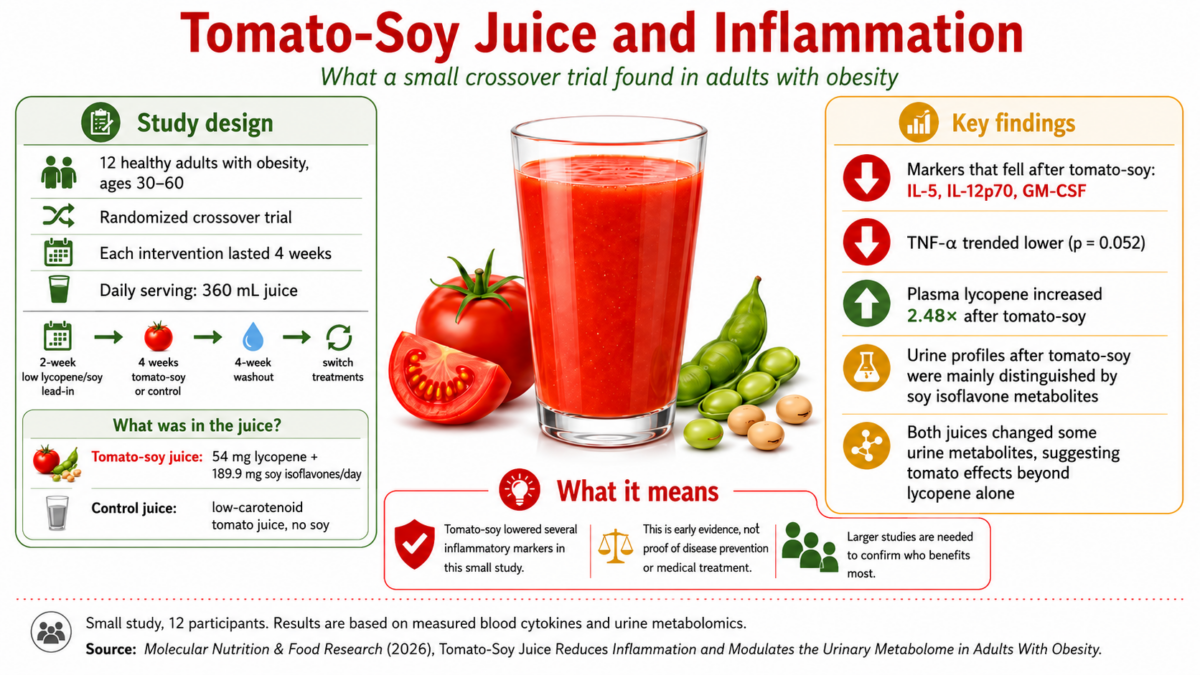
Twelve adults with obesity, ages 30 to 60, completed the trial at the Beltsville Human Nutrition Research Center in Maryland, a USDA-operated facility. Every participant tried both treatments and served as their own comparison group, a design that helps control for individual differences.
Before the intervention, participants spent two weeks on a diet low in lycopene and soy compounds to establish a clean baseline. They were then randomly assigned to drink either the tomato-soy juice or a control juice made from a yellow-fleshed tomato variety containing almost no red pigments and no soy. Each person drank their assigned juice daily for four weeks, took a washout break, then switched to the other juice for another four weeks.
Participants in the tomato-soy group received 54 mg of lycopene and nearly 190 mg of soy isoflavones per day. For context, the average American consumes roughly 3 to 15 mg of lycopene daily and fewer than 3 mg of soy isoflavones. Worth noting: the beverage was a processed tomato juice enriched with a soy isoflavone extract, not simply blended whole tomatoes and soybeans. Still, the approach represented a departure from most nutrition research, which tends to isolate a single compound and test it in supplement form.
Three Inflammation Markers Dropped Significantly During the Tomato-Soy Period
At the start and end of each four-week period, the team measured levels of inflammation-signaling proteins in participants’ blood. After the tomato-soy period, three of those proteins, IL-5, IL-12p70, and GM-CSF, decreased significantly. A fourth, TNF-alpha, a well-known inflammation marker that tends to be overactive in people with obesity, also trended downward but narrowly missed statistical significance. None of these changes appeared during the control juice period, suggesting the tomato-soy drink may have had an anti-inflammatory effect, though the study could not pin that effect specifically on lycopene, soy, or other tomato compounds. Blood lycopene levels also rose nearly 2.5-fold, confirming the compounds were being absorbed, while lycopene dipped slightly when participants switched to the control juice.
None of those three proteins are household names, but their roles matter. IL-5 is tied to inflammation associated with asthma and runs higher in people with obesity. GM-CSF has been connected to inflammatory lung conditions in obesity research. IL-12p70 can set off a chain of other inflammatory signals. That all three declined hints at a wider anti-inflammatory shift, though many other markers did not change significantly. IL-6 and IL-8, for instance, did not reach statistical significance, and a post-hoc calculation found that detecting a meaningful difference in IL-6 alone would have required roughly 108 participants, nearly nine times those who completed this trial.
Soy Compound Byproducts Dominated Urine Samples After Tomato-Soy Consumption
Beyond blood tests, researchers used a broad chemical screening method to examine small molecules in participants’ urine. Samples collected after tomato-soy consumption looked chemically distinct from other timepoints, with the primary signatures being breakdown products of soy isoflavones, confirming those compounds were being actively processed by the body.
Notably, both juices produced some overlapping chemical changes in urine. That finding suggests tomatoes contain biologically active substances beyond lycopene, compounds that affect body chemistry in ways not yet fully mapped. It is a reminder that the science of whole foods is more layered than any single ingredient can capture.
Only 12 people completed the trial, far fewer than the 30 originally planned before COVID-19 cut recruitment short. Participants were also not required to eat specific foods alongside the juice, which may have introduced variability in how well their bodies absorbed the plant compounds. A larger trial with a more diverse group and tighter dietary controls would be needed before drawing firm conclusions about who benefits and by how much.
What the research does offer is a plausible early case that combining tomatoes and soy in a food-based product can produce measurable reductions in certain inflammatory markers in people with obesity. A daily glass of juice will not replace medical treatment, but for a condition as stubborn and widespread as obesity-related inflammation, a food-based tool that moves the needle even modestly is worth pursuing.
Disclaimer: This article is based on a single small-scale clinical study and is intended for informational purposes only. It should not be taken as medical advice. Consult a qualified healthcare provider before making changes to your diet or health regimen.
Paper Notes
Study Limitations
Only 12 participants completed the trial, well short of the 30 the researchers had originally planned to enroll. Recruitment was cut short by the COVID-19 pandemic, and the authors acknowledge that this reduced the study’s statistical power. Several inflammation markers the team expected to detect changes in, including IL-6, TNF-alpha, and IL-8, did not reach significance, and a post-hoc power calculation indicated that detecting a difference in IL-6 alone would have required approximately 108 participants. Findings should be treated as preliminary. Participants were not required to eat specific foods alongside the juice, which may have introduced variability in absorption. Genetic differences in how individuals process carotenoids are another source of individual variation the study could not fully account for.
Funding and Disclosures
According to the published paper, this work was supported by grants from the United States Department of Agriculture (NIFA AFRI 2018-67017-27519, National Needs Fellowship 2020-38420-30723, and Hatch OHO01470, OHO01563, and OHO01538) and the National Institutes of Health (R01DK138871). Research was additionally supported by the Lisa and Dan Wampler Endowed Fellowship for Foods and Health Research and the Foods for Health Initiative at The Ohio State University. Readers seeking full author disclosure details should consult the published article’s end matter directly.
Publication Details
Paper Title: Tomato-Soy Juice Reduces Inflammation and Modulates the Urinary Metabolome in Adults With Obesity | Authors: Maria J. Sholola, Jenna Miller, Emma A. Bilbrey, Janet A. Novotny, David M. Francis, Thomas A. Mace, and Jessica L. Cooperstone | Institutional Affiliations: Department of Food Science and Technology, The Ohio State University; Department of Horticulture and Crop Science, The Ohio State University; Beltsville Human Nutrition Research Center, Agricultural Research Service, U.S. Department of Agriculture; Division of Gastroenterology, Hepatology, and Nutrition, The Ohio State University Wexner Medical Center | Journal: Molecular Nutrition & Food Research (2026, Volume 70) | DOI: 10.1002/mnfr.70420 | Clinical Trial Registration: ClinicalTrials.gov, NCT03783013


