
(© Photoboyko - stock.adobe.com)
In A Nutshell
- The “guilty” look tracks human reactions. In Alexandra Horowitz’s 2009 experiment with 14 pet dogs, scolding affected the display, while eating the forbidden treat did not.
- Appeasement offers a simpler reading. Looking away, lowering posture and lip licking can help manage tension, although their meaning depends on the full situation.
- Neutral owners could not reliably tell. In a 2015 follow-up involving 96 owner-dog pairs, owners performed no better than chance at identifying disobedience.
- The emotional question remains open. Reviews describe evidence for canine guilt as absent or preliminary, so an unreliable look does not prove dogs can never feel guilt.
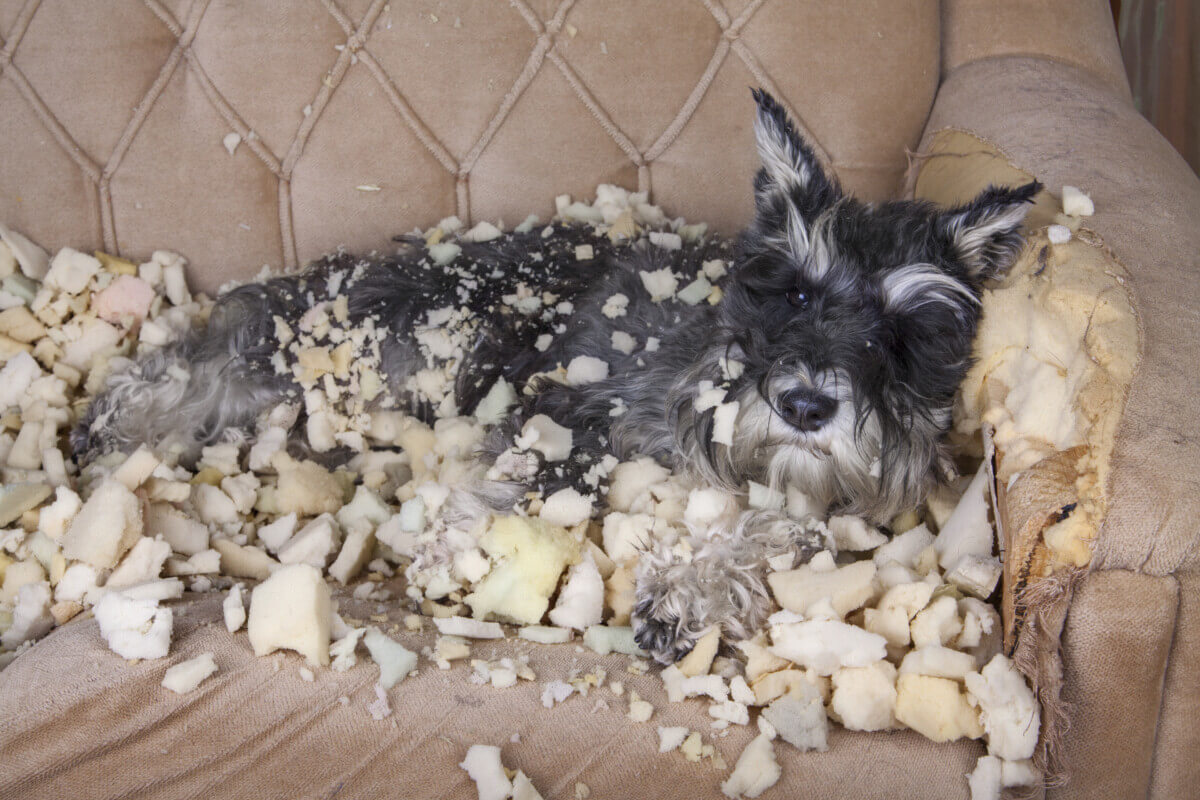
Your dog chewed the shoe, shredded the paper towels, and is now staring at the floor with its ears back. It’s the face of a suspect who knows exactly what it did. But research suggests that the famous “guilty look” may not be a confession after all.
In experiments designed to separate a dog’s behavior from an owner’s reaction, dogs gave the look more often after being scolded, even when they had done nothing wrong. Scientists say the look may be less about regret for breaking a rule earlier and more about reacting to tension in the moment. Here’s what the studies found, and why the expression is so convincing to humans.
Why Does A Dog’s Guilty Look Seem So Convincing?
Because the posture is real, even if we misread what’s behind it.
Lowered ears, looking away, lip-licking, and slinking off are all real canine body language. Scientists often call these signals appeasement behavior. A dog uses them to show it means no harm and to keep a tense situation from getting worse. To people, the same signals look a lot like human shame, so it’s easy to assume the dog feels what we would feel in its place.
Research supports the idea that these are conflict signals. In a 2017 study published in the Journal of Veterinary Behavior, researchers at Ludwig Maximilian University of Munich observed 116 dogs, all at least 13 months old, as strangers acted in neutral, friendly, or threatening ways toward them. Looking away and lip-licking were more common when the strangers acted in threatening or confrontational ways. The signals weren’t a perfect code, though. When the threat was most severe, dogs showed fewer of them and tended to cower or try to escape instead. Lip-licking also showed up when dogs approached a person in a friendly but submissive way.
So the look is real. The harder question is what sets it off: the dog’s memory of what it did, or the owner’s reaction in the moment.
What Happens When Researchers Separate Action From Reaction?
Alexandra Horowitz, a dog cognition researcher at Barnard College, designed a 2009 experiment to answer that question. The study, published in Behavioural Processes, followed 14 pet dogs in their homes. Each owner told the dog not to eat a treat and then left the room. While the owner was gone, the experimenter either removed the treat or handed it to the dog. When owners returned, they were told whether their dog had behaved, but in half the trials that information was false. Owners who were told their dog had eaten the treat were instructed to scold it.
Researchers then scored nine behaviors during the first 10 seconds of each reunion, including lowered ears, avoiding eye contact, retreating, raising a paw, and licking. Whether a dog had actually eaten the treat made no significant difference. Being scolded made a big difference, whether the dog had obeyed or not. Dogs that had obeyed but were scolded anyway showed the strongest guilty look of all.
The study was small. And because the experimenter sometimes handed over the treat, dogs that ate it may have thought it was now allowed, leaving them with nothing to feel guilty about. Still, the design separated the owner’s reaction from the dog’s action, something everyday life never does.
Later studies tested the idea in other ways, with mixed results. In a 2012 study in Applied Animal Behaviour Science, dogs that ate a forbidden treat weren’t more likely to look guilty than dogs that didn’t. But when researchers analyzed the dogs one by one, only those that had broken the rule showed an increase in guilty behavior across test situations, which leaves room for some dogs to react to their own actions. Overall, owners guessed correctly more often than chance would predict. But they had already watched their dogs, and scolded them if needed, in an earlier round of the test. When researchers looked only at owners who were most likely judging by the greeting alone, those owners did no better than chance.
A 2015 follow-up, also in Behavioural Processes, tested 96 owner-dog pairs in Croatia. This time owners were told not to speak to or touch their dogs, just watch them for 10 seconds, so any guilty look would have to come from the dog alone. Owners were then asked whether their dog’s behavior showed it had eaten the food, and they did no better than chance. The researchers cautioned that the experimenter’s presence and the way the food was handled may have interfered with the dogs’ memory of the owner’s command.
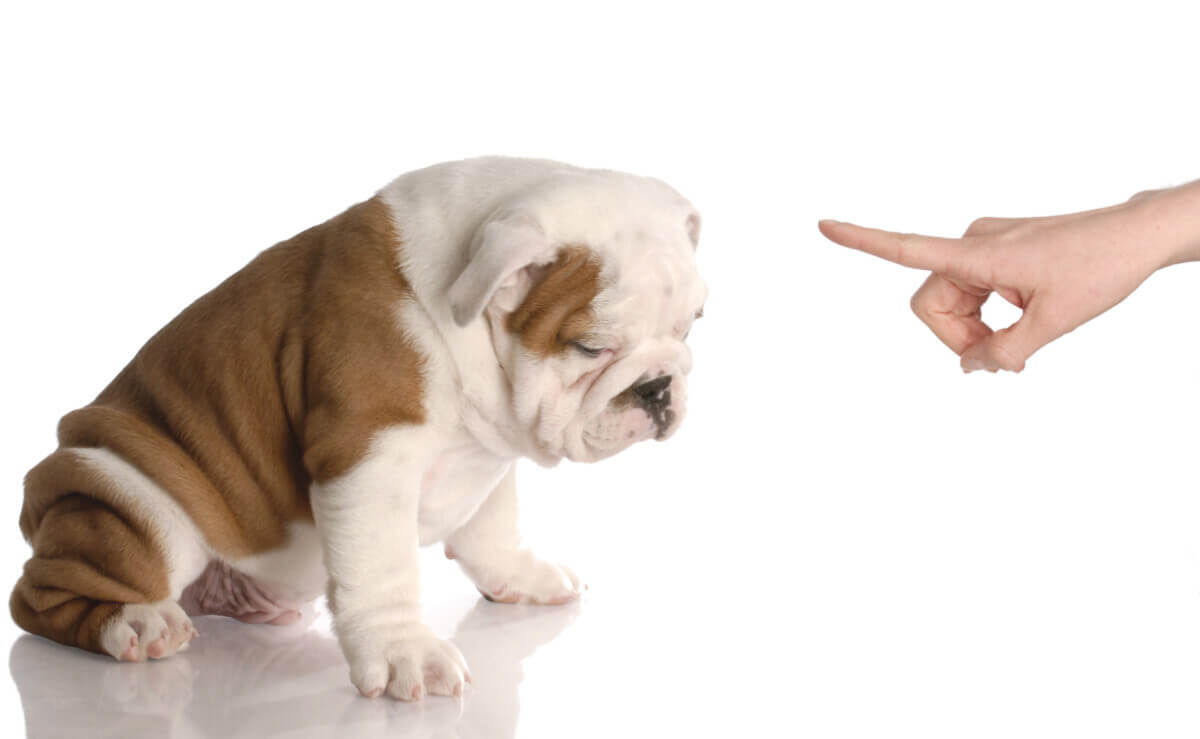
Put together, the studies point the same way: human disapproval predicts the guilty look more reliably than a dog’s misbehavior does. That fits the appeasement explanation. The dog is responding to the upset person in front of it.
Could Dogs Still Experience A Complex Emotion?
Possibly, but these experiments can’t prove it either way. Guilt is what scientists call a secondary emotion, neuroscientist Miiamaaria Kujala explains in a 2017 review in Animal Sentience. Unlike basic emotions such as fear or anger, secondary emotions depend on interpreting social situations and having some sense of what another mind is thinking. Kujala writes that guilt “fits the dog mind poorly,” and that the guilty look can come from “a simple learned association” between misbehaving and being scolded.
Researchers have also looked for jealousy, another emotion often placed in this category. In a 2014 PLOS ONE experiment, 36 dogs watched their owners give affection to a realistic stuffed dog that barked, whined and wagged its tail. For comparison, owners also gave the same attention to a jack-o’-lantern and read aloud from a children’s pop-up book. With the stuffed dog, the dogs were more likely to push or touch their owners and try to get between the owner and the “rival,” and about a quarter snapped at it. The researchers concluded that dogs may feel a basic form of jealousy, similar to what human infants show, that doesn’t require complex thinking.
Not everyone agrees that this counts as jealousy in the human sense. In a 2018 follow-up to her review, Kujala pointed out that protecting something valuable isn’t the same thing. “Human defense of one’s possessions such as food, a car, or a house, is not called jealousy,” she wrote. Human jealousy is about relationships: “We do not feel hurt and angry about an apple if someone steals it, but we can feel hurt and angry about a friend if they decide to go to a party with someone other than ourselves.”
A 2020 review in Frontiers in Psychology sums up where the science stands. It described the evidence for guilt in dogs as absent or preliminary, and research on jealousy and complex empathy as limited, mixed, and heavily debated.
What Does The Evidence Actually Support?
That something real is happening, just not necessarily guilt. A crouching or retreating dog may be scared, unsure, conflicted or trying to calm things down. Dogs are sensitive to a person’s posture, tone of voice and expectations, and that sensitivity can make their response look remarkably knowing.
What the look doesn’t reliably show is that a dog judged its earlier behavior to be wrong. So the next time you find a chewed shoe and a dog that won’t meet your eyes, the look is probably less a confession than a reaction to you, and to the tension in the room right now.


