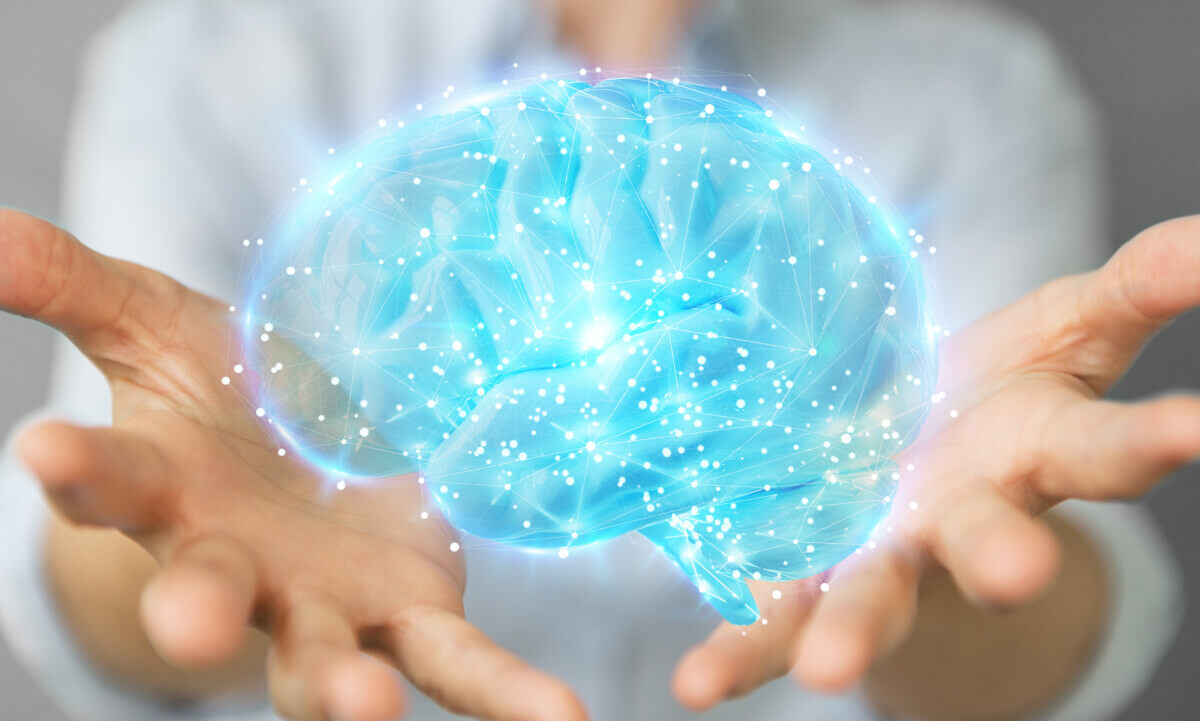
(© sdecoret - stock.adobe.com)
In A Nutshell
- Researchers in Japan built an AI system that constructs a personalized virtual brain from each individual’s brain connectivity scan, creating a unique digital twin for every person.
- In tests on 228 participants, the model predicted task-specific behavior with up to 94% accuracy and tracked brain activity patterns with strong correlations to real fMRI data.
- Virtual treatment simulations run on the digital twins produced widely varying responses across individuals, reflecting the same person-to-person variability seen with real psychiatric treatments.
- The system is still in early development and has not been tested in clinical settings, but researchers say it could one day help guide treatment selection before patients are exposed to trial and error.
An AI model trained on individual brain scans predicted how people would behave on cognitive tasks with over 90% accuracy, then ran virtual experiments on the brain model to see how targeted changes might affect behavior.
Prescribing psychiatric medication has always involved a lot of guesswork. A drug that lifts one person’s depression may do nothing for another, and figuring out which is which usually means waiting weeks, sometimes months, for an answer. Researchers at Japan’s National Center of Neurology and Psychiatry think they’ve found a better starting point: a working digital copy of each patient’s brain that could one day help guide treatment decisions before anything is actually prescribed.
Published in BME Frontiers, the study describes an AI system that takes a brain connectivity scan and uses it to construct a personalized virtual brain. That model can then predict how a specific person performs on cognitive and emotional tasks and simulate what would happen if certain brain connections were altered.
At the center of the system is something called a connectome, a map of how different brain regions communicate with each other during rest, captured through standard brain imaging. Each person’s connectome is unique. Researchers feed that map into a two-part AI system: one component reads the connectivity data and uses it to build a personalized brain model for that individual, while the second simulates how the brain processes sensory input and produces behavior over time. Because the second component is built entirely from the individual’s own brain map, no two digital twins are the same.
Building and Testing the Digital Twin Brain
To develop and validate the system, the team drew on the Transdiagnostic Connectome Project, a publicly available dataset covering 228 participants, including 139 with psychiatric diagnoses spanning multiple conditions and 89 healthy controls, ranging in age from 18 to 68.
All participants had completed two tasks inside an MRI scanner. One, the Emotional Faces test, asked participants to match images of fearful or angry faces, measuring how the brain handles threatening emotional stimuli and how strongly the amygdala, the brain’s emotional alarm center, responds. A second task, the Stroop test, showed color words printed in mismatched ink colors (the word “blue” in red ink, for instance) and asked participants to name the ink color. Because the brain’s automatic reading response conflicts with the correct answer, it’s a well-established measure of cognitive control and mental processing speed.
Each participant’s data was split in half. The model trained on the first half, then was tested on the second, data it had never seen. On the Emotional Faces test, the digital twin matched participant behavior with 94% average accuracy. On the harder Stroop test, a three-choice task, accuracy held at 90%. Reaction time predictions and brain activity patterns also tracked closely with real measurements, and the model correctly showed heightened amygdala activity during emotional face processing, consistent with decades of neuroimaging research. Both accuracy and reaction time predictions outperformed prior models that attempted similar predictions from brain scans alone.
Running Experiments on a Virtual Brain
With accuracy established, researchers ran virtual experiments to see whether the model could simulate what might happen if specific brain connections were altered. No real brains were modified. Instead, they mathematically shifted each digital twin’s parameters toward two goals: reduced emotional reactivity and faster cognitive processing. For emotional reactivity, the simulated changes involved connectivity between limbic regions near the amygdala and parietal and temporal networks. For processing speed, the focus was on connections linking the prefrontal cortex, parietal lobe, motor cortex, and subcortical regions.
Most participants showed measurable shifts in the targeted function after the simulated change. Response sizes varied widely. Some showed large improvements, others minimal change, and a small number showed near-zero response. That spread closely mirrors the person-to-person variability clinicians see when real treatments are applied, which is what makes the model potentially valuable. Rather than predicting one uniform outcome, it reproduced the individual differences that make psychiatric treatment so difficult to plan.
What appeared to drive the variation was underlying biology rather than random noise. Participants whose baseline connectivity patterns aligned more closely with the direction of the simulated cognitive change tended to show stronger predicted responses, suggesting that a person’s brain wiring may shape how much they stand to benefit from a given intervention. It’s a promising lead, though the study stops well short of predicting outcomes for specific medications or therapies.
A Gap Between Simulation and the Clinic
A real-world gap remains between what the model can simulate and what current technology can physically do. Brain stimulation techniques like transcranial magnetic stimulation cannot yet target individual connections with the precision the model envisions. The researchers noted that targeting a small number of high-influence hub regions, areas whose activity ripples outward across broader networks, could produce effects closer to what the simulation predicts, an approach supported by recent work in stimulation-based network mapping.
The model also performed better at predicting behavior within the same individual than when applied to entirely new patients. Reaction time predictions for new participants dropped considerably, a limitation the authors attributed to the current dataset size. Larger datasets in future research may help address that.
For patients who have cycled through medications and therapies without understanding why results vary so much from person to person, a model grounded in individual brain biology is a meaningful step. Whether the digital twin brain eventually serves as a clinical planning aid, a drug research tool, or simply a new way to study psychiatric differences, it moves the field closer to treatment that starts with the patient’s own neurobiology rather than a population average.
Disclaimer: This study is based on computational simulations using data from 228 participants and has not been tested in clinical settings. The digital twin brain system has not been validated as a real-world treatment prediction tool. Findings should not be interpreted as evidence that this technology is ready for use in psychiatric diagnosis or treatment planning.
Paper Notes
Limitations
The study’s authors identified several constraints worth noting. The sample of 228 participants, 139 with psychiatric diagnoses and 89 healthy controls, may not fully capture the diversity seen across psychiatric conditions in the broader population. The model was evaluated on only two cognitive tasks, the Emotional Faces test and the Stroop test, which cover a narrow slice of the mental processes affected by psychiatric illness. Because of dataset constraints, the team evaluated generalization using a temporal split within a single session rather than across separate testing dates; future work using longitudinal data would better assess how stable the model’s predictions are over time. The study also relied on functionally defined brain atlases, and the authors noted that different methods used to divide the brain into regions are known to affect connectome-based prediction performance. Finally, the model operates at the level of brain region connectivity rather than cellular or molecular detail, which currently limits its ability to simulate the effects of specific medications or genetic factors.
Funding and Disclosures
This work was supported by the Japan Society for the Promotion of Science (JSPS KAKENHI grants JP21K15723, JP24K20897, JP20H00625, JP24H00076, JP24K00499, and JP25H01173), the Japan Science and Technology Agency (JST BOOST grant JPMJBY24E5 and JST CREST grant JPMJCR21P4), the Japan Agency for Medical Research and Development (AMED grants JP25wm0625419, JP21tm0424601, and JP24wm0625407), and the Intramural Research Grant for Neurological and Psychiatric Disorders of the National Center of Neurology and Psychiatry (grants 4-6, 6-9, and 7-9). The funders played no role in study design, data collection, analysis, interpretation, or manuscript preparation. The authors declared no competing interests.
Publication Details
‘Digital Twin Brain: Generating Multitask Behavior from Connectomes for Personalized Therapy’ was authored by Yuta Takahashi, Takafumi Soda, Hiroaki Tomita, and Yuichi Yamashita. Takahashi and Yamashita are affiliated with the Department of Information Medicine, National Center of Neurology and Psychiatry, Tokyo, Japan; Takahashi and Tomita also hold positions at the Department of Psychiatry, Graduate School of Medicine, Tohoku University, Sendai, Japan. The paper was published February 12, 2026, in BME Frontiers (BME Front.), Volume 7, Article 0231. DOI: 10.34133/bmef.0231. Brain imaging and behavioral data from the Transdiagnostic Connectome Project are publicly accessible via OpenNeuro (https://openneuro.org/datasets/ds005237). Study code is available at https://osf.io/zuqf6/.


