(© vchalup - stock.adobe.com)
TEL AVIV, Israel — It may be impossible to predict exactly when an earthquake will occur, but a new study reveals a powerful seismic event is due to hit Israel in the near future. Researchers from Tel Aviv University say a destructive cycle of earthquakes in the Dead Sea have struck like clockwork for thousands of years and the next one may be just a few years away.
The study finds this cycle shakes the land of Israel every 130 to 150 years. Although there are instances where earthquakes arrive much sooner or much later, they consistently occur and cause massive damage. Researchers say the last earthquake measuring at least 6.5 on the Richter scale took place in the Dead Sea valley in 1927. Hundreds of people across Amman, Bethlehem, Jaffa, and Jerusalem were injured in the quake.
With help from the International Continental Scientific Drilling Program (ICDP), study authors placed a drilling rig in the center of the Dead Sea in 2010. Digging down hundreds of feet, researchers gathered data on around 220,000 years of geological records from the Earth.
Peeling back layers of earthquake history in Israel
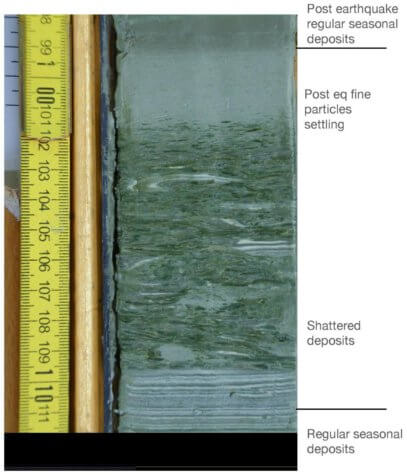
The Dead Sea is the lowest place on Earth. Study author Professor Shmuel Marco says, because of this, flood waters flowing into the Dead Sea carry sediment that accumulates at the bottom of the lake every winter. This annual cycle forms different layers in the lakebed. A dark winter layer, about one millimeter thick, represents the winter flood. A lighter layer of the same thickness forms by increased evaporation of water during the summer. The two form a perfect picture of that year’s geological activity.
The study finds that when an earthquake strikes, the sediment swirls together and blends in with previous layers in the lakebed. Using formulas and computational models to measure these changes, researchers determined how long it usually takes before the next major 6.5 earthquake strikes Israel.
Setting a timeline for disaster
The results show there is no fixed schedule for these devastating quakes. Over the centuries, there have been periods of thousands of years with significant earthquake activity and thousands of years with very little. When it comes to catastrophic quakes however, the study finds scientists significantly underestimate their frequency in Israel.
Marco’s team says it was believed that earthquakes greater than 7.5 on the Richter scale happen every 10,000 years. The new study concludes these massive quakes likely strike every 1,300 to 1,400 years. The last such quake hit the region around the year 1,033.
As for the more regular magnitude 6.5 earthquakes, the range between events only varies from a few hundred years to a couple of decades. Marco warns that if a quake arrives early, Israel could literally be moments away from a devastating seismic shock.
“I don’t want to cause alarm,” the head of Tel Aviv University’s Porter School of the Environment and Earth Sciences says in a media release. “But we are living in a tectonically active period. The geological record does not lie and a major earthquake in Israel will come. Of course, we have no way of predicting exactly when the earth will shake under our feet – this is a statistical projection – but unfortunately, I can say that an earthquake that will cause hundreds of casualties will hit in the coming years. It could be in ten years or in several decades, but it could also be next week, and we need to constantly be prepared for that.”
The study appears in the journal Science Advances.


