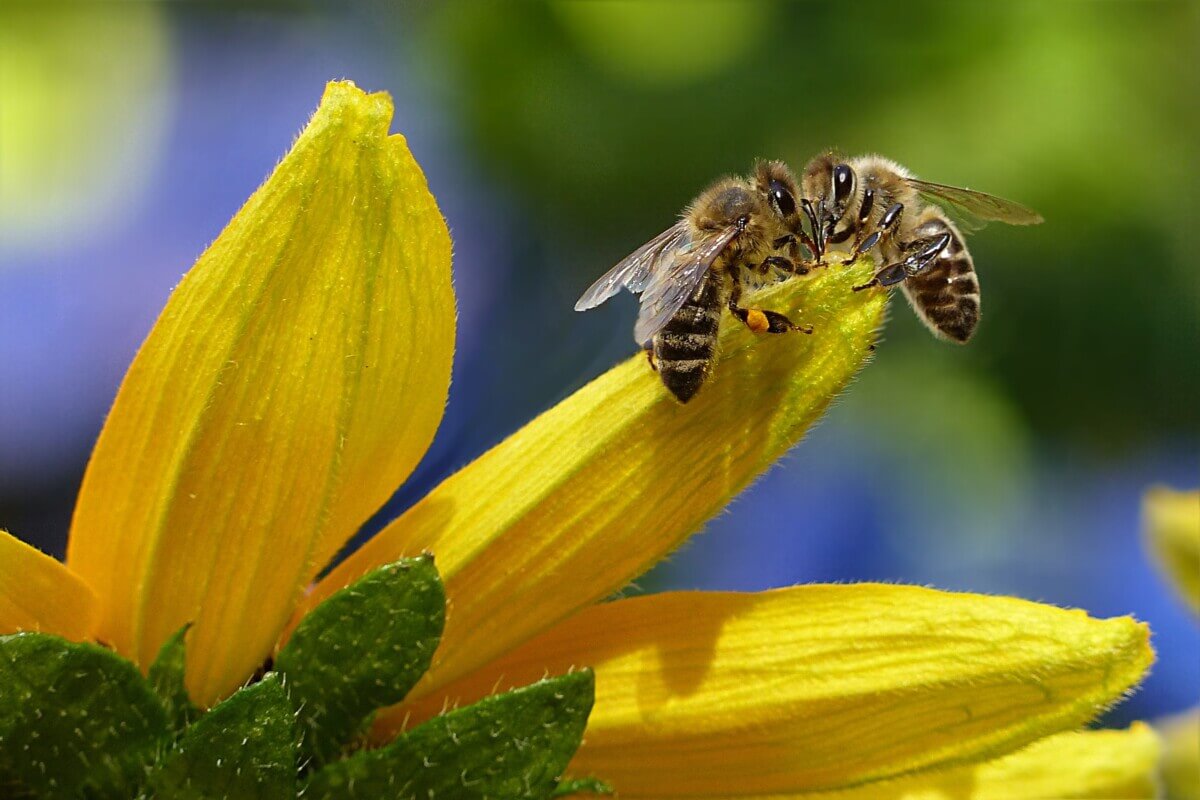
(Photo by Pixabay from Pexels)
Study Reveals Two-Piston Pump Inside Detached Honey Bee Stingers
In A Nutshell
- Detached honey bee stingers pumped venom on their own in lab tests.
- Two flexible valves worked as pistons, sliding in opposite directions.
- Strong pumping lasted 15 to 70 seconds, about 31 on average.
- Researchers point to tiny medical pumps as a possible use.
For more than a century, scientists have described the anatomy of a honey bee’s stinger, but no one had watched it pump venom. Now high-speed cameras have, and what they caught is a tiny machine that keeps working after the bee is gone.
When a worker honey bee stings elastic tissue such as skin, its barbed stinger can rip free from its body and stay lodged in the wound. The bee flies off to die, yet the stinger carries its own venom sac, muscles, and a small cluster of nerve cells, so it keeps pushing venom into the wound by itself. Shedding a body part this way is rare, suspected in only a handful of other relatives in the bee, wasp, and ant group. For honey bees, the payoff is defense: a pump that keeps delivering venom after the worker is gone would keep deterring predators.
Published in the journal Proceedings of the National Academy of Sciences (PNAS), the work describes what the team calls “a unique double-piston micro-pump.” A group from Macquarie University and the University of New South Wales in Australia, including first author Fiorella Ramirez-Esquivel, filmed the pump in action and then built an enlarged copy to test how it works.
High-Speed Video Captures a Honey Bee Stinger Venom Pump at Work
Stingers are tiny and sit deep inside the insect, which kept them hard to study. A honey bee’s is reasonably large, translucent, and conveniently detaches, which made it a workable subject.
Researchers pulled stingers from live worker bees with forceps, then killed the bees immediately. Each stinger was partly pressed into a small block of artificial material made to mimic human tissue, and a strong light was shone through its translucent outer shell. High-speed cameras, filming at up to 500 frames per second, captured the moving parts.
A separate batch of workers from a managed hive in Canberra, Australia, had their stingers scanned with micro-CT, an X-ray method that builds detailed 3D models. The scans mapped the venom chamber, called the bulb, a space less than a millimeter long.

Bee Stinger Valves Act as Two Opposing Pistons
Inside the bulb, two long, barbed rods called lancets slide back and forth, and each carries a flexible valve. In the six worker bees whose stings were analyzed, the valves moved in opposite directions, like two kids on a seesaw, and a typical stroke took less than a second.
On the downstroke, a valve inflates like a parachute and presses against the chamber wall, forcing venom toward the exit. On the upstroke, it deflates, letting fresh venom flow in and, most likely, limiting how much gets pulled backward. No muscles control the valves, so their changes in shape are passive, set off by the motion of the stroke itself.
Two pistons working in shifts solve a problem that stumps a syringe. A syringe used for intravenous drugs has one rigid piston, so it cannot refill without risking backflow, and it cannot deliver a continuous stream. The bee’s design refills and pushes at the same time, helped by a bulb shaped like an upside-down teardrop that leaves room for fresh venom even while the other valve is mid-push.
Collapsing Valves Slide Past Each Other Mid-Stroke
Trickiest of all is the mid-stroke moment when the valves meet. To get past each other, both must change shape, then spring back and rebuild their seals. Researchers could not pin down exactly how, though two explanations fit the evidence: either the cup-shaped body of each valve caves in sideways, or winglike flaps on the downward-moving valve flip upward.
To test the design, the team built an enlarged model of the chamber with 3D-printed parts and rubbery valves, using glycerol, a thick liquid, in place of venom. Valves made from extremely stretchy material proved essential for copying the real behavior. Motors drove the valves, and the model moved much like the real stinger, including the way each valve squeezes into the narrow tip at the end of a stroke. It pushed out less fluid than predicted, probably because the rods holding its valves disrupted the seal.
Detached Bee Stingers Pump Strongly for Half a Minute on Average
Across 10 stingers placed in artificial tissue, strong pumping lasted 15 to 70 seconds, about 31 on average, before fading into twitching that lasted a few more minutes. Each stroke also grew slower as the stinger tired.
Tissue mattered, too. Without artificial tissue to push into, the valves moved only short distances and never crossed. With it, they covered about half a millimeter, and the barbed lancets worked the stinger deeper into the material, which would make it harder to pull out.
Engineers may find a use for the design. The paper points to tiny medical and fluid-handling devices as places a pump this small could help, though the researchers describe no such device.
For a creature that can lose its life to a single sting, the honey bee left behind a self-contained pump that keeps running, and designers of tiny medical devices now have a working example to study.
Paper Notes
Limitations
Stingers were pulled from bees that were then killed, and they were pressed into artificial tissue instead of living skin, so real stings may behave differently. Sample sizes were small: the motion analysis used six workers, and some measurements used five. Only worker honey bees were studied. Venom was assumed to flow like water when calculating flow conditions for the scaled model, and the team could not directly watch venom moving through the bulb, calling its flow visualization results preliminary. How the valves deform when they pass each other remains unresolved, with two competing explanations. The scaled model released less fluid than predicted, and its valves deformed somewhat differently from the real ones. Some of the 3D scans captured stingers frozen at different moments, and it is unclear whether those shapes match what happens during active pumping. Medical applications are speculative.
Funding and Disclosures
Support came from grant N62909-20-1-2088 from the Office of Naval Research Global and an Australian Research Council Discovery project grant (DP250104339). The authors declare no competing interest.
Publication Details
Fiorella Ramirez-Esquivel, Claudia Klose, Hyun Chai Lee, Quinn Graco, Ajay Narendra, and Sridhar Ravi, “The honey bee stinger: An unusual pump with collapsible double pistons,” Proceedings of the National Academy of Sciences (PNAS), 2026, Vol. 123, e2603916123. DOI: https://doi.org/10.1073/pnas.2603916123. Authors are affiliated with the School of Engineering and Technology at the University of New South Wales, Canberra; the School of Natural Sciences at Macquarie University, Sydney; and the Pollinator Futures Research Centre at Macquarie University. The paper was edited by Raghavendra Gadagkar, received February 13, 2026, and accepted August 26, 2026. It is open access under a CC BY-NC-ND 4.0 license. Micro-CT data are deposited in MorphoSource (https://doi.org/10.17602/M2/M478590).


