
European swallowtail butterfly. Credit: Dr George Hancock
Study: Butterfly Wing Patterns May Make Predators Misjudge How Fast Their Prey Is Moving
In A Nutshell
- Bold wing patterns may trick a predator’s sense of motion.
- Volunteers’ taps landed behind butterflies with the strongest illusion.
- Patterns bred to distort speed came to resemble real wings.
- No wild predators were tested, so real-world effects remain unproven.
Swatting at a fluttering butterfly is harder than it looks, and a new study suggests the insects’ wing patterns are partly to blame. In a touch-screen game, 100 volunteers chased virtual butterflies, and their taps tended to land behind the insects. The more a species’ markings scrambled the look of its movement, the farther back players aimed. Between the most and least baffling species tested, the typical tap shifted backward by roughly 38 percent of a butterfly’s body length.
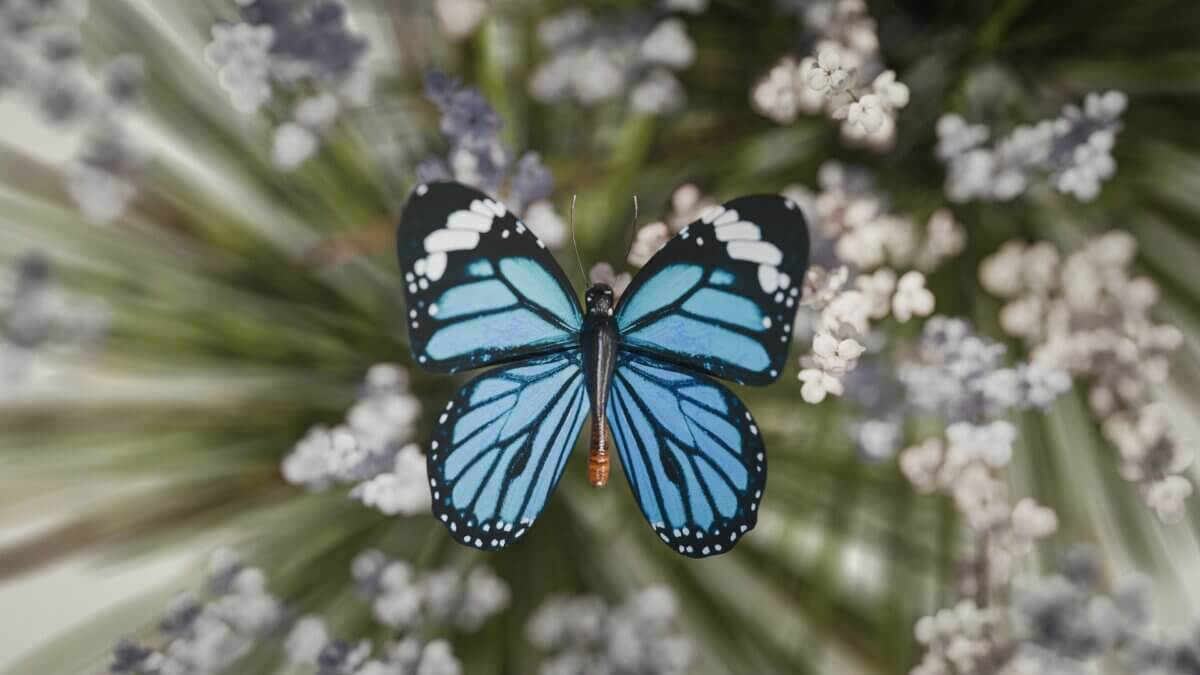
Researchers from the University of Exeter and the University of Essex in England report in Nature that bold wing patterns, paired with the way the insects fly, can create an optical illusion that misleads an observer about how fast, and in which direction, a butterfly is moving. Film of real butterflies, computer simulations of hundreds of species, a program that evolved its own wing designs, and the volunteer game all supported the idea.
Zebra stripes and snake patterns have long been suspected of rattling predators in a similar way, an idea called “motion dazzle.” Proof has been thin, partly because earlier experiments used rigid prey, even though real animals swing their limbs against their direction of travel. Butterflies, with flapping wings and an enormous range of high-contrast patterns, make a better test.
Butterfly Wing Patterns Scramble the Look of Motion at Take-Off
Researchers filmed butterflies launching into flight with a camera fast enough to freeze each wingbeat. Five species were recorded, which gave seven wing-pattern types once males and females were counted separately, across 18 flights.
Footage was digitally edited so each insect appeared with its natural markings and again with plain grey, black, or white wings. Both versions then went through a computer model of how animal eyes detect movement. Natural patterns made the movement signal point backward or sideways significantly more often than any plain version did.
Bold Stripes and Tails Boost the Illusion Across 397 European Species
Next, the team scanned illustrations from a field guide covering 397 European species, or 757 butterfly forms when males, females, and subspecies are counted separately. Each became an animated three-dimensional model that could flap or glide, and a computer analysis of dozens of wing traits showed which mattered most.
Strong contrast on the front wings, vertical stripes on the back wings, and a single stripe did the most to throw off judgments of speed. Tails on the back wings and larger body size also muddied side-to-side movement.
Results varied by family. Swallowtails, which glide, scored high in both directions, and every swallowtail measured had contrasting stripes. Another big family, which includes red admirals, ranged from the strongest effect, usually in species with one vertical stripe, to almost none. Flapping was required to distort forward speed, while gliding alone still threw off side-to-side judgment.
Computer-Evolved Butterfly Wing Patterns Built to Distort Speed Came to Resemble Real Ones
For a test with no real butterflies involved, the team turned to a genetic algorithm, a program that mimics natural selection by keeping the best-performing designs and breeding new ones from them. Over 20 generations, 120 digital populations produced 57,600 wing patterns. Most populations were bred to excel at one measure of motion trickery, while a control group was selected at random, and none had input from real species.
Patterns bred to distort forward speed ended up measurably closer to real European butterflies than random starting patterns, patterns shaped by chance, or even unusual real species. Patterns bred to throw off side-to-side judgment landed about as close to real butterflies as real species are to one another. Breeding for the strongest forward-motion signal produced pure white butterflies, echoing the “whites” family, although those looked the least like natural butterflies overall. Bright targets tend to seem faster than they are, so predators would be expected to overshoot.
Human Players Aimed Behind the Butterflies That Scrambled Motion Most
Human volunteers served as stand-in predators for the final check. Those 100 people, recruited at the University of Exeter’s Penryn Campus and aged 18 to 70, each completed 30 trials. Five species spanning the range of illusion strength flew along varied paths on a fast-refresh screen. After a short tutorial, a tap counted as a hit if it landed within a small margin around the insect.
Because birds see motion faster than humans, the targets crossed the screen at a catchable pace but were blurred as if flying twice as fast. Taps aimed at the butterflies with the strongest illusion trailed farther back, the pattern expected if a target looks slower than it really is and matching what the computer predicted.
Bright colors probably do several jobs at once, from warning predators to controlling body temperature, and the authors say motion trickery may complement those roles. Even so, a bird lunging at a flapping butterfly may be aiming at a spot the insect has already left.
Paper Notes
Limitations
Simulations relied on a single overhead viewing angle and left out wing undersides, because illustrations of undersides were unavailable for most species. Real take-off footage covered only seven pattern types, with two or three butterflies each, and sample sizes were set by availability. The motion model reflects bird vision, but the attack test used human volunteers, whose age and sex were not recorded, and targets were slowed to suit human reaction times. Only five species appeared in the human test. The authors also note that viewing distance, background type, and a wider range of flight styles were not fully captured, and they expect these factors to refine the findings rather than overturn them. The work shows that patterns can mislead a motion-detection model and human attackers, not that the illusion protects butterflies from birds in the wild.
Funding and Disclosures
This research was funded by the Biotechnology and Biological Sciences Research Council (BBSRC) through grant number 128145R001. Co-author Laura A. Kelley is funded by a Royal Society Dorothy Hodgkin Fellowship (DH160082). The authors declare no competing interests. The University of Exeter ethics committee approved the butterfly filming and the volunteer game, which followed the Declaration of Helsinki, and no identifying data were collected from participants.
Publication Details
Titled “Butterfly wing patterns in flight create powerful illusory motion cues,” the paper was written by George R. A. Hancock, Emmanuelle S. Briolat, Anna E. Hughes, Laura A. Kelley, and Jolyon Troscianko. Hancock, Briolat, Kelley, and Troscianko are affiliated with the Centre for Ecology and Conservation at the University of Exeter, and Hughes with the Department of Psychology at the University of Essex. It was received on October 9, 2025, accepted on August 19, 2026, and published online in Nature on September 30, 2026, as an open-access article. DOI: https://doi.org/10.1038/s41586-026-11062-w


