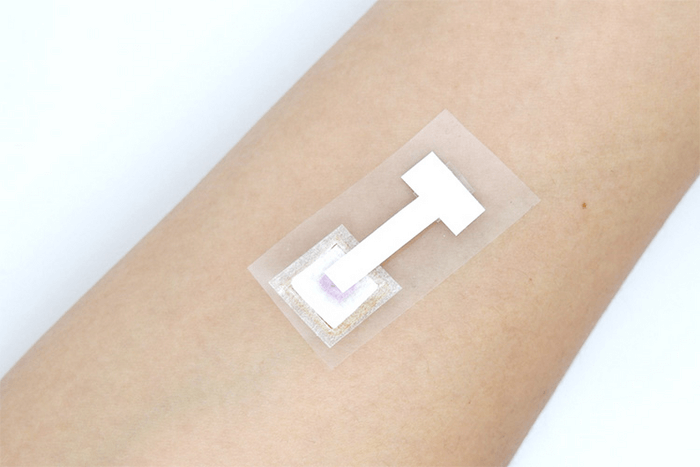
Researchers report a new, minimally invasive, antibody-based detection method for SARS-CoV-2 that could lead to the blood sample-free detection of many diseases. (CREDIT: Institute of Industrial Science, The University of Tokyo)
TOKYO — A new COVID-19 test can successfully screen for the virus in just three minutes. Moreover, researchers in Japan say this new rapid testing method doesn’t require a blood sample.
A team from the University of Tokyo notes that one of the main challenges in limiting the spread of SARS-CoV-2 is accurately identifying who has the virus. Along with inconsistent screening methods throughout the pandemic, the relatively high rate of asymptomatic patients (16%–38%) complicates the world’s ability to curb the spread.
Even when testing is reliable, time becomes a major factor. The most common method of swabbing a person’s nose or throat can take between four and six hours to detect the virus. Another way is to test for SARS-CoV-2-specific antibodies using testing strips with gold nanoparticles.
While this screening process can detect antibodies in 10 to 20 minutes, it also requires patients to give a blood sample — similar to the way diabetes patients prick their fingers to measure glucose levels. This technique is not only painful, it also comes with cross-contamination, infection, and biohazard risks.
Cutting down the time and finger pricks
“To develop a minimally invasive detection assay that would avoid these drawbacks, we explored the idea of sampling and testing the interstitial fluid (ISF), which is located in the epidermis and dermis layers of human skin. Although the antibody levels in the ISF are approximately 15%–25% of those in blood, it was still feasible that anti-SARS-CoV-2 IgM/IgG antibodies could be detected and that ISF could act as a direct substitute for blood sampling,” explains lead author Leilei Bao from the Institute of Industrial Science at the University of Tokyo, in a media release.
After discovering that ISF is suitable for detecting antibodies, the team created a method for sampling and testing ISF within seconds.
“First, we developed biodegradable porous microneedles made of polylactic acid that draws up the ISF from human skin,” notes senior author Beomjoon Kim. “Then, we constructed a paper-based immunoassay biosensor for the detection of SARS-CoV-2-specific antibodies.”
By combining the two, researchers were able to make a small patch that can detect COVID antibodies within three minutes, according to laboratory tests. Study authors say their invention represents a rapid and safe way of screening for coronavirus. It could also provide a cost-effective way of testing for COVID in lower income countries.
The findings appear in the journal Scientific Reports.


