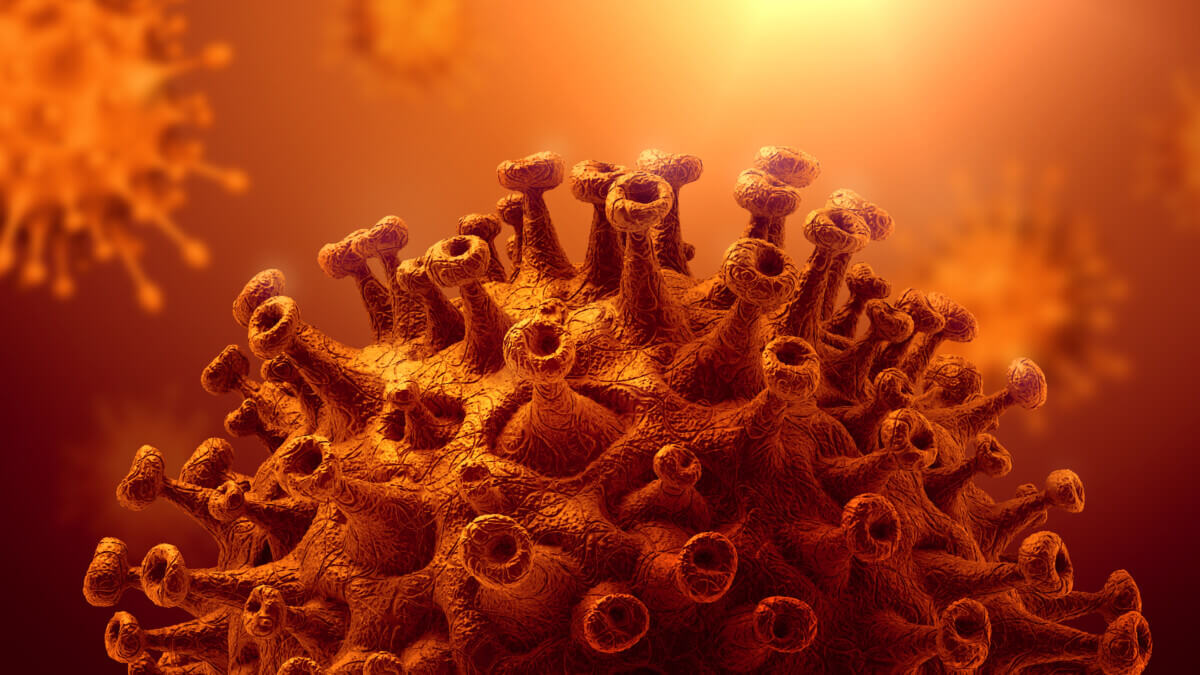
(© CROCOTHERY - stock.adobe.com)
Scientists Uncover Shared Molecular Dependency Across Human Coronaviruses, From SARS To The Common Cold
In A Nutshell
- Coronaviruses trigger the body’s own stress responses to chemically reprogram cellular machinery, making it easier to produce viral proteins.
- Scientists identified four specific chemical changes inside human cells that known human-infecting coronaviruses all appear to depend on.
- Blocking the enzymes that drive those changes significantly reduced viral protein production in lab experiments, pointing to a potential new drug strategy.
- Codon patterns in coronavirus genomes may one day serve as an early research tool for studying how well a new strain has adapted to humans.
Most antiviral drugs are built to hit one target in one virus. A treatment gets developed, the virus mutates, and suddenly the drug stops working. A study published in Nature Communications suggests there may be a way out of that cycle: a conserved molecular dependency found across known human-infecting coronaviruses, from the deadly SARS-CoV-2 to the mild strains behind ordinary winter colds.
To understand how researchers found it, there’s a puzzle worth appreciating first. Coronavirus genomes are written in a kind of biological shorthand that human cells find difficult to read, yet these viruses still manage to make their proteins efficiently. The answer involves tiny molecular machines called transfer RNAs, or tRNAs, which read genetic instructions and build proteins. When a coronavirus infects a cell, it triggers stress responses, like those triggered by DNA damage or oxygen imbalances, and those responses chemically alter tRNAs in ways that favor decoding of codons (three-letter genetic instructions) that are unusually common in coronavirus genomes. The virus doesn’t rewire the cell directly. It puts the cell under enough stress that the cell rewires itself, and the virus is built to benefit from exactly that.
How Coronaviruses Exploit the Cell’s Own Stress Response
Researchers from Universitat Pompeu Fabra in Barcelona and the MRC-University of Glasgow Centre for Virus Research infected human lung cells with SARS-CoV-2 and a coronavirus strain behind ordinary seasonal colds, then used high-precision chemical analysis to track changes in tRNA chemistry. Four specific chemical modifications stood out.
A modified form of a chemical tag called inosine, normally present at high levels in healthy cells, dropped sharply after infection. A different tag called mcm5U increased. Both shifts altered tRNA chemistry in ways that favor decoding of the specific genetic codons coronaviruses rely on most heavily. Two additional chemical tags shifted in ways that further favored viral protein production. The team then infected Syrian hamsters with SARS-CoV-2 and found the same mcm5U increase in lung tissue, strongest in the most heavily infected animals. The other three modifications were not confirmed in the hamster tissue, which the authors attribute partly to infection variability between individual animals and differences between the animal model and cell culture conditions.
To confirm these shifts were actually driving viral replication, researchers genetically blocked the enzymes responsible for the virus-friendly tRNA modifications. In each case, viral protein production dropped considerably. Forcing cells to ramp up enzymes that work against those modifications had the same effect. The tRNA landscape wasn’t just changing alongside infection. It was actively enabling it.

Frederic Camallonga / Universitat Pompeu Fabra)
A Shared Molecular Strategy Across Human Coronaviruses
When scientists examined codon patterns across human-infecting alpha- and betacoronaviruses, including SARS-CoV-2, MERS-CoV, and the milder strains that circulate every winter, the same dependency on these four tRNA modifications appeared across all of them. Not just in pandemic strains. The pattern showed up consistently across known human-infecting strains.
Current antiviral treatments targeting the virus’s surface proteins are in a constant arms race with viral mutations. The findings suggest that enzymes controlling these tRNA modifications could be explored as potential broad-spectrum antiviral targets. Because those enzymes sit inside the human cell rather than the virus, it would be harder for the virus to escape through simple mutation. One important caveat: these enzymes are part of normal human cell biology, so any therapy targeting them would need to avoid disrupting essential cellular functions. Researchers also found that related RNA viruses, including chikungunya, appear to use similar codon strategies based on prior work and codon analysis, hinting that this line of research could eventually extend beyond coronaviruses.
Could a Coronavirus’s Genetic Code Signal Pandemic Risk Before It Spreads?
Running alongside the drug target hypothesis is a second observation that could matter long before any treatment exists. The codon signatures in a newly identified coronavirus genome may one day help researchers study how dangerous a new strain might be.
Milder coronavirus strains, those that have circulated in humans longer, tend to be more deeply adapted to these tRNA modifications than recently emerged, highly pathogenic ones like SARS-CoV-2. The authors propose that viruses may fine-tune their genetic code to exploit human cell biology more precisely over time, and that newly jumped strains haven’t had that adaptation period yet. They suggest this as one possible contributing factor to why newly emerged coronaviruses sometimes cause more severe disease, though disease severity depends on many viral and host factors beyond codon usage. The idea remains speculative and would require further validation.
If the pattern holds, scanning a new coronavirus genome for these codon signatures could become one early research tool for studying how well a new virus may be adapting to humans before clinical data are available. As recent history showed, early signals matter more than almost anything else.
Before 2020, most people thought of coronaviruses as the cause of annoying winter colds. What this research makes clear is that these viruses have been quietly tuning their genetics to exploit human cell biology at the most basic level. Understanding that mechanism could inform future antiviral development, and may eventually help scientists get a faster read on the next dangerous coronavirus before it spreads.
Disclaimer: This article is for informational purposes only and does not constitute medical advice. The research described is preliminary and has not been validated in human clinical trials. No approved drugs or therapies are currently based on these findings.
Paper Notes
Study Limitations
Several limitations are worth keeping in mind. Experiments on SARS-CoV-2 were conducted in one type of lung cell, while experiments on the milder coronavirus strain used a different type. Because the cell lines differ, some observed differences may reflect the cells rather than the viruses. The animal portion used Syrian hamsters infected with an early SARS-CoV-2 strain with lower infectivity than the strain used in cell culture. Only one of the four tRNA modifications was confirmed in animal tissue; the others were not detected in hamster lungs, likely due to infection variability among individual animals and differences between the animal model and cell culture conditions. The chemical analysis method measures tRNA modifications across the entire cell and cannot distinguish between two separate cellular compartments, complicating interpretation of some findings. Sample sizes in some sequencing experiments were small, with only two replicates. Finally, while the authors propose that viral adaptation to stress-induced tRNA changes may be a broader feature of RNA viruses, direct experimental validation across multiple virus families was not conducted in this study.
Funding and Disclosures
This research was supported by the Spanish Ministry of Science, Innovation and Universities, the Departament de Recerca i Universitats de la Generalitat de Catalunya, a Marie Skłodowska-Curie fellowship, a LifeArc COVID-19 award, and MRC core funding. Additional support came from a European Research Council Consolidator Grant. Mass spectrometry and flow cytometry analyses were performed at the CRG/UPF Proteomics and Flow Cytometry Units, part of Spain’s National Infrastructure for Omics Technologies. The authors used ChatGPT to assist with grammatical corrections during manuscript preparation. No competing interests were declared.
Publication Details
Authors: Elena Muscolino, Mireia Puig-Torrents, Jaime Buigues Bisquert, Diogo Correa Mendonca, Marc Talló-Parra, Gemma Perez-Vilaro, Omar Caño-Prades, Gavin R. Meehan, Karen Kerr, Vanessa Herder, Miguel Chillón, Alfredo Castello, Rafael Sanjuan, Arvind H. Patel, and Juana Díez. Affiliations include Universitat Pompeu Fabra (Barcelona), the Instituto de Biología Integrativa de Sistemas at the Universitat de València, the MRC-University of Glasgow Centre for Virus Research, and Universitat Autònoma Barcelona, among others. | Journal: Nature Communications | Title: “Coronaviruses reprogram the tRNA epitranscriptome to favor viral protein expression” | DOI: https://doi.org/10.1038/s41467-026-69700-w | Status: Article in Press. Received May 2, 2025; accepted February 6, 2026.


