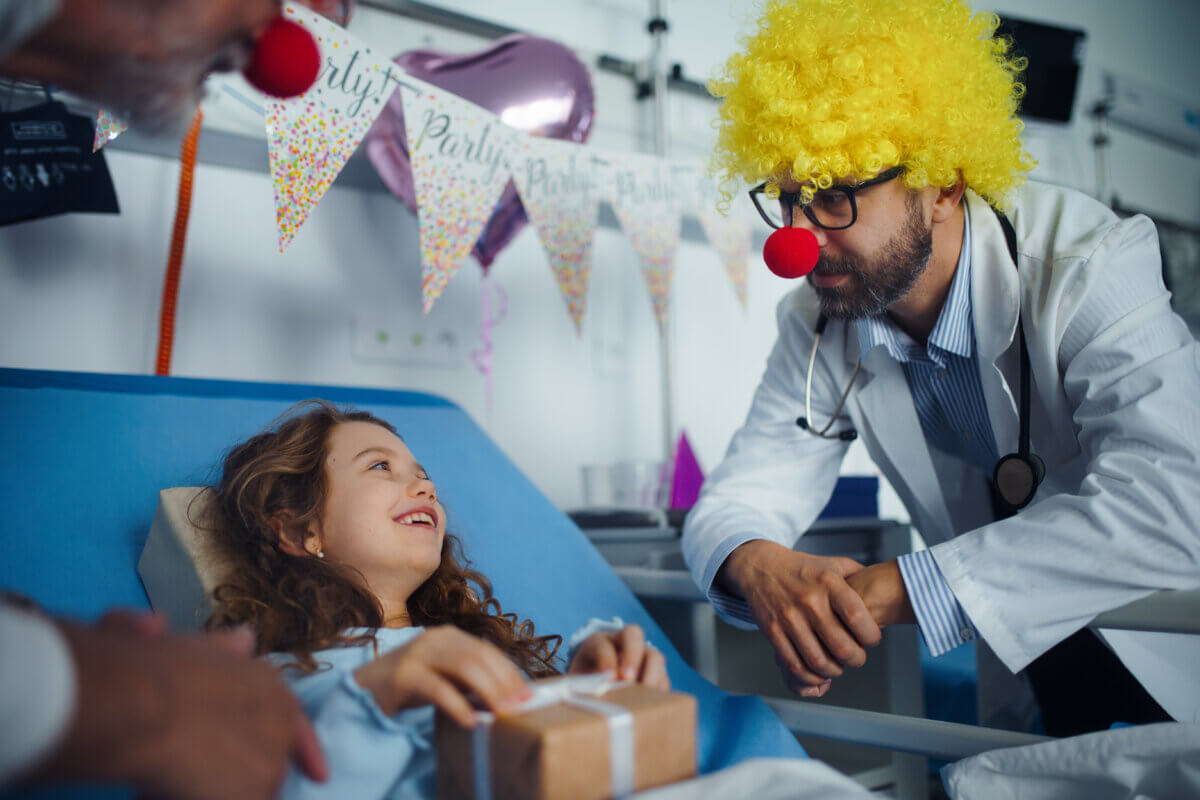
Happy doctor with clown red noses celebrating birthday with little girl in a hospital room. (© Halfpoint - stock.adobe.com)
VIENNA, Austria — For children, it turns out that laughter really is the best medicine.
Imagine you’re a kid stuck in a hospital bed, feeling sick and scared. Now picture a colorful character with a red nose and oversized shoes walking into your room, ready to make you laugh. It might sound like an unlikely scenario, but recent research suggests that these “medical clowns” could be a powerful tool in helping children recover from pneumonia faster.
The Healing Power of Laughter
A new study presented at the European Respiratory Society (ERS) Congress has revealed some fascinating findings. It turns out that spending time with a medical clown can actually shorten a child’s hospital stay when they’re battling pneumonia. So, what exactly is a medical clown, and how can they help sick kids?
“Medical clowns undergo specific training to work in hospitals. They have been shown to reduce pain and alleviate stress and anxiety in children and their families during medical treatment, and have been gradually integrated into many aspects of hospital care,” explains Dr. Karin Yaacoby-Bianu, the lead researcher from Carmel Medical Center in Israel, in a media release.
These aren’t your average birthday party clowns. Medical clowns are specially trained professionals who use humor, music, and playfulness to help patients cope with the stress of being in the hospital. They’re like a ray of sunshine in an otherwise sterile and sometimes scary environment.
The Study: Clowns vs. Pneumonia
So, how did the researchers figure out that clowns could help kids with pneumonia? They looked at 51 children between the ages of two and 18 who were in the hospital with pneumonia. Pneumonia, by the way, is a serious lung infection that can be particularly dangerous for young children.
The kids were split into two groups. One group received standard medical care, while the other got the same care plus two 15-minute visits from a medical clown each day for the first two days of their hospital stay.
The clowns, who were part of a group called The Dream Doctors Project, used various techniques to help the kids relax. They played music, sang songs, and even used something called “guided imagination” – probably helping the kids picture themselves somewhere fun and exciting instead of in a hospital bed.
The Results: Laughter Really Is the Best Medicine
Here’s where it gets really interesting. The kids who got to hang out with the clowns got better faster! On average, they were able to leave the hospital after about 43.5 hours, compared to 70 hours for the kids who didn’t see the clowns. That’s more than a full day difference!
Not only that, but the “clown group” only needed two days of intravenous (IV) antibiotics, while the other group needed three days. The researchers also noticed that the kids who spent time with clowns had lower heart rates, slower breathing, and even showed signs of less inflammation in their bodies.
“While the practice of medical clowning is not a standardized interaction, we believe that it helps to alleviate stress and anxiety, improves psychological adjustment to the hospital environment and allows patients to better participate in treatment plans like adherence to oral antibiotics and fluids. This in turn helps the children to recuperate faster,” Dr. Yaacoby-Bianu theorizes.
In other words, when kids are less stressed and more relaxed, their bodies might be better able to fight off the infection. Plus, they might be more willing to take their medicine and drink fluids, which are crucial for getting better.
The Science Behind the Smiles
It’s not just about feeling better emotionally. Dr. Yaacoby-Bianu suggests that laughter and humor might have direct effects on the body.
“Laughter and humor may also have direct physiological benefits by lowering respiratory and heart rates, reducing air trapping, modulating hormones, and enhancing the immune function,” the study author says.
This means that laughing could actually help kids breathe better, calm their hearts, balance their hormones, and even boost their immune systems. It’s like a natural medicine that comes with no side effects – except maybe sore cheeks from smiling too much!
What’s Next for Medical Clowns?
This study is just the beginning. The research team is now looking at how “sending in the clowns” might help with other illnesses. They want to figure out where these jolly healers might be most effective.
“This study indicates the positive effect that humor can have in healthcare settings and emphasizes the potential for non-pharmacological interventions to influence clinical outcomes,” notes Dr. Stefan Unger, a pediatric respiratory specialist who wasn’t involved in the study.
Dr. Unger points out that using medical clowns could have benefits beyond just helping the kids get better faster. It could reduce stress for families, cut healthcare costs, and even help ease the burden on overworked hospital staff.
Of course, more research is necessary to confirm these findings and understand exactly how humor helps healing. For now, it seems that a dose of laughter might be just what the doctor ordered for kids fighting pneumonia.


