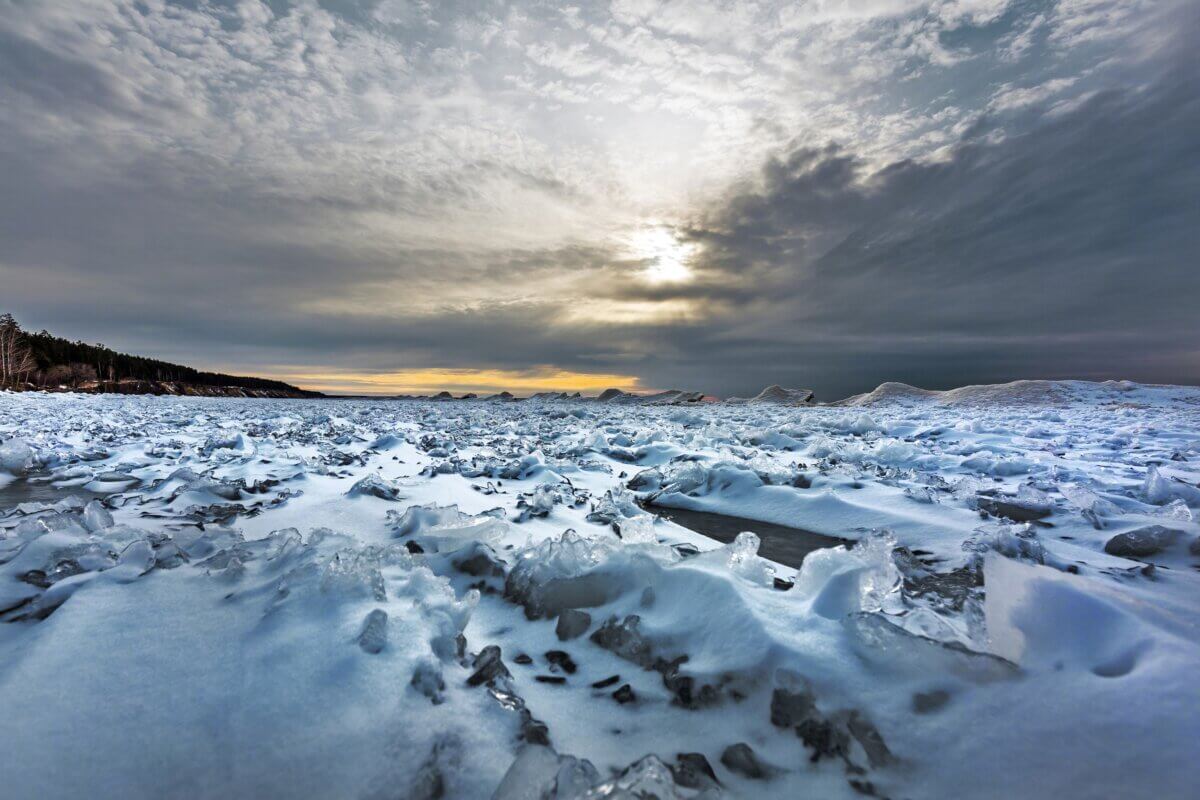
The beginning of the ice age on the Ob River with snow and ice hummocks off the coast. Berdsk, Novosibirsk region, Western Siberia of Russia. (Photo by Starover Sibiriak on Shutterstock)
BLACKSBURG, Va. — The Earth underwent a complete makeover after the last Ice Age, turning from a frozen wasteland to a slushy planet surrounded by oceans. In a new study, researchers looked at how it was possible for the once snowball Earth to rapidly melt and enter its “plumeworld ocean” era.
The surface ocean remained deeply frozen for several million years during the Ice Ages, which occurred about 635 to 650 million years ago. Scientists believe global temperatures dropped, causing the polar ice caps to spread around the hemispheres. More ice meant more sunlight reflected away from the Earth, contributing further to the frigid temperatures.
In a new study published in the Proceedings of the National Academy of Sciences journal, researchers show the first geochemical evidence of Earth setting conditions for the climate to change, with carbon dioxide from the sky eventually thawing out the ice.
“Our results have important implications for understanding how Earth’s climate and ocean chemistry changed after the extreme conditions of the last global ice age,” says Tian Gan, a former Virginia Tech postdoctoral researcher and lead author of the study, in a press release.
Along with sunlight reflected off the polar ice caps, a quarter of the ocean stayed deeply frozen because of low carbon dioxide levels. The frozen ocean stopped several chain reactions. The water cycle locked up, preventing evaporation, rain, and snow. With no water available, chemical weathering declined. This carbon dioxide-consuming process involves rocks breaking down because they interact with environmental chemicals. A lack of weathering and erosion causes carbon dioxide to build up in the atmosphere, trapping heat.
“It was just a matter of time until the carbon dioxide levels were high enough to break the pattern of ice,” says Shuhai Xiao, a geologist at Virginia Tech and study coauthor. “When it ended, it probably ended catastrophically.”
Over time, the accumulation of carbon dioxide trapping sunlight caused more heat to pile in the atmosphere. This caused ice caps to melt, and Earth’s climate turned frozen to slushy. Over 10 million years, the average global temperatures moved from -50 to 120 degrees Fahrenheit.
In the current study, researchers analyzed lithium isotopes from carbonate rocks formed after the Ice Age ended. The rocks’ geochemical signatures would give researchers a better idea of what the climate was like after the Ice Age.
In agreement with the plumeworld ocean theory, the authors saw the geochemical signatures of freshwater were stronger in rocks formed under near-shore meltwater than rocks formed offshore beneath the deep sea. These changes led to an Earth that is different from today. Researchers describe it as rivers of glacial water storming like a reverse tsunami from land into the sea, combined with the extra dense and salty ocean water. According to the authors, the study findings give a snapshot of life back in time and show the resiliency of life under extreme conditions.
Paper Summary
Methodology
The researchers collected rock samples from five locations in China, representing different ancient ocean depths. They analyzed these samples for their lithium isotope compositions using sophisticated mass spectrometry techniques. They also created computer models to simulate how ocean chemistry would have changed during and after the snowball Earth period. The analysis involved careful consideration of potential contamination and alteration of the samples over time.
Results
The study found that lithium isotope values decreased from shallow to deep water environments, ranging from about 10.4‰ in shallow waters to 2.6‰ in deep waters. These values are significantly lower than modern ocean measurements. The team also identified three distinct stages in the recovery period, each with its own chemical signature.
Limitations
The study relies on ancient rocks that have undergone some degree of alteration over hundreds of millions of years. While the researchers carefully accounted for these effects, some uncertainty remains. Additionally, the samples come from one region (South China), and global patterns might have varied.
Discussion and Takeaways
The research provides strong support for the plumeworld hypothesis and suggests that Earth’s oceans underwent dramatic chemical changes during the snowball Earth period. The study demonstrates how the ocean gradually recovered through a series of distinct stages, offering insights into how Earth’s systems respond to extreme climate changes.
Funding and Disclosures
The research was supported by the National Science Foundation, the Patricia Caldwell Faculty Fellowship at Virginia Tech, the University of North Carolina at Chapel Hill, and the National Natural Science Foundation of China. The authors declared no competing interests.


