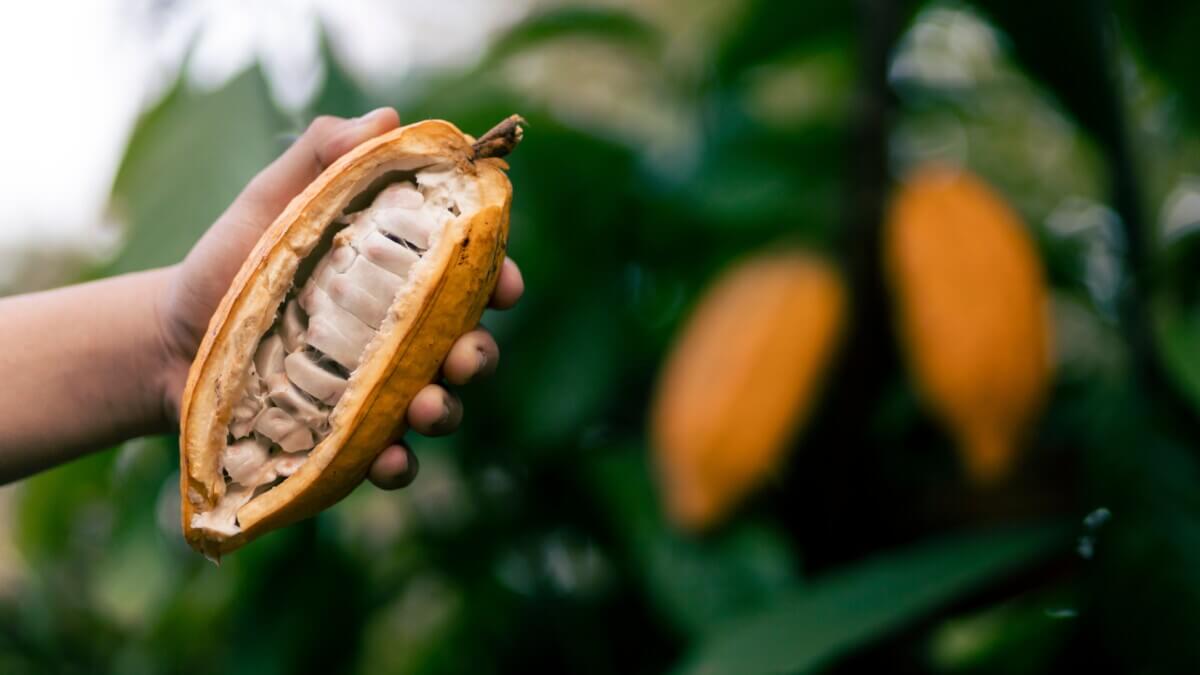
(Credit: CoreRock/Shutterstock)
Scientists Uncover a Surprising New Culprit Behind Cocoa Shortages
In A Nutshell
- A new study finds heavy rain and dry-season drought together explain 68% of the year-to-year swings in Ghana’s cocoa harvests.
- Extreme rainfall during the flowering season lined up with poorer cocoa harvests in Ghana, Ecuador, and Indonesia alike.
- Heavy downpours knock flowers and young pods off cocoa trees and fuel a fungal disease called black pod rot.
- Because rainfall extremes track El Niño patterns, farmers and markets could eventually get a year or more of advance warning.
Heavy rain falling at exactly the wrong moment, together with drought later in the growing cycle, explains 68% of the year-to-year swings in cocoa harvests in Ghana, according to a new study published in the Proceedings of the National Academy of Sciences. That finding upends the common assumption that drought and rising temperatures alone are the biggest threats to the world’s chocolate supply, and it spotlights a risk that has gotten far less attention: short bursts of extreme rainfall hitting cocoa trees at precisely the wrong moment.
Researchers from Harvard University and the University of Ghana analyzed more than two decades of farming records across 66 districts in Ghana, then checked their findings against national data from Ecuador and Indonesia. Across all three countries, unusually heavy rain during flowering lined up with poorer harvests. In Ghana specifically, dry weather later in the season made things even worse.
West Africa lost up to 40% of its harvest during the 2023/2024 season, part of a run of shortfalls blamed on aging trees, illegal gold mining, and smuggling. Those factors likely play some role, but the new research points to weather, specifically extreme rain, as a major driver behind the price-driving swings.
Heavy Rain and Dry Spells Are Driving up Chocolate Prices
Researchers focused first on Ghana, where newly available production records covered 66 farming districts from the 2000/2001 season through 2022/2023. They paired those numbers with daily rainfall and temperature data, then used statistical models to find which weather patterns lined up most closely with good and bad years for cocoa.
Two rainfall measurements, taken together, explained 68% of the year-to-year swings in Ghana’s cocoa production: how much heavy rain fell during the flowering season from April through June, and how dry the following stretch from November through February turned out to be. Heavier downpours during flowering meant worse harvests, and drier conditions later in the dry season also hurt yields. Adding temperature extremes, the kind of heat stress many scientists have worried about, didn’t make the predictions more accurate.
Applying a similar approach to Ecuador and Indonesia, researchers found that heavy rainfall during the wet season lined up with poorer harvests in both countries too, despite very different growing conditions and farming practices. In Ecuador, adding a drought measure improved the model only modestly, while Indonesia’s model explained less of the yield swings overall and didn’t feature dry-season conditions as a notable factor. Still, the recurring wet-season signal across three regions is a big reason researchers feel confident it isn’t tied to one country’s circumstances.

Too Much Rain Wrecks a Cocoa Harvest
Cocoa trees flower and form young pods during the rainy season, right when pollinators are most active. Heavy rain and wind can knock flowers and young pods off the tree before they develop. Wet conditions also fuel a fungal disease called black pod rot, which spreads through splashing rainwater and can destroy pods that survived the initial storm damage. Field observations cited in the study found that outbreaks of this disease tend to follow rainfall events by about a week, backing up the idea that rain-driven damage and disease, not just soggy soil, are likely behind many of the losses.
El Niño Patterns Offer a Possible Early Warning System
Bursts of heavy rain are tied to larger climate patterns, including El Niño, a shift in Pacific Ocean temperatures scientists can often predict a year or more ahead. In Ghana and Ecuador, El Niño patterns explained a large share of the variation in wet-season rainfall extremes. That matters because if heavy rainfall risk can be anticipated through El Niño, farmers, cooperatives, and commodity markets could get earlier warning of a rough season coming.
Researchers also checked whether rainfall extremes have worsened over time, separate from El Niño’s influence. In West Africa, they found an increasing trend in heavy wet-season rainfall, consistent with what scientists expect as the planet warms, since warmer air holds more moisture and tends to fuel more intense rain. That trend wasn’t the same everywhere. Ecuador showed a decrease in extreme wet-season rainfall over the same stretch, and Indonesia’s trend was weak. Even so, the West African pattern is worth watching given how much of the world’s cocoa comes from that region.
Cocoa’s Future May Hinge on Managing Rainfall Extremes
Cocoa farming has long been described mainly as a fight against drought and heat. This research suggests the more urgent risk hides in the opposite extreme: short, intense bursts of rain hitting cocoa trees at exactly the wrong moment, working alongside dry stretches later in the season. With such downpours expected to grow more common as the climate warms, and millions of livelihoods riding on cocoa harvests, treating rainfall extremes as a serious, forecastable risk could make a real difference for farmers and the global chocolate supply.
Disclaimer: This article summarizes findings from a peer-reviewed study for general audiences and is intended for informational purposes only. It does not constitute agricultural, financial, or investment advice regarding cocoa markets or commodities. Readers should consult the original study or a qualified professional before making decisions based on this information.
Paper Notes
Limitations
Several caveats accompany this work. Uncertainty in how much land is actually harvested each year in Ghana can affect the accuracy of yield estimates, since the study relies on production data divided by long-term trends rather than direct measurements of yield per acre. Different rainfall datasets did not always agree. Some satellite-based rainfall products consistently underestimated the heaviest downpours compared with actual rain gauge readings, so the authors relied on TAMSAT, a satellite-based dataset that matched gauge observations most closely, as the most reliable source for Ghana. In Indonesia, rainfall explained less of the variation in cocoa yields, which the authors attribute partly to data limitations and partly to farmers switching away from cocoa to other crops like oil palm and cloves during the study period, which muddies the climate signal. About a quarter of Ghana’s cocoa-growing districts did not show a strong relationship with either rainfall measure, suggesting nonclimatic factors, such as small-scale gold mining, may dominate in those specific areas. The study also notes that its regional rainfall averages are fairly broad and may smooth over very localized, intense rain events that could be driving the worst local crop failures.
Funding and Disclosures
One of the authors acknowledged funding from the Harvard Center for the Environment, while two other authors acknowledged support from the Harvard Salata Institute. The authors stated they declare no competing interest.
Publication Details
This paper, titled “Rainfall extremes drive cocoa yield losses across the tropics,” was written by Anna Lea Albright, Rebecca Berkoh-Oforiwaa, and Peter Huybers. Albright and Huybers are affiliated with the Department of Earth and Planetary Sciences at Harvard University, while Berkoh-Oforiwaa is affiliated with the Department of Physics at the University of Ghana. The study was published in PNAS (Proceedings of the National Academy of Sciences), Volume 123, No. 39, in 2026, and was edited by David Lobell of Stanford University. It can be found at DOI: https://doi.org/10.1073/pnas.2606123123.


