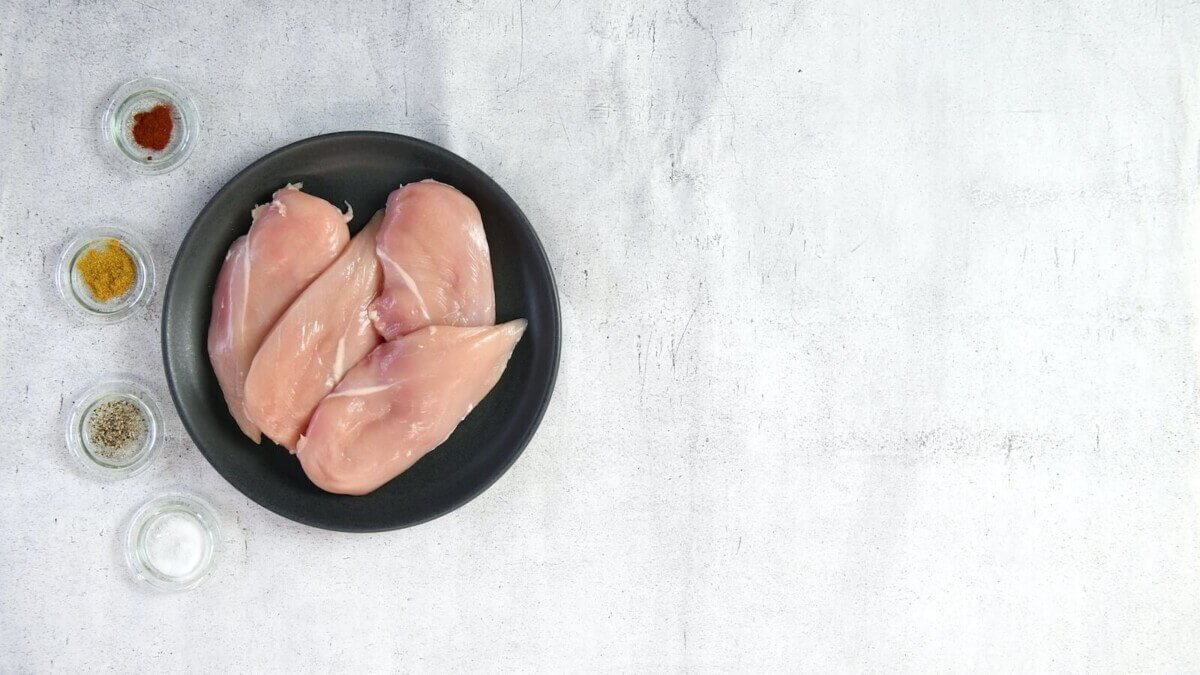
Raw chicken breasts (Photo by Philippe Zuber on Unsplash)
Blue Light Knocked Back 64 Samples of Chicken Food Poisoning Bacteria
In A Nutshell
- All 64 Campylobacter samples from UK poultry proved vulnerable to blue light, drug-resistant strains included.
- Antibiotic resistance and oxygen tolerance did not protect the bacteria.
- Fifteen rounds of light produced no detectable resistance, though only one farm sample was tested.
- Calculations suggest big cuts in contaminated chicken, but real carcasses have not been tested.
Roughly two-thirds of raw chicken sold in UK stores carries Campylobacter, the country’s most common bacterial cause of food poisoning. Meanwhile, resistance to important antibiotics is climbing in poultry-linked strains. A new study points to an unlikely weapon: a beam of blue light. All 64 bacterial samples from British poultry proved vulnerable to it, including strains that shrug off multiple antibiotics, and repeated exposure in a laboratory experiment turned up no detectable resistance.
Infections hit record highs in 2024 and 2025, with about 70,000 laboratory-confirmed cases, up 55% from 2020. Many cases never get reported, so researchers estimate the true number runs about ten times higher, costing the country an estimated £0.7 billion a year in health care and lost work. Most cases clear up within a week, but up to 10% turn severe enough to need hospital care. Around 70% of chicken and turkey flocks raised for meat carry the bacteria in their guts, and slaughterhouses processing more than 10,000 birds an hour can spread that intestinal material onto the meat.
Researchers at the University of Reading and the Animal and Plant Health Agency tested violet-blue light, often shortened to blue light, which activates natural light-sensitive molecules inside bacterial cells and sets off damage from within. Earlier work showed it killed a tidy lab strain of Campylobacter jejuni. This study, published in the journal Microbiology, asked a tougher question: does it work on the messier bacteria circulating on real farms?
Blue Light Worked on Food Poisoning Bacteria From Farms, Drug-Resistant or Not
Researchers gathered 64 samples from chickens, turkeys and farm environments, collected by UK surveillance programs between 2008 and 2024. Many came loaded with resistance. More than half resisted each of two common antibiotics, and nearly one in five resisted three or more types.
Each sample got three doses of light, and more light meant fewer survivors every time. At the highest dose, every sample shrank by at least 99%, and the average drop topped 99.9%. The three Campylobacter species fared alike, and the farm samples were slightly more sensitive than the lab strain.
Drug resistance bought the bacteria no protection. Strains resistant to several antibiotics were knocked back about as much as drug-susceptible ones. A small test using a low dose of the antibiotic ciprofloxacin beforehand did not blunt the light’s effect either.
A hunch got tested too. Some Campylobacter handle oxygen better than their relatives, and since the light works by flooding cells with damaging oxygen compounds, sturdier strains might resist it. The light worked on them anyway. Only eight samples landed in the two sturdiest groups, though, so that result is less firm than the rest.

Food Poisoning Bacteria Developed No Resistance to Blue Light in Lab Test
A new germ killer is only useful if bacteria can’t quickly evolve around it, as happened with antibiotics. To test that, researchers took one farm sample and put it through 15 rounds of light, each round wiping out roughly 99.9% of the bacteria. Survivors regrew before the next round. Three light-exposed lines were compared with two unexposed lines, and none of the light-exposed lines became harder to kill. A separate timing test on a few Campylobacter jejuni samples found steady die-off as exposure lengthened, with no bacteria detected after 15 minutes at high power or 80 minutes at low power.
According to the authors, the light damages many parts of a cell at once, so they cannot see any single mutation that would likely protect it. Whether resistance can evolve was only tested in one sample, though, and the authors say further investigation is needed to rule it out.
Blue Light Could Sharply Cut Contaminated Chicken, Calculations Suggest
Chicken contamination has been stubborn. When UK slaughterhouses were last assessed, between 2012 and 2017, 26% of carcasses leaving them were heavily contaminated. A 2023 survey found 10% of whole chickens in supermarkets still were.
Researchers calculated what would happen if the light cut bacteria on carcasses by 99%, a drop every sample matched or beat at the highest dose. Heavily contaminated carcasses at slaughterhouses would fall from 26% to 7%, and at supermarkets from 10% to 2%. Those figures are projections, not results from treating real chicken, though the paper cites earlier estimates that a 99% cut could lower infection risk by as much as 90%. Because the treatment uses low-power LEDs, the authors say it could cost less than some alternatives.
Lab tests used clear liquid, a much simpler setting than a processing plant. Sticky bacterial layers called biofilms may shield cells from light, and bacteria stuck to chicken skin may be hardier than those floating in liquid. Trials on actual contaminated carcasses in industry settings are essential, the researchers say.
Current prevention efforts have struggled to contain Campylobacter, and an LED-based fix would be a welcome change. Until blue light clears real carcasses in real processing plants, though, it remains a promising lab result, not a food safety tool.
Disclaimer: This article reports on a published scientific study and is for general information only. Findings from laboratory research may not apply to real-world settings, and nothing here is medical or food safety advice. Readers with health or food safety concerns should consult a qualified professional or official guidance.
Paper Notes
Limitations
Every experiment used bacteria in controlled liquid cultures, not on actual chicken carcasses, which the authors say differ considerably and may include biofilms and skin that affect how well light reaches bacteria. The evolution experiment used a single C. jejuni farm sample. The pre-exposure test used ciprofloxacin only and a small selection of samples. Samples were also sorted by how well they tolerate oxygen, and none differed significantly, but only eight fell in the two most tolerant groups. A genetic screen of 6,658 Campylobacter genomes across 53 species found the genes tied to light sensitivity throughout, though species beyond those in the 64 samples were never exposed to light. A separate timing test on a few C. jejuni samples found no survivors after enough exposure. The authors state that further investigation is needed to thoroughly discount resistance. The contamination figures are calculations based on a hypothetical 99% reduction, not outcomes from carcass trials.
Funding and Disclosures
According to the paper, Jack K. Whitmore and Aidan J. Taylor were supported by an Academy of Medical Sciences Springboard award. Samuel A. M. Connelly and John D. Rodgers were supported by funding from the Department for Environment, Food and Rural Affairs and the Veterinary Medicines Directorate. The authors declare no conflicts of interest.
Publication Details
The study, titled “One light to rule them all: photodynamic inactivation of diverse Campylobacter,” was authored by Finlay Bembridge, Jack K. Whitmore, Adrian M. Ciesielski and Aidan J. Taylor of the University of Reading’s School of Biological Sciences, and John D. Rodgers and Samuel A. M. Connelly of the Animal and Plant Health Agency’s Bacteriology Department. Aidan J. Taylor is the corresponding author. It was received June 27, 2026, accepted August 19, 2026, and published October 5, 2026, in the journal Microbiology (Microbiology Society), volume 172, issue 10, article 001769, and is open access. DOI: 10.1099/mic.0.001769.


