
(Credit: © V. Yakobchuk - stock.adobe.com)
In A Nutshell
- A new blood-based score called BioTAK uses five factors, four biomarkers plus sex, to distinguish takotsubo syndrome (‘broken heart syndrome’) from a real heart attack before an invasive procedure is needed.
- The score was built and tested on 3,615 patients across two Swiss hospital databases, correctly ruling in likely cases and ruling out unlikely ones with strong accuracy.
- Takotsubo syndrome overwhelmingly affects women past menopause and often shows up without the classic EKG warning signs doctors typically look for.
- Two of the score’s five biomarkers aren’t yet routine hospital lab tests, and whether the tool actually improves patient outcomes in real hospitals still hasn’t been tested.
Chest pain strikes without warning. An ambulance rushes the patient to the hospital, and doctors immediately suspect a heart attack. The usual next step is invasive: threading a catheter into the heart to check for blocked arteries. But for a surprising number of patients, especially women, there’s no blockage at all. Instead, they have takotsubo syndrome, better known as “broken heart syndrome,” a condition where intense stress or emotion causes part of the heart to stop pumping normally.
It looks like a heart attack. It feels like a heart attack. But it isn’t one, and treating it like one can mean an invasive procedure that, in some cases, might ultimately prove avoidable.
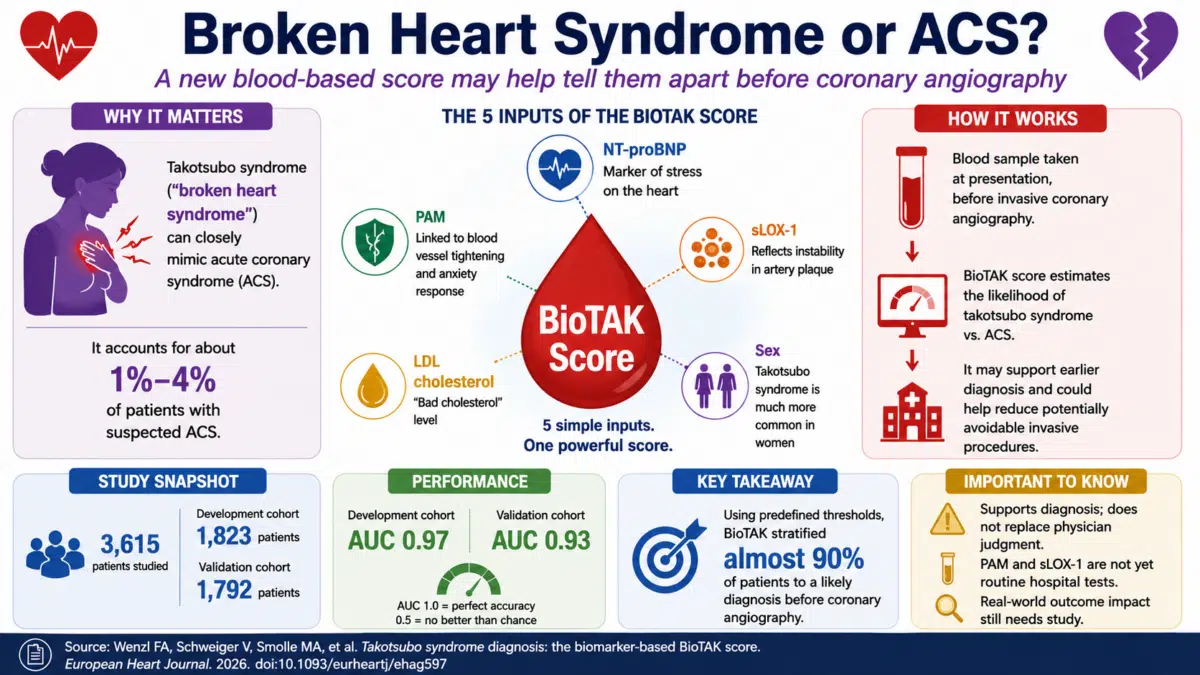
A new international study in the European Heart Journal says there may be a smarter way to sort this out before doctors ever pick up a catheter. Researchers built a diagnostic tool called the BioTAK score, based on four blood measurements and one factor (sex), that flags takotsubo syndrome with high reliability before invasive coronary angiography.
This matters because takotsubo syndrome isn’t rare, accounting for roughly 1% to 4% of patients who show up with suspected heart attack symptoms, according to the paper. Telling it apart from a real heart attack, known medically as acute coronary syndrome, currently requires a patient’s psychiatric and neurological history, repeated heart imaging, and an invasive procedure to rule out a blocked artery, a process that takes time and carries risk. A fast, blood-based score could change how emergency rooms handle these cases.
Five Blood Markers, Including One Tied to Sex, Set the Two Conditions Apart
Researchers pulled data from two overlapping Swiss patient databases, combining information on 3,615 people who arrived with either a real heart attack or takotsubo syndrome. Blood samples were taken when patients came in, before any invasive procedure took place.
Scientists split patients into two groups. The first, 1,823 people (1,754 heart attack patients, just 69 with takotsubo syndrome, reflecting how rare the condition is), built the score, sifting through dozens of blood markers to find the ones that mattered most. A second group of 1,792 patients (1,715 heart attack cases, 77 takotsubo cases) served as an independent check, testing whether the tool still worked on a completely different set of people.
That final score, called BioTAK, landed on five ingredients: NT-proBNP, a marker of heart-muscle stress; PAM, tied to blood vessel tightening and anxiety response; sLOX-1, which reflects instability in the fatty buildups that clog arteries; LDL cholesterol, or “bad cholesterol”; and whether the patient is male or female, since takotsubo syndrome overwhelmingly affects women.
These five markers work because takotsubo syndrome and heart attacks come from different biological processes. Heart attacks are typically driven by plaque rupturing inside an artery and blocking blood flow. Takotsubo syndrome instead involves a surge of stress hormones and disrupted signaling between the brain’s emotional centers and the heart, without a blocked artery in sight. Patients with the condition showed more severe heart strain, more favorable cholesterol, lower plaque-instability markers, and higher anxiety-linked enzyme levels than heart attack patients.
The Score Sorted Nearly 9 in 10 Patients Before Any Procedure Began
When researchers measured how well BioTAK could tell the two conditions apart, results were strong: .97 on a scale where 1.0 means perfect separation and .5 means pure guesswork, in the group used to build the score, and .93 on the separate validation group, showing it held up outside the original data.
Beyond the raw numbers, researchers set point thresholds sorting patients from “very unlikely” to “very likely” to have takotsubo syndrome. At the high end, the score avoided false alarms well: about 99% of patients who did not have the condition were correctly kept out of the “likely” group. Among patients labeled “likely,” about 59% actually had it, rising to roughly 89% for “very likely.” At the low end, when the score labeled someone unlikely to have takotsubo syndrome, that call was correct almost 99.8% of the time, rising to 99.9% for patients labeled “very unlikely.” In plain terms, it excels at ruling takotsubo syndrome out, and grows sharper at ruling it in near the highest thresholds.
The Condition Overwhelmingly Strikes Women Past Menopause
Patients came from Swiss hospital databases collected between 2011 and 2023. Women made up a large share of takotsubo cases, matching how the condition typically shows up: it affects women past menopause far more often than men, and most arrive with chest pain lacking the classic warning pattern on an EKG, the standard heart-rhythm test used in the ER, exactly where a fast, objective score could matter most.
Two of the biomarkers powering BioTAK, sLOX-1 and PAM, aren’t yet routine hospital lab tests, and current versions take three to five hours to return results, though the authors say that still falls within the recommended window for treatment decisions. One unanswered question: whether using the score in real hospitals actually changes patient outcomes. That real-world test still needs to happen.
This score won’t replace a doctor’s judgment. But it points toward a future where a stressed heart doesn’t always mean a trip to the catheterization lab, a real shift for a condition misdiagnosed almost as often as it’s misunderstood.
Disclaimer: This article is based on findings from a peer-reviewed study and is intended for general informational purposes. It is not a substitute for professional medical advice, diagnosis, or treatment. Anyone experiencing chest pain or symptoms of a possible heart attack should seek emergency medical care immediately.
Paper Notes
Limitations
The study authors point out several caveats. Although the score was tested on a separate group of patients, both groups came from closely related registry systems in Switzerland, so testing the score in other countries or with different hospital setups would strengthen confidence in the results. In patients who show ST-segment elevation or other high-risk warning signs, doctors may still need to proceed straight to an invasive procedure regardless of what the score says. The two newer blood markers used in the score, sLOX-1 and PAM, aren’t yet part of routine hospital lab testing, which could limit how quickly this tool gets used in everyday practice. The authors also note that predictive accuracy numbers can shift depending on how common takotsubo syndrome is in a given patient population, and that the real-world effect of using this score on patient care and outcomes hasn’t yet been tested.
Funding and Disclosures
The study was supported by research grants including funding from the Swiss Heart Foundation and several university and foundation research funds. The SPUM-ACS registry received support from the Swiss National Science Foundation, the Swiss Heart Foundation, and unrestricted grants from several pharmaceutical and medical device companies. Measurements of some biomarkers used in the score were funded and performed by outside companies, including PAM Theragnostics GmbH, SphingoTec GmbH, and 4TEEN4 Pharmaceuticals GmbH. The paper states that no company involved in funding had any role in the study’s design, data analysis, data interpretation, or the writing of the report. Several individual authors disclosed financial relationships with pharmaceutical and diagnostics companies, research grants, and consulting roles, as detailed in the paper’s disclosure section.
Publication Details
The study, titled “Takotsubo syndrome diagnosis: the biomarker-based BioTAK score,” was published in the European Heart Journal. The lead authors are Florian A. Wenzl and Victor Schweiger, who contributed equally as first authors, with Thomas F. Lüscher and Christian Templin serving as senior authors alongside Wenzl. The research was conducted on behalf of the InterTAK and SPUM-ACS investigators, with contributing authors from institutions including the University of Zurich, University Hospital Zurich, University of Bern, University of Geneva, and other collaborating centers. The paper’s DOI is 10.1093/eurheartj/ehag597. The study is registered under Clinical Trial identifiers NCT01000701 and NCT01947621.


