NASA/CXC/SAO/D. Bogensberger et al; Image Processing: NASA/CXC/SAO/N. Wolk;
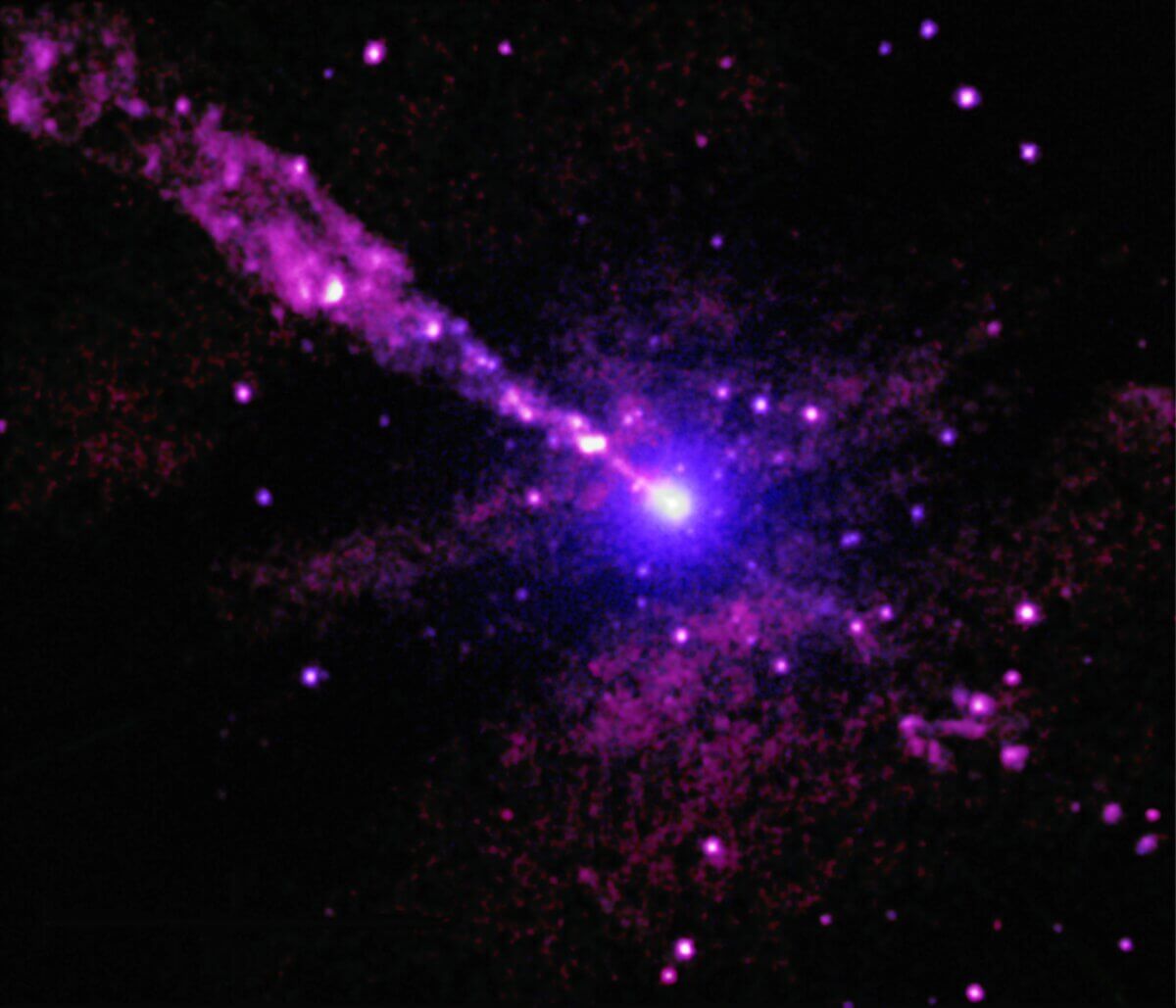
ANN ARBOR, Mich. — Imagine a cosmic sledgehammer hurtling through space at nearly the speed of light, suddenly smacking into something mysterious lurking in the darkness. That’s exactly what astronomers have captured in a groundbreaking image from NASA’s Chandra X-ray Observatory, revealing an extraordinary moment in the life of a distant galaxy.
The cosmic drama unfolded in Centaurus A, a galaxy located a staggering 12 million light-years from Earth. At its heart sits a supermassive black hole launching powerful jets of high-energy particles that stretch across the entire galaxy. In this latest observation, however, scientists discovered something unprecedented: the jet appears to have crashed into an unidentified object, leaving behind a distinctive V-shaped mark in X-ray emissions.
“Even matter ejected by black holes can run into objects in the dark,” the researchers note in a media release, highlighting the unpredictable nature of cosmic interactions.
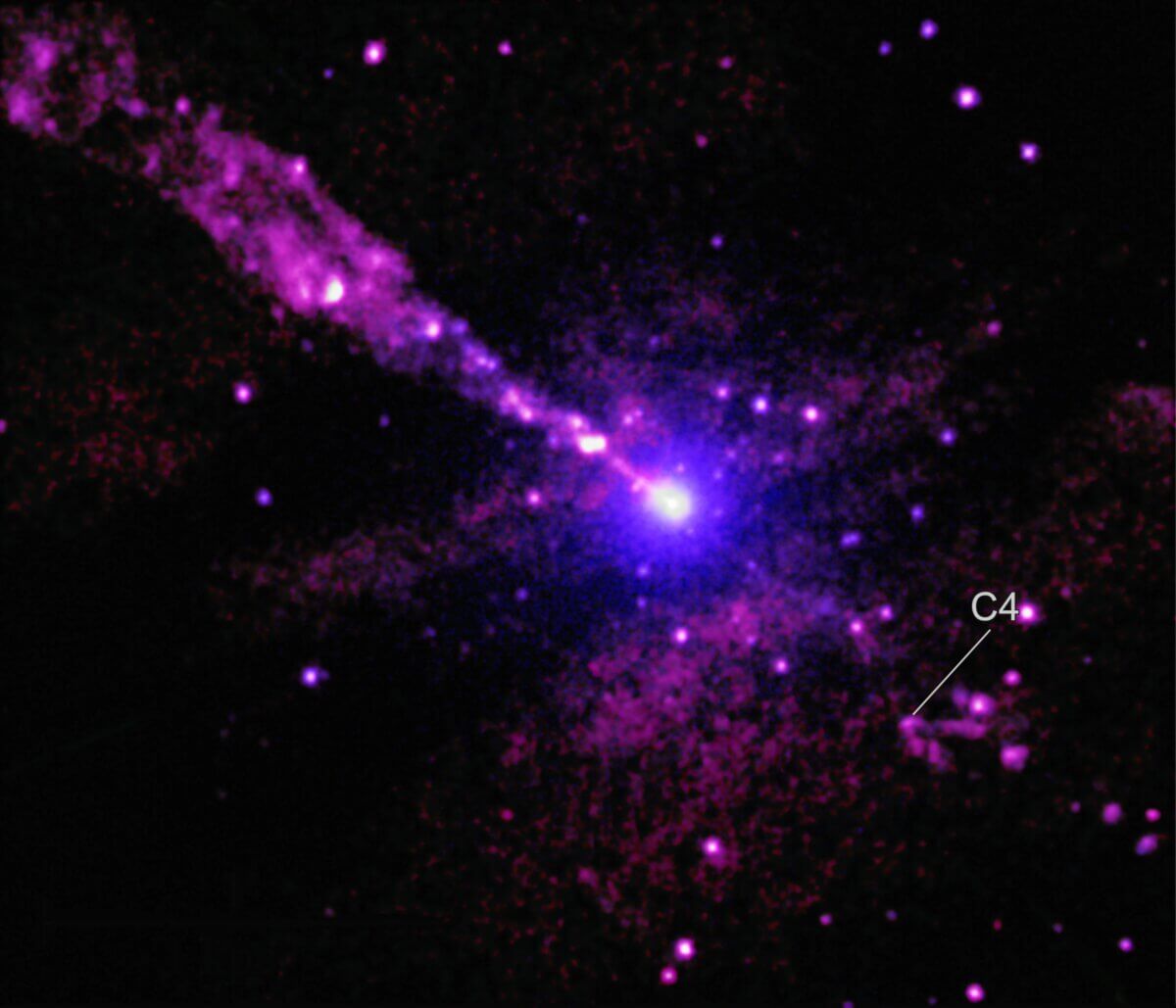
The image, created using the deepest X-ray observation ever made of Centaurus A, shows a fascinating visual puzzle. The jet’s collision with the mystery object created a V-shaped emission at least 700 light-years long – that’s nearly 175 times the distance from Earth to the nearest star. The arms of this cosmic “V” are colored in striking shades of pink, purple, and blue, representing different energy levels of X-ray radiation.
What exactly did the jet hit?
The scientists aren’t entirely sure. Their leading theory suggests it could be a massive star, potentially with a companion, whose stellar winds interact dramatically with the jet’s high-energy particles. When these particles collide with the star’s gaseous environment, they create turbulence that generates the X-ray emissions detected by Chandra.
What makes this discovery particularly intriguing is how unique it is. While astronomers have previously observed black hole jets striking objects in Centaurus A, the V-shaped emission is something entirely new. Other similar interactions typically produce more uniform, elliptical shapes in X-ray images.
The research team, comprising scientists from universities across the United States and France, highlights that this observation was only possible thanks to Chandra’s extraordinary capabilities. As the only X-ray observatory able to capture such detailed images, it provides a window into cosmic interactions we’ve never seen before.
This cosmic collision serves as a reminder of the dynamic and often violent processes happening in the universe. Objects moving at nearly the speed of light can unexpectedly interact, creating spectacular and mysterious phenomena that challenge our understanding of galactic evolution.
The full details of this remarkable observation have been published in The Astrophysical Journal, inviting further exploration and speculation about the hidden dramas playing out in the vast, dark theater of space.
Paper Summary
Methodology
The researchers analyzed 22 years of X-ray data from the Chandra X-ray Observatory to study the movements and brightness of jet “knots” in the galaxy Centaurus A. These “knots” are bright spots within the jet, which extend from the galaxy’s central black hole. They developed a specialized algorithm to track how these knots moved over time, which was critical because such motions are hard to detect in X-rays. The study used a total of 34 high-quality observations, eliminating any compromised by distortions or noise, to ensure accuracy.
The team employed a grid of bright, stable points in the image to align all observations precisely. They then used advanced fitting techniques to measure the motion and changes in brightness of these jet features. By comparing images taken over two decades, they could detect even the smallest shifts, helping to uncover how fast and in what direction these knots were moving.
Key Results
The researchers discovered that most of the X-ray jet knots in Centaurus A were stationary or had motions too small to detect. However, one knot, located about 520 parsecs from the galaxy’s center, showed a surprising apparent speed greater than the speed of light, a phenomenon known as superluminal motion. This is a visual effect caused by the jet’s angle relative to Earth and its high velocity, not a violation of physics.
The results showed that this superluminal motion likely indicates the jet’s angle is less than 41° to our line of sight, and the knot itself is moving at 94% the speed of light. Interestingly, this X-ray motion does not match earlier radio observations, hinting at complex differences in how these jet structures emit energy in different wavelengths.
Study Limitations
The observations were spaced out over two decades, making it hard to capture fast or transient events in the jet. Small uncertainties in aligning images from different times could introduce minor errors in measuring motion. The sensitivity of the Chandra telescope declines at low energy levels over time, potentially affecting measurements. Some features, like nearby stars or background galaxies, could be misidentified as jet knots, leading to uncertainties.
Discussion & Takeaways
This research provides fresh insights into the behavior of relativistic jets, particularly those originating from nearby galaxies. The detection of superluminal motion in X-rays highlights the unique properties of the Centaurus A jet, suggesting differences in how X-rays and radio waves are emitted. This could mean that X-rays trace faster or more energetic processes than radio emissions do.
The study also supports theories that jet angles play a crucial role in their apparent motions. Furthermore, understanding jet behavior helps astronomers learn more about the extreme environments around black holes and how they influence their host galaxies.
Funding & Disclosures
This research was supported by a mix of institutional and grant funding. Contributors included universities like the University of Michigan, the University of Maryland, and international institutions in France, Italy, and Israel. Data was provided through the public archives of the Chandra X-ray Observatory. All authors disclosed no conflicts of interest, and the research adhered to open-access policies under the Creative Commons Attribution license.


