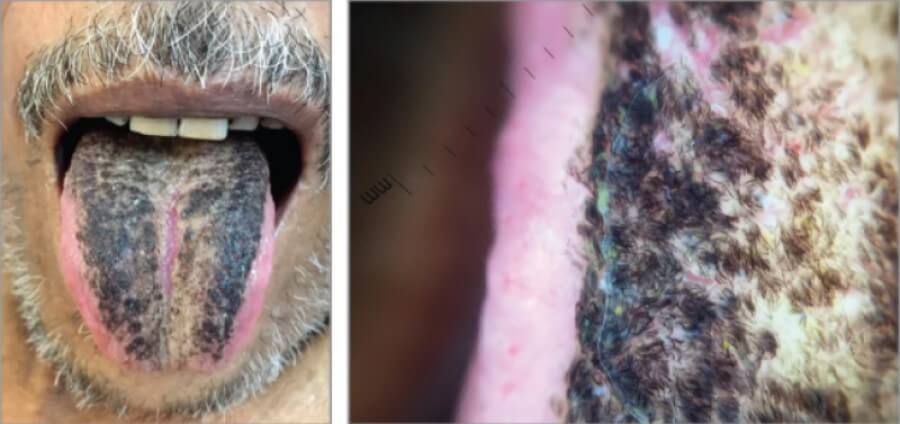
(Jayasree et al., JAMA Dermatology, 2022)
KERALA, India — A patient in India developed a stunning side-effect after a stroke — essentially growing hair on his tongue.
According to a report in JAMA Dermatology, the man in his 50s suffered a stroke just under three months before visiting the dermatology department with a thick, black coating over the top of his tongue.
“Dermoscopy results showed thin, elongated, black fibers that gave the appearance of a hairy surface,” the team writes in their report.
Doctors quickly diagnosed the patient with a condition called lingua villosa nigra — or black hairy tongue. According to the American Academy of Oral Medicine, this is a harmless condition which around 13 percent of the population experiences.
What caused this to happen?
The Indian team at Medical Trust Hospital in Kerala note that the patient started to develop this hairy tongue about two weeks before entering the hospital. Three months earlier, the man suffered a stroke which left him with weakness in the left side of his body.
His caregivers had been feeding the man a diet of pureed food and liquids, along with oral antiplatelet drugs to prevent blood clots and antihypertensives to control his blood pressure.
As for the exact cause of the hairy tongue, study authors suspect the stroke patient’s diet likely played a key role. The team explains that people on a pureed diet suffer from a lack of abrasion or stimulation on the top of their tongues. This causes a buildup of a protein called keratin.
From there, tiny projections which cover the tongue, filiform papillae, start getting longer and look like actual hair follicles on the tongue. Although black is a typical color for this overgrowth, the color can actually change depending on the bacteria or fungi in the mouth.
Other issues which can cause this to happen include poor oral hygiene, radiation treatments around the head and neck, too much tea or coffee drinking, and tobacco use.
How do you get rid of a hairy tongue?
Doctors gave the patient and his caregivers some advice on how to clean out the man’s hairy tongue. Typical preventative measures include brushing the tongue with a toothbrush or using a tongue scraper.
For cases that don’t go away using these methods, the AAOM notes that medical and surgical treatments are available for certain patients.
For this man, the odd reaction cleared up in about 20 days.


