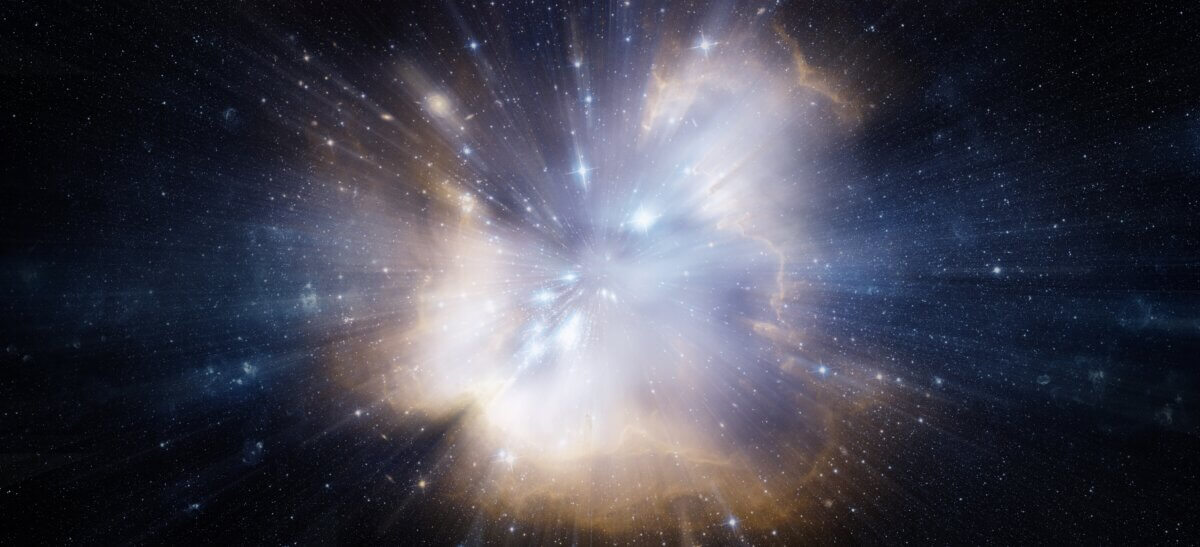
What happened before the Big Bang? (Credit: Triff/Shutterstock)
In A Nutshell
- Researchers are using supercomputer simulations grounded in Einstein’s relativity to test scenarios about what may have preceded the Big Bang.
- These simulations can’t deliver definitive answers, but they reveal which cosmological models are mathematically possible.
- Early-universe scenarios include chaotic singularities, bouncing universes, and higher-dimensional brane collisions.
- In today’s universe, numerical relativity helps check standard galaxy simulations, mostly refining results at the tiny, percent level.
LONDON — For decades, the Big Bang has stood as the starting gun for our universe: the moment space, time, matter, and energy came into being. Yet scientists have long wondered whether that really was the beginning of everything, or just the latest chapter in a larger cosmic story. Thanks to advances in supercomputing, researchers are beginning to put these once-speculative ideas to the test.
A growing branch of cosmology is now using numerical relativity, or high-powered simulations that combine Einstein’s equations of gravity with supercomputing, to probe this mystery. A new paper published in Living Reviews in Relativity, authored by British physicists Josu C. Aurrekoetxea, Katy Clough, and Eugene A. Lim, explores how these methods are reshaping long-standing debates about the universe’s origin, evolution, and fate. Rather than leaning solely on pencil-and-paper equations or simplified models, researchers are feeding the laws of physics into digital experiments, watching entire universes play out on screen.
These efforts are not producing definitive answers yet. But they are testing which bold ideas survive contact with Einstein’s equations and which collapse under their own weight. In doing so, they are helping to redraw the boundaries of what cosmology can actually prove.
Peering Into the Universe’s First Moments
One of the thorniest questions in physics is what happened at the very beginning. If we run general relativity backward, rewinding the universe, the equations predict a point of infinite density called a singularity. This doesn’t necessarily mean the universe literally “began” from nothing; rather, it shows that the known laws of physics break down at that extreme.
Numerical relativity allows researchers to investigate what kind of singularity may have been reached. Some models suggest a chaotic “mixmaster” state, with regions of the cosmos evolving almost independently in a jagged, oscillating fashion. Others propose smoother “bounce” scenarios, where a contracting universe rebounds into the expansion we see today. These aren’t certainties, but simulations help separate which of these possibilities are mathematically viable.
Another set of ideas comes from string theory, where higher-dimensional “branes” could have collided, sparking the Big Bang. Supercomputer models let scientists test how such events might unfold and whether they could produce the universe’s observed patterns of galaxies and cosmic microwave background radiation. The point is not that one scenario has been proven, but that modern simulations can now stress-test these proposals in ways that were once impossible.
The review revisits this through the lens of numerical relativity, especially in the context of the Belinski–Khalatnikov–Lifshitz (BKL) conjecture. First proposed in the 1960s and 1970s, BKL suggested that as the universe approaches a singularity, space itself might behave chaotically, with different regions collapsing and stretching in unpredictable rhythms. Early on, this idea unsettled physicists: if true, the Big Bang would not have been a smooth, uniform event but a chaotic storm at every point.
By simulating such scenarios directly, today’s researchers can see whether these oscillations persist under more realistic conditions. Numerical experiments confirm that singularities remain unavoidable in many cases, as predicted by Roger Penrose’s singularity theorems. Yet they also reveal that the “flavor” of the singularity — chaotic or smooth, violent or soft — depends heavily on what kind of matter is present. That makes the singularity less of a wall and more of a doorway: the details of how it forms may hold clues to new physics.
The Idea of a Bounce
If singularities are where current theories break down, one possible way forward is to imagine that the universe never hit one at all. Instead of springing from nothing, perhaps it “bounced” from an earlier state.
Bouncing cosmologies suggest that a prior universe collapsed in on itself before rebounding into the expansion we see today. These models often rely on unusual forms of matter or energy to prevent the collapse from ending in a destructive singularity. While skeptics note that such ingredients remain hypothetical, numerical relativity is allowing researchers to stress-test whether these bounces are mathematically consistent.
Here, supercomputers run through the collapse and rebound step by step, checking whether exotic matter can stabilize the process without violating Einstein’s rules. While no bounce model has emerged as the clear front-runner, the ability to test them in detail marks progress. What was once only a speculative sketch can now be interrogated in a controlled setting.
Bubbles and Collisions
Another frontier involves the theory of cosmic inflation, a burst of faster-than-light expansion in the universe’s first fraction of a second. Inflation helps explain why the cosmos today looks so uniform on large scales. But some versions of inflation predict that space may have inflated unevenly, creating “bubbles” of universe that expand like soap froth.
If such bubbles exist, they could in principle collide, leaving behind scars in the cosmic microwave background, the faint afterglow of the Big Bang. Detecting such a signature would be revolutionary, but predicting what it would look like requires detailed modeling.
Numerical relativity is well-suited for this task. By simulating the full equations of motion, physicists can see what happens when two bubble-like universes slam into one another. The results often show distinctive ripples in the simulated spacetime fabric. While no such ripples have been confirmed in actual data, these digital experiments provide templates for astronomers to search against.
Transitional Eras: Reheating and Phase Changes
The review doesn’t stop at the first instants. It also explores the “transitional” periods when the universe’s underlying ingredients transformed. One major moment is known as reheating. This is the time after inflation when energy locked in the inflating field decayed into the hot soup of particles that would form the first atoms.
Reheating is thought to have seeded much of the structure we see today. But its details remain mysterious: how evenly did energy spread? Did it produce gravitational waves, faint ripples in spacetime that might still be detectable? Numerical relativity lets researchers model these violent transitions in more than one dimension, following not just average behaviors but local variations.
Another transitional period involves phase changes in the universe’s fundamental forces, akin to water freezing into ice. These could also have generated gravitational waves or left imprints on cosmic structure. Once again, supercomputer simulations are giving physicists a way to map the possible outcomes.

The Later Universe and Cosmic Structure
Numerical relativity is not only for the beginning of time. It also sheds light on the “late universe,” including how galaxies and cosmic structures evolve.
Most cosmological simulations today use Newtonian gravity (a simplified version of Einstein’s equations) because it is faster to compute. For many purposes, this is accurate enough. But when precision matters, relativistic effects can creep in.
One hotly debated topic is backreaction, or the idea that local lumps and voids of matter could alter the universe’s large-scale expansion. Early claims suggested this might even explain away the need for dark energy, the mysterious force driving cosmic acceleration. Numerical relativity has tested these scenarios in detail, showing that while inhomogeneities do produce small effects, they are typically at the level of a few percent, not enough to replace dark energy altogether.
These “small” corrections still matter. Cosmologists are locked in a puzzle known as the Hubble tension, where different methods of measuring the universe’s expansion rate disagree. When measurements are so precise that even a 1–2% shift causes controversy, understanding sub-percent relativistic corrections becomes critical. It might sound negligible, but in modern cosmology, even a one percent tweak can matter when researchers are debating questions like how fast the universe is expanding. Numerical relativity provides the gold-standard check on whether those tiny adjustments are being properly accounted for.
Cosmic Voids, Redshift Drift, and Other Subtleties
Beyond galaxies, researchers are also simulating how relativity shapes cosmic voids, or the vast empty regions that dominate the universe’s volume. Voids may subtly distort light traveling through them, affecting distance measurements used to infer dark energy’s properties.
Another subtle effect is known as redshift drift. Over time, the redshift of distant galaxies (the stretching of their light by cosmic expansion) should change very slightly. Detecting this drift would provide a direct probe of cosmic dynamics, but interpreting it requires careful relativistic modeling. Numerical relativity offers the most faithful way to predict how the signal should look.
Individually, these effects are small. Collectively, they act as cross-checks that keep cosmology honest, ensuring that bold claims about the universe’s fate rest on solid ground.
These efforts underscore a key point: numerical relativity is not replacing standard methods but enhancing them. It offers a way to validate existing models, catch small systematic errors, and explore where Newtonian shortcuts may start to break down. That’s a modest but important role in sharpening our overall picture of the cosmos.
A Shift in How Cosmology Is Done
What ties all these threads together is a methodological shift. For decades, cosmologists worked with simplified models because they had no choice. The full Einstein equations were too unwieldy to solve in anything but special cases. Now, with numerical relativity and powerful supercomputers, those constraints are lifting.
This doesn’t mean every cosmic riddle is solved. Far from it. But it does mean that once-speculative scenarios, from bouncing universes to bubble collisions, can be tested rather than merely debated. As the review’s authors write, these tools “at the very least provide material with which to inform the debate, and at most they provide strong statements about consistency in models invoked to explain the observed features of our universe.”
The difference may sound modest, but in a field where questions about the universe’s origin were once thought unanswerable, it represents a profound step forward.
Why This Matters Beyond Physics
Even for those not steeped in equations, the implications ripple outward. If numerical relativity continues to mature, it could clarify whether the Big Bang was a one-off event or part of a larger cycle, whether cosmic inflation left scars we can still see, and how reliable today’s measurements of dark energy and cosmic expansion truly are.
It also reflects a broader truth about science: progress often comes not from sudden revelations but from better tools. Just as microscopes opened the cellular world and particle accelerators opened the subatomic one, supercomputer simulations are opening the earliest and largest scales of the cosmos.
The questions are ancient, but the means of tackling them are brand new.
Final Word
The Big Bang may remain the leading story of our cosmic origins, but it is no longer the only one being seriously investigated. Numerical relativity is giving physicists a laboratory of universes to explore, testing possibilities that once seemed forever beyond reach.
In the coming years, as computing power grows and new data arrives, we may find ourselves revisiting some of the most profound questions humans have ever asked: Was the Big Bang truly the beginning? Could there have been a universe before ours? And if so, what traces has it left behind in the fabric of reality we see today?
Paper Summary
Methodology
The review paper surveys how numerical relativity—solving Einstein’s equations on supercomputers—has been applied to cosmology. It organizes these applications into the early universe (singularities, bounce models, inflation, bubble collisions), transitional eras (reheating, phase changes), and the late universe (structure formation, voids, backreaction, redshift drift). Rather than presenting new data, it synthesizes recent numerical experiments across these domains.
Results
Findings show that numerical relativity confirms singularities in many scenarios but also illuminates how their properties vary with matter content. Simulations test bounce models, probe bubble collisions, and model reheating and phase transitions. For the late universe, they validate the accuracy of Newtonian approximations while quantifying small relativistic corrections, typically at the sub-percent level, relevant for tensions in precision cosmology.
Limitations
Numerical relativity is computationally expensive, limiting resolution and the range of scenarios that can be simulated. Many models also rely on hypothetical forms of matter or energy, so simulations test consistency rather than physical reality.
Funding and Disclosures
The paper is a scholarly review and does not list commercial conflicts of interest. As with many such reviews, it draws on publicly available research supported by various national science foundations and academic institutions.
Publication Details
Aurrekoetxea, J. C., Clough, K., & Lim, E. A. (2025). “Cosmology using numerical relativity,” published in Living Reviews in Relativity on June 23, 2025. DOI: 10.1007/s41114-025-00058-z


