
(Credit: oneinchpunch/Shutterstock)
NEWARK, Del. — It turns out that avoiding a fight might be as simple as changing the subject. A new study has revealed that male mice use a clever “bait-and-switch” tactic to escape aggressive brawls with their peers. By running to a female mouse, they effectively distract their aggressor and defuse potentially violent situations. Yes, you read that right — hiding behind an “attractive distraction” helps get male mice out of fights before they start!
This fascinating discovery comes from a research team led by Joshua Neunuebel at the University of Delaware. Their findings, published in the journal PLOS Biology, shed light on how these tiny creatures navigate their social world and handle conflict.
Just like humans, mice have their own social hierarchies and drama. In most groups, there’s usually one male mouse that’s more aggressive than the others. This can lead to tense situations and confrontations between male mice.
To study these interactions, Neunuebel’s team set up an experiment that might sound a bit like a reality TV show. They put two male and two female mice together and recorded their behavior for five hours. Instead of relying on human observers to interpret the mice’s actions, however, the researchers turned to a high-tech solution: machine learning.
Artificial Intelligence Meets Animal Behavior
Machine learning, a type of artificial intelligence, allowed the researchers to analyze mouse behavior more objectively than ever before. They fed data from over 3,000 aggressive encounters into their algorithm, which then helped identify patterns in how mice respond to aggression.
This approach is groundbreaking in the field of animal behavior. By removing human bias and increasing the scale of observation, machine learning opens up new possibilities for understanding the subtleties of animal interactions.
The ‘Bait-and-Switch’ in Action
So, what did this AI-powered analysis reveal? When a male mouse found himself on the receiving end of aggression, he often employed a clever strategy. Instead of fighting back or simply running away, he would dash over to one of the female mice in the group.
This move served as a kind of social sleight-of-hand. The aggressive male, initially focused on picking a fight, would follow his intended target. Upon reaching the female mouse, however, his attention would shift. Instead of continuing the aggressive encounter, he’d interact with the female instead.
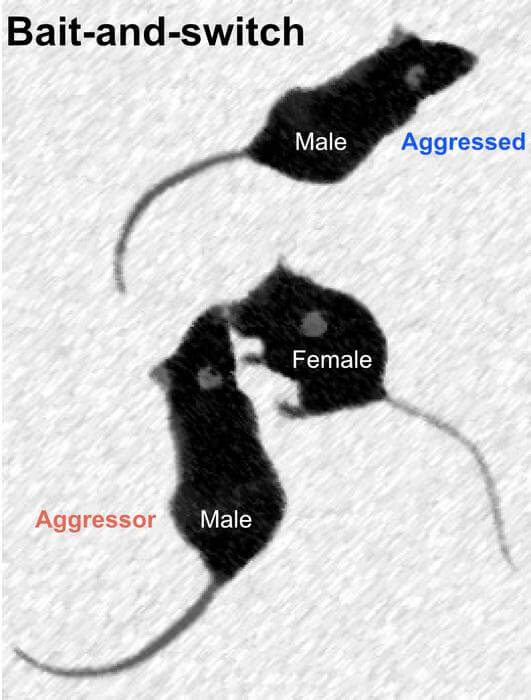
“Using artificial intelligence, we found that male mice turn to nearby females to distract aggressors and de-escalate conflicts. After an aggressive encounter, the aggressed male briefly engages with a female before quickly escaping, as the aggressor’s focus shifts to her,” the study authors note in a media release.
A Peaceful Resolution
What’s particularly interesting about this tactic is how effective it seems to be. Unlike some other avoidance strategies, which might only delay a fight, the “bait-and-switch” appeared to resolve conflicts more permanently.
After employing this tactic, the male mice tended to keep their distance from each other. The previously aggressive mouse often continued to interact with the female, while the other male was free to go about his business without further harassment.
The Cost of Peace
While this strategy seems to be an effective way to avoid fights, it’s not without its downsides. The male mice using this tactic might be sacrificing valuable time with female mice. In the competitive world of mouse mating, this could potentially impact their chances of reproducing.
Future research might explore whether this trade-off is worthwhile from an evolutionary perspective. It could also investigate whether these tactics remain effective in larger groups of mice, where social dynamics might be more complex.
This study isn’t just about understanding mice. It demonstrates the power of machine learning tools in studying animal behavior. Similar approaches could be used to explore how other species with social hierarchies handle aggression.
From meerkats to monkeys, many animals live in complex social groups where managing conflict is crucial. By applying these AI-powered techniques to other species, researchers might uncover a wealth of previously hidden behavioral strategies.
Moreover, understanding how animals naturally de-escalate conflicts could have implications for human conflict resolution. While we can’t directly apply mouse strategies to human situations, the principle of diverting attention to defuse tension is one that mediators and diplomats might find familiar.
Paper Summary
Methodology
The researchers observed social interactions in mice to study how they avoid conflicts, specifically between males. They set up an experiment where mixed-sex groups of mice interacted freely in a large enclosure. Over several hours, they recorded and tracked the movements and behaviors of the mice using special software.
This allowed the researchers to identify patterns of aggressive behavior and track how males in submissive roles responded to threats from more dominant males. They used machine learning to analyze the behaviors and identify any recurring strategies, such as how a submissive male might interact with a female after a confrontation to avoid further conflict.
Key Results
The researchers discovered that after a fight or aggressive encounter, the submissive male often quickly approached a female before the aggressor could. This action seemed to distract the aggressor, reducing the chances of a physical altercation. The data showed that when the submissive male interacted with a female, it led to fewer fights between the males. Additionally, these interactions were brief and predictable, suggesting that the submissive males used this strategy to de-escalate conflicts and avoid injury.
Study Limitations
First, the experiments took place in a controlled laboratory environment, which may not fully capture how mice behave in more natural settings. Second, the social hierarchy between the mice wasn’t deeply explored, so it’s unclear if a more rigid social structure would affect the outcomes. Finally, since the researchers focused on a small group of mice in mixed-sex settings, the findings might differ in larger or single-sex groups. Future research is needed to see if these results apply more broadly.
Discussion & Takeaways
The key takeaway from the study is that male mice in submissive roles use a clever “bait-and-switch” strategy to avoid getting hurt in aggressive situations. By interacting with females immediately after a conflict, these males can distract the aggressor, preventing further fighting.
This behavior shows how animals can adapt their social strategies to minimize risks and ensure survival. Understanding these dynamics helps researchers learn more about social behavior in animals and could have implications for studying conflict resolution in other species as well.
Funding & Disclosures
This research was funded by the National Institutes of Mental Health, the National Institutes of Health, the University of Delaware Research Foundation, and Delaware’s General University Research Program. The funders had no role in study design, data collection and analysis, decision to publish, or preparation of the manuscript and the study authors have declared no competing interests.


