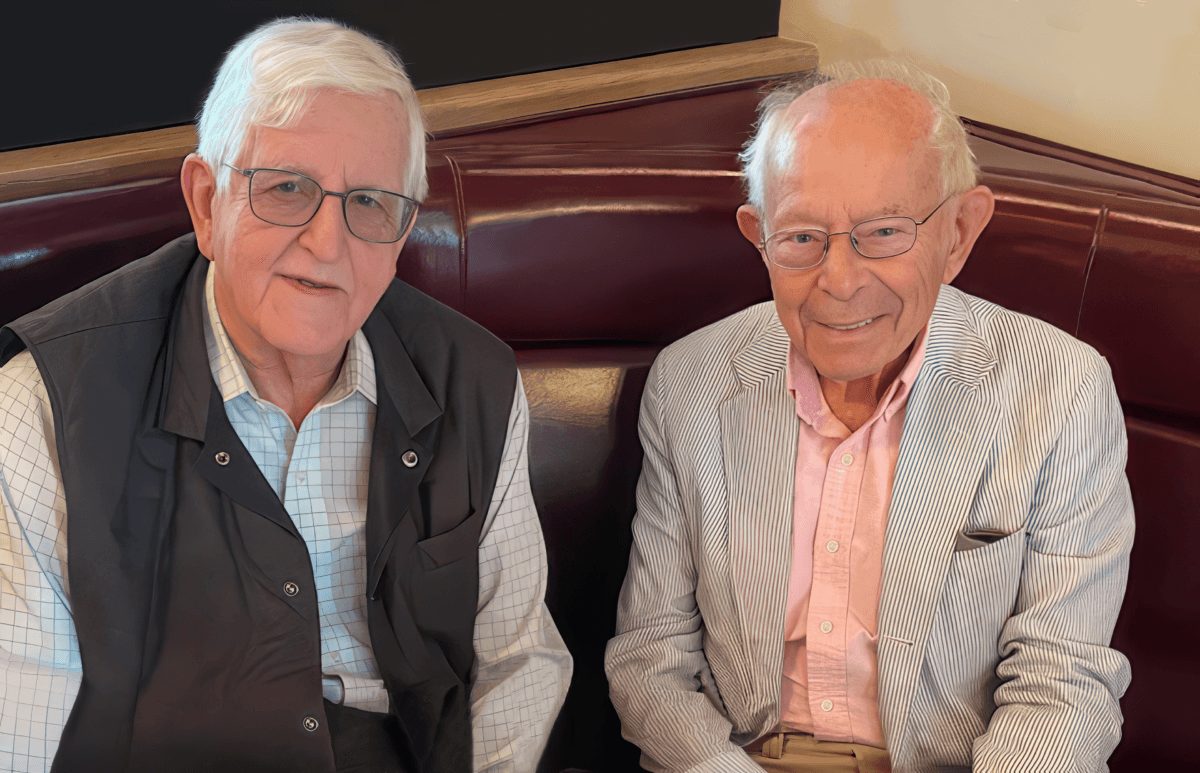
Joseph B. Martin (left) and his mentor Seymour Reichlin (right) photographed during their annual meeting at Il Capriccio restaurant in Waltham, Massachusetts, in the fall of 2024. They joyfully celebrated Reichlin’s 100th birthday and their 58 years of friendship. (Photo credit: Joseph B. Martin)
Dr. Seymour Reichlin, a world-renowned neuroendocrinologist, is celebrated in a touching editorial by his mentee.
At age 100, Dr. Seymour Reichlin is still making groundbreaking discoveries about how the brain and hormones work together to influence memory and our senses. In a touching editorial published in Brain Medicine, Dr. Joseph B. Martin, former Dean of Harvard Medical School, celebrates this remarkable milestone of his longtime mentor, painting a portrait of a scientist whose curiosity about how the human body works remains as vibrant today as it was when their paths first crossed 58 years ago.
The editorial offers an intimate window into their decades-long relationship and chronicles Reichlin’s extraordinary contributions to understanding how the brain orchestrates the body’s hormone systems, a field known as neuroendocrinology.
Early Connections and Training
Martin first encountered Reichlin’s work through a groundbreaking three-part review published in the New England Journal of Medicine in 1963. (Part 1 | Part 2 | Part 3) His interest in joining Reichlin’s laboratory was sparked by treating four patients with a condition that prevented them from maintaining stable blood pressure when standing up. This experience led Martin to wonder about how the brain regulates the body’s automatic functions through hormones – chemical messengers that travel through the bloodstream to control various bodily processes.
After completing medical school in Edmonton, Alberta, Canada, and his neurological residency at Case Western University in Cleveland, Martin joined Reichlin’s laboratory as a fellow at the University of Rochester in July 1967. Reichlin had emerged as a leader in understanding brain-hormone interactions after returning from two years in Geoffrey Harris’s laboratory at the Maudsley Hospital, University College, London, in 1954.
“Seymour was the quintessential physician-scientist,” Martin writes, “equally at home treating patients and conducting clinical trials as he was in the laboratory.”
Known affectionately as “Si,” Reichlin possessed an encyclopedic knowledge spanning internal medicine, neurology, and psychiatry. Martin paints a vivid picture of Reichlin’s intellectual dynamism.
“Si arrived almost every day with a new idea about the following experiments before I had finished the last. His research often was left partly done as he moved on to bigger ideas.” This constant flow of creativity left “many laboratory manuals of unpublished research as better ones supplanted older ideas.”
Decades Of Groundbreaking Research
The mentor-mentee relationship began during an exciting era in brain research. Martin’s doctoral work focused on understanding how the brain controls the thyroid gland, which regulates metabolism throughout the body. Using newly available techniques that could measure tiny amounts of hormones in the blood, he showed that stimulating specific areas of the brain with electrical currents could trigger the release of thyroid-stimulating hormones. This helped prove that the brain directly controls hormone production through specific pathways – a concept that would later be confirmed when other scientists discovered the specific hormones involved.
A significant breakthrough came in 1973 when Martin recruited Paul Brazeau, a researcher who had just discovered a new hormone called somatostatin, which controls growth and development by regulating growth hormone. This discovery opened new avenues for understanding how the brain controls body growth and metabolism.
Martin’s career trajectory was significantly influenced by Reichlin’s guidance. In 1978, Martin was recruited to Harvard Medical School as chief of neurology at Massachusetts General Hospital (MGH), a move facilitated by Reichlin’s recommendation. At MGH, Martin collaborated with neurosurgeon Dr. Nicholas Zervas and Dr. John Potts, Chair of the Department of Medicine, to establish a specialized clinic that became a leading center for treating disorders involving the delicate interaction between the brain and hormone systems.
Dr. Reichlin’s Power Of Scientific Diplomacy
One of Reichlin’s most remarkable qualities was his ability to maintain productive relationships with competing scientists. Martin describes watching “with amazement as the enmity between the scientists Roger Guillemin and Andrew Schally, each at different institutions, escalated as they tried to outdo each other in identifying the chemical signals that the brain uses to control hormone production.” These discoveries were so important that Guillemin and Schally would eventually share the 1977 Nobel Prize. Through it all, Martin notes that “Si got on with both, and they greeted him (separately) with great affection at annual endocrine meetings.”
The collaboration between Martin and Reichlin produced several influential publications that helped establish brain-hormone interactions as a crucial field of medicine. Their crowning achievement was their 1987 textbook “Clinical Neuroendocrinology,” which took five years to complete. This comprehensive 750-page volume explained how disruptions in the brain’s control of hormones could lead to various diseases, and how doctors could diagnose and treat these conditions.
Continuing Curiosity
After moving to Tucson, Arizona, with his dear wife Eleanor (Ellie), Reichlin spent thirty years exploring new frontiers in medicine. He became particularly interested in how stress affects hormone levels and the immune system, and what he called “emotional homeostasis” – the body’s ability to maintain emotional balance through hormonal changes. His work expanded into studying how various drugs, including psychedelics, might influence these delicate brain-hormone relationships.
Today, at 100 years old, Reichlin continues to engage with cutting-edge research. During their fall 2024 meeting, three months after their June celebration of his 100th birthday with friends and former fellows in Boston, they discussed fascinating new discoveries about how certain hormones, when administered in carefully timed pulses, can improve the sense of smell and enhance memory. This research has shown particular promise for people with Down’s syndrome.
A Lasting Bond
A photograph in the editorial captures the two scientists at their fall 2024 meeting at Il Capriccio restaurant in Waltham, Massachusetts, showing both men smiling warmly – a testament to a friendship and intellectual partnership spanning nearly six decades. While Reichlin still drives, for their most recent meeting, he allowed Martin the privilege of picking him up at the Embassy Suites hotel for their traditional dinner together.
“Si remains my greatest hero,” Martin concludes, “one of three or four individuals whose influence on my career trajectory and accomplishments is immeasurable and who evokes wonderfully fond memories and my deepest appreciation.”
Reichlin’s century of life spans the entire history of our modern understanding of how the brain controls hormones. From early experiments proving that the brain directs hormone production to today’s sophisticated understanding of how hormones influence thinking and behavior, his work has helped establish an entirely new field of medicine. His continuing engagement with science at age 100 stands as an inspiration to researchers everywhere, while his mentorship of leaders like Martin demonstrates how a single exceptional teacher can shape entire fields of medicine through succeeding generations.
You can read the full editorial here.


