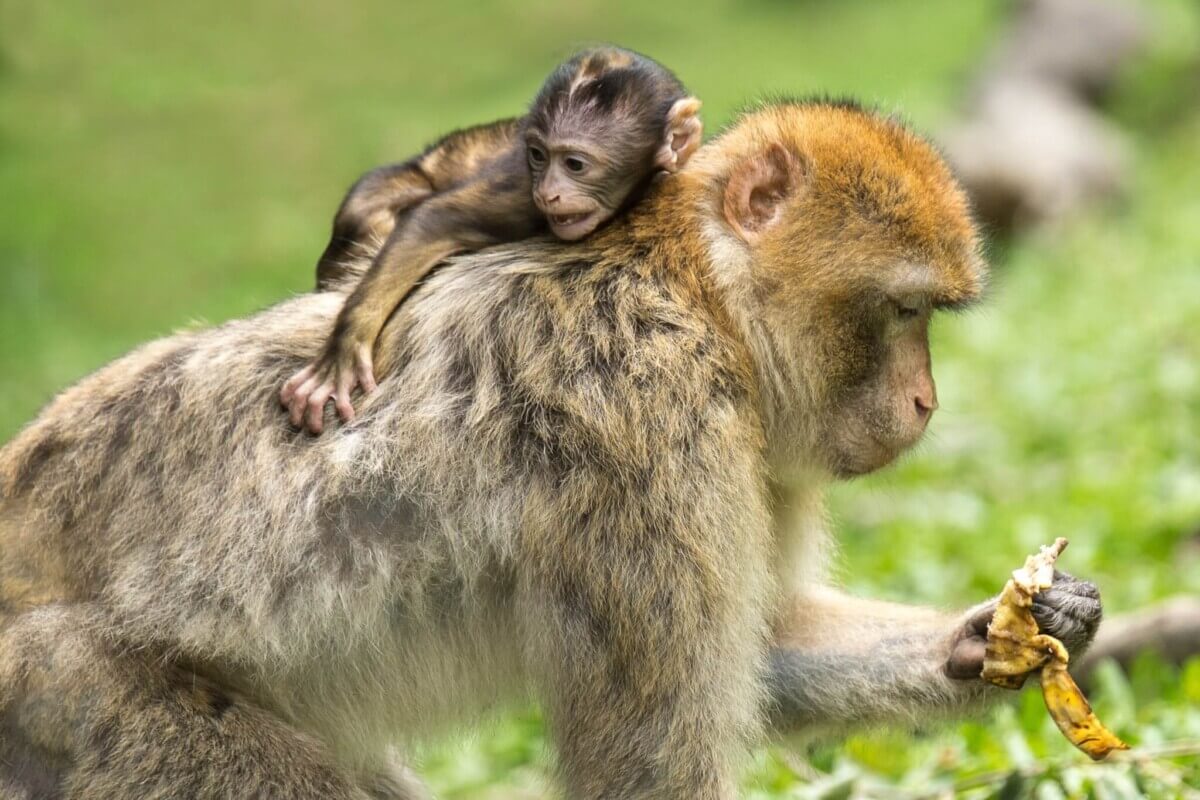
A barbary macaque carries its baby. (pexels.com)
LINCOLN, England — You shouldn’t judge a book by it’s cover, or a monkey, according to a new study. Researchers from Lincoln University asked a group of participants to rate how willing they would be to approach various monkeys, and their answers were actually quite different than what actually happened in a real setting.
Participants first said they would be more willing to interact with subordinate or cuter monkeys shown to them, but ended up getting closer to more dominant monkeys that were initially more intimidating.
First, the study subjects were shown pictures of Barbary macaques, a type of monkey known for interacting with tourists quite frequently in Gibraltar and North Africa. Each person was asked to grade the monkeys’ faces based on indications of trustworthiness, dominance, sociability, and cuteness, as well as whether or not they would be willing to approach each monkey in a real-life situation.
Judging solely off of the pictures, participants overwhelmingly said they would be more willing to hang out with (walk towards, feed, take pictures) the monkeys that appeared cuter, more feminine, younger, subordinate, etc. These results, according to the research team, suggest that on a subconscious level the participants perceived these traits to be safer.
Monkeys that appeared more dominant, on the other hand, were considered much more potentially dangerous by participants.
However, once the participants were actually given the opportunity to interact with these monkeys, it was the dominant primates that ended up making a better connection. In short, the subjects became closer with the monkeys they originally wanted to avoid.
“Despite forming these first impressions based on faces, in reality the interactions we observe don’t follow what people say. When people feed wildlife they are more likely to end up close to dominant animals; the ones people claimed to be less willing to approach due to being perceived as less safe,” comments Dr. Laëtitia Maréchal, Senior Lecturer in Psychology at the University of Lincoln, in a release.
“It is important to study wildlife interactions to improve the safety and welfare of both humans and the animals involved. This is an important step towards understanding how to better communicate with other species. This has great positive implications for human safety and animal welfare,” she adds.
The recorded human and macaque interactions took place at a popular tourist destination in Morocco.
The study is published in Scientific Reports.


