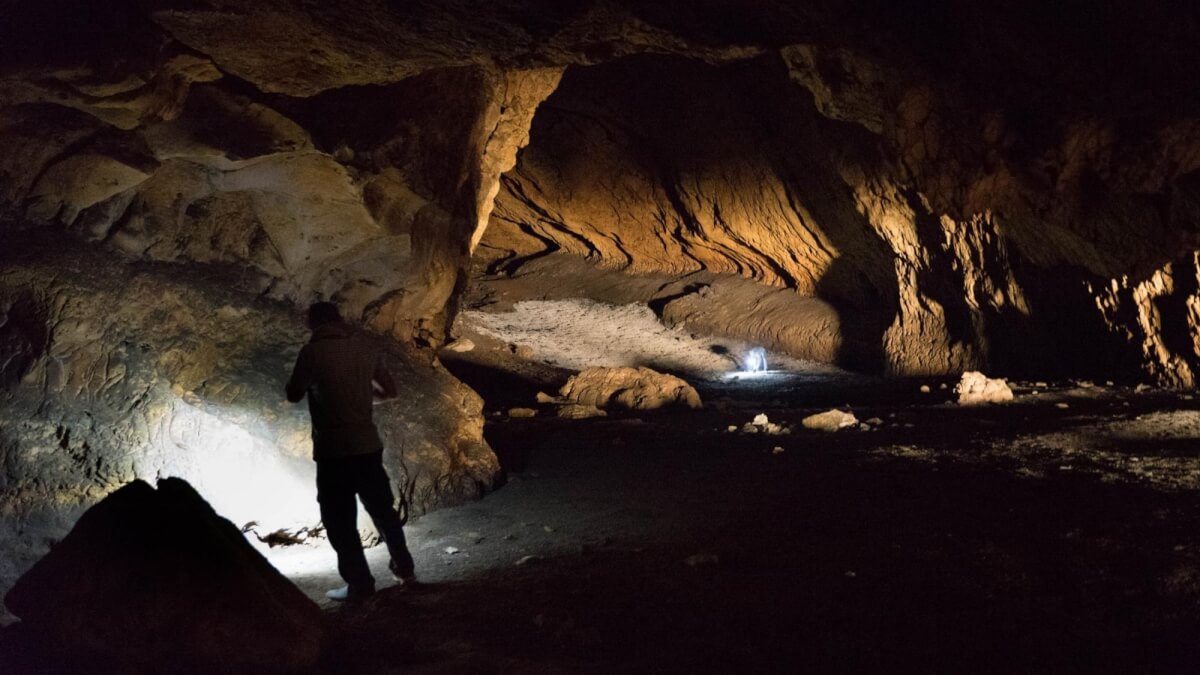
Pebdeh Cave located in the southern Zagros Mountains. Pebdeh was occupied by hunter-gatherers as early as 42,000 years ago. (CREDIT: Mohammad Javad Shoaee)
BRISBANE, Australia — Modern adults often view moving as a highly stressful endeavor, but we all have it easy compared to our ancestors tens of thousands of years ago. A fascinating new study that combined genetic, palaeoecological, and archeological evidence has revealed the Persian Plateau was a hub for Homo sapiens (humans) during our earliest stages of migration out of Africa.
Spanning about 1,200 miles, the Persian Plateau stretches across numerous Middle Eastern countries including present-day Iran, Iraq, and Afghanistan.
This new revelation provides some much-needed clarification regarding the complex journey of ancient human populations, and also serves to challenge previous long-held beliefs pertaining to our species’ expansion into Eurasia. The study focuses on a crucial yet largely mysterious period in human history; roughly 70,000 to 45,000 years ago. Back then, human populations did not uniformly spread across Eurasia, leaving modern historians and scientists in the dark regarding humanity’s whereabouts during this time frame.
This latest work offers four key findings:
- The Persian plateau was a hub for early human settlement: Using a novel genetic approach in combination with palaeoecological modeling, researchers successfully showed the Persian Plateau was the region population waves that settled all over Eurasia originated from.
- This region emerged as a suitable habitat capable of supporting a larger population in comparison to other areas in West Asia.
- Genetic resemblance in ancient and modern populations: The genetic component identified in populations from the Persian Plateau underscores its long-lasting differentiation in the area, compatible with the hub nature of the region, and ancestral to the genetic components already known to have inhabited the Plateau.
- Researchers identified this genetic signature thanks to a new approach capable of disentangling 40,000 years of admixture and other confounding events. This genetic connection highlights the Plateau’s significance as a pivotal location for early human settlement and subsequent migrations.
“Our multidisciplinary study provides a more coherent view of the ancient past, offering insights into the critical period between the Out of Africa expansion and the differentiation of Eurasian populations,” Professor Petraglia says in a media release. “The Persian Plateau emerges as a key region, underlining the need for further archaeological explorations.”
“The discovery elucidates a 20,000 year long portion of the history of Homo sapiens outside of Africa, a timeframe during which we interacted with Neanderthal populations, and sheds light on the relationships between various Eurasian populations, providing crucial clues for understanding the demographic history of our species across Europe, East Asia, and Oceania,” explains first study author Leonardo Vallini of the University of Padova, Italy.
“The revelation of the Persian Plateau as a hub for early human migration opens new doors for archaeological exploration, enriching our understanding of our species’ journey across continents and highlighting this region’s pivotal role in shaping human history,” concludes senior study author professor Luca Pagani.
The study is published in the journal Nature Communications.


