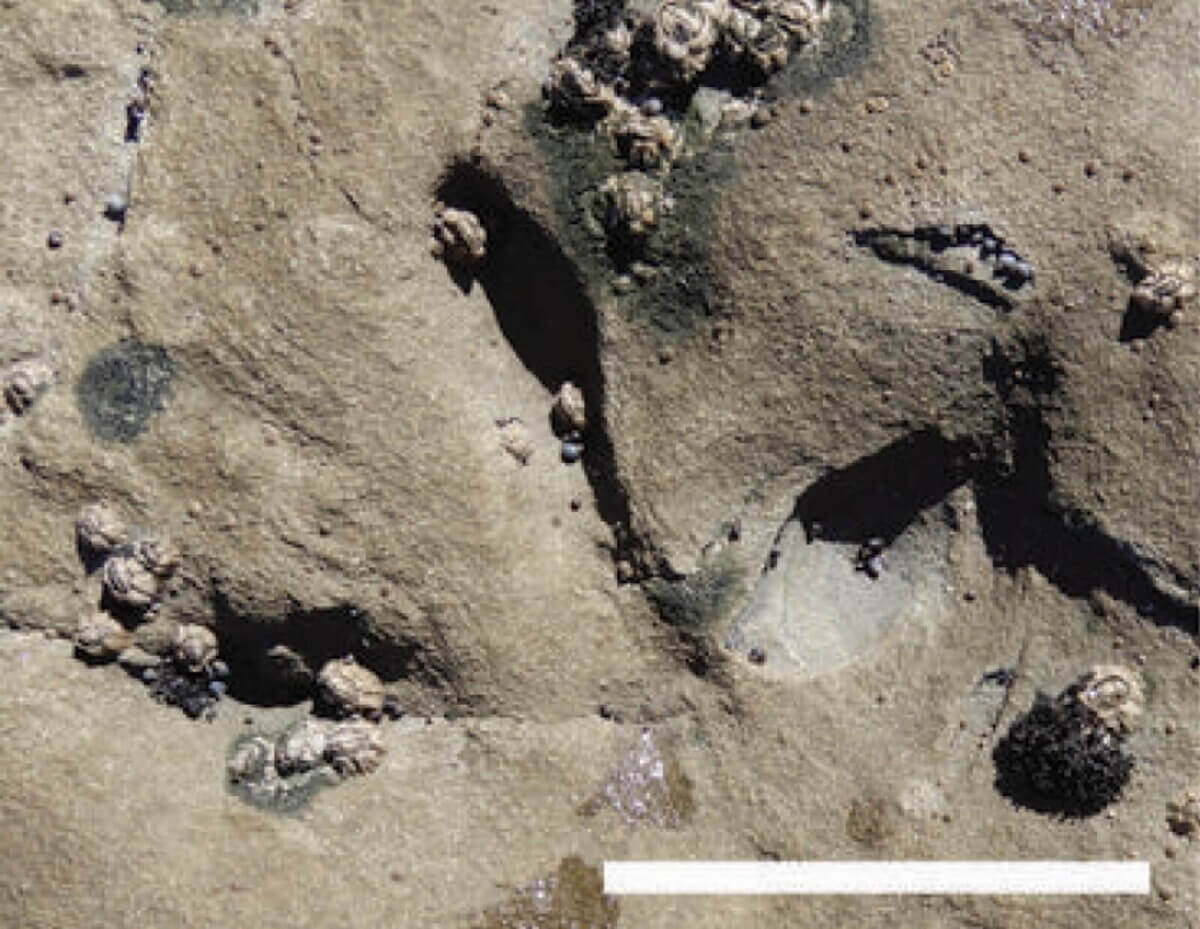
Wonthaggi bird tracks affected by modern erosion and marine organisms at Footprint Flats locality. Scale = 5 cm in all parts. CREDIT: Martin et al., 2023, PLOS ONE, CC-BY 4.0 (https://creativecommons.org/licenses/by/4.0/)
ATLANTA, Ga. — Ancient footprints discovered in Australia, dating back over 100 million years, represent the earliest known evidence of birds in the Southern Hemisphere. A new study by Emory University in the United States reveals that early birds reached southern polar regions 120 million years ago.
Cretaceous bird fossils are plentiful in Northern continents, yet exceedingly rare in the South. Until now, paleontologists have faced challenges in understanding the distribution of early birds, owing to this scarcity of evidence.
The discovery of 27 individual footprints with bird-like features in Victoria, Australia may aid in overcoming this challenge. The diverse sizes and shapes of these tracks suggest the existence of various bird species, including some of the largest known from the Cretaceous Period.
These imprints imply that the birds might have visited the area seasonally, possibly as part of a migratory path.
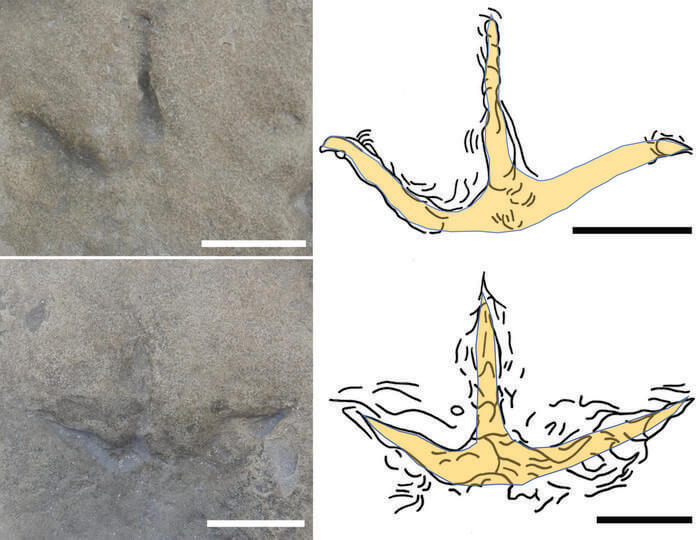
Apart from a single bone and a few feathers, these tracks constitute the oldest known evidence of birds in Australia or any part of ancient Gondwana, and the oldest evidence of birds in ancient polar environments. This discovery could indicate that early birds were more prevalent in southern regions than previously believed.
“We are very excited to document that a variety of birds were living in polar Australia during the Early Cretaceous Period. But we also hope our trace fossil discovery inspires other researchers to look for and find more Early Cretaceous bird tracks elsewhere in the Southern Hemisphere,” the study authors write in a media release.
The findings are published in the journal PLoS ONE.
You might also be interested in:
- Fossil reveals why some prehistoric birds lived, while others died
- Ancient footprints discovered in Greece may be at least 6 million years-old
- The southern hemisphere is drying out — here’s how that affects the whole planet
South West News Service writer Isobel Williams contributed to this report.


