
Scientists believe hair samples could potentially help yield earlier ALS diagnoses. (Photo by Tonhom1009 on Shutterstock)
In A Nutshell
- A new eBioMedicine study shows that hair strands can reveal disrupted patterns in how the body processes metals, offering a possible new tool for ALS research.
- Men with ALS showed reduced copper-related synchrony, especially copper-zinc, while women showed chromium-nickel disruptions on unadjusted tests.
- Copper network “connectedness” was significantly lower in men and lower on unadjusted tests in women, highlighting copper’s role in ALS.
- Researchers stress this is early-stage research, not a diagnostic test — more studies are needed before hair analysis could be used in clinics.
NEW YORK — Scientists say a single strand of hair may carry hidden clues about amyotrophic lateral sclerosis (ALS), the devastating neurological disease that affects roughly 30,000 Americans. By examining how the body processes metals like copper and zinc over time, researchers found clear differences between people with ALS and healthy individuals — differences that might one day speed up diagnosis.
The findings, published in eBioMedicine, suggest hair analysis could complement existing methods and shorten the lengthy diagnostic process, which currently takes 10 to 16 months on average after symptoms first appear. During this waiting period, motor neurons continue deteriorating while patients and families search for answers.
How Hair Reveals ALS Clues
Hair acts like a biological timeline, recording what happens inside the body as it grows and develops. Each strand stores traces of metals and other elements that have been absorbed and processed over time, providing scientists with a moving picture of how the body maintains (or fails to maintain) balance.
In this study, researchers used advanced laser technology to measure 17 different elements along individual hair strands. They analyzed samples from 391 people — 295 with ALS and 96 without the disease. The laser technique produced highly detailed data, capturing between 400 and 800 measurements from each 1.5-inch hair sample. This meant researchers could track changes at two- to four-hour intervals, essentially building a chemical diary of each person’s recent history.
Scientists found that people with ALS exhibited disrupted patterns in how their bodies managed essential metals, particularly copper. Instead of examining single elements in isolation, the scientists investigated how metals interacted with one another over time. It was these coordination patterns, or the breakdown of them, that distinguished ALS patients from healthy individuals.
“We demonstrate that ALS-positive cases have significantly higher odds of collapse in the synchronisation of elemental biodynamics and worse connectedness in copper-based networks compared to ALS-negative controls,” the researchers wrote.
Why Copper Matters in ALS
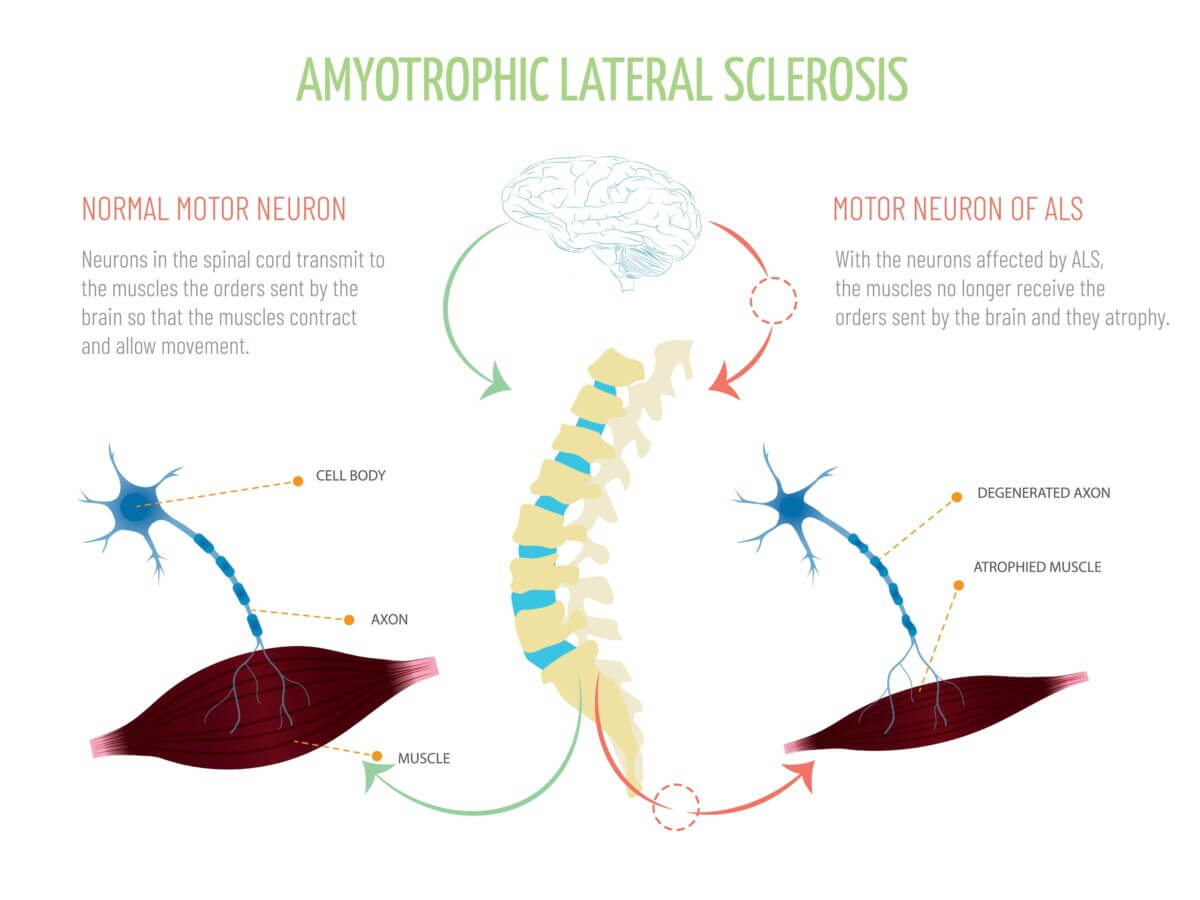
Copper plays an essential role in brain health because it powers an enzyme called SOD1, which helps protect nerve cells from damage. When this protective system fails, motor neurons (the nerve cells responsible for muscle movement) begin to die. This leads to the muscle weakness and paralysis that define ALS.
Earlier research has found abnormal copper levels in the spinal cords of ALS patients, as well as in animal models of the disease. But this new study goes further by showing that the problem isn’t just the amount of copper in the body; rather, it’s also how copper interacts with other metals over time. Think of it less like a single broken cog and more like a disrupted rhythm in a larger machine.
In men, reduced copper-related synchrony, especially the copper-zinc pairing, stood out and remained significant after more rigorous checks. In women, chromium-nickel showed the strongest signal, though it did not hold up under stricter analysis. Overall, many of the disrupted patterns in men involved copper, not just the copper-zinc relationship.
From Lab Research to Possible Diagnosis
Hair testing has several potential advantages over current diagnostic methods. Collecting a hair sample is painless, requires no special medical equipment, and can be done anywhere. Once collected, hair can be stored or shipped easily, making it accessible for communities without advanced neurology clinics.
Right now, ALS diagnosis depends on a combination of neurological exams, imaging, lab tests, and the gradual process of ruling out other conditions. This can take over a year — precious time when nerve cells are being lost. A reliable biomarker in hair, if validated, could help shorten these delays.
That said, the researchers caution that their work represents early-stage research. At this point, the findings reveal strong associations between disrupted elemental “biodynamics” and ALS; however, they do not provide a ready-to-use diagnostic test. The team emphasizes that more studies are needed, ideally with larger and more diverse groups of participants, before hair analysis could ever be introduced in a clinical setting.
The study itself involved participants from the Dartmouth Biobank in New Hampshire and the CDC National ALS Biorepository. Most were older adults and predominantly White, which limits how broadly the results can be applied. To protect against contamination, researchers carefully washed the hair and used laser pre-treatment to remove residues from shampoos, dyes, or environmental exposure.

What the Findings Could Mean
The research points to ALS as more than just a disease of dying motor neurons. It may also involve a breakdown in the body’s timing systems for handling essential metals. In this view, copper and zinc don’t just drift out of balance; their coordination becomes less reliable. Understanding this disruption could eventually open the door to treatments that restore balance across the system rather than focusing only on individual molecular pathways.
The approach may also be valuable beyond ALS. Other neurological diseases, including Parkinson’s and Alzheimer’s, have been linked to disruptions in metal processing. If hair analysis can reliably reveal these patterns, scientists could develop new tools for studying — and perhaps one day diagnosing — multiple conditions using nothing more invasive than a strand of hair.
For patients and families, there’s new hope for meaningful progress at a time when treatment options remain limited. While a clinical application is still years away, this research offers hope that faster, more accessible testing may eventually become part of the fight against ALS.
Paper Summary
Methodology
Researchers analyzed hair samples from 391 participants (295 with ALS, 96 without) collected from the Dartmouth Biobank and CDC National ALS Biorepository. They used laser ablation-inductively coupled plasma-mass spectrometry to measure 17 different elements along single hair strands, creating time-series data with 400-800 points per sample at approximately 2-4 hour resolution. The team employed two advanced analytical methods: cross-recurrence quantification analysis to measure synchronization between different elements, and transfer entropy-based network analysis to assess how elements influence each other over time. All analyses were conducted separately for men and women due to known differences in metal metabolism between sexes.
Results
The study found that people with ALS showed significantly disrupted patterns in elemental biodynamics compared to healthy controls. In men with ALS, copper-zinc synchronization was severely reduced, while women with ALS showed disrupted chromium-nickel interactions on unadjusted tests. Multiple measures of copper’s connectivity within the body’s elemental network were significantly lower in men after correction, and lower in women on unadjusted tests. Individual element analysis revealed that women with ALS had significantly lower tin levels, but most notable findings emerged from the temporal pattern analysis rather than simple concentration measurements.
Limitations
The study had an unbalanced sample with more ALS cases than controls, and participants were predominantly white and over 60 years old. The research lacked information about occupational exposures, socioeconomic factors, additional medical conditions in controls, and ALS subtypes. While multiple safeguards protected against contamination from hair products, some residual contamination risk remained. Results represent associations rather than predictive capabilities and would require additional validation before clinical application.
Funding and Disclosures
The research received funding from multiple US National Institutes of Health grants and CDC/ATSDR grants. Several authors have financial interests in Linus Biotechnology Inc., a company developing hair-based biomarkers, including founder/CEO Manish Arora who owns equity and is listed on patent applications for hair biomarkers of ALS. The study authors declared these potential conflicts of interest.
Publication Information
The paper, “Dysregulation of hair-strand-based elemental biodynamics in amyotrophic lateral sclerosis,” was published in eBioMedicine, Volume 119, September 2025. The research was conducted by teams from Mount Sinai’s Icahn School of Medicine, Linus Biotechnology Inc., Dartmouth Health, and Columbia University’s Mailman School of Public Health. The study was published as an open-access article under Creative Commons licensing.


