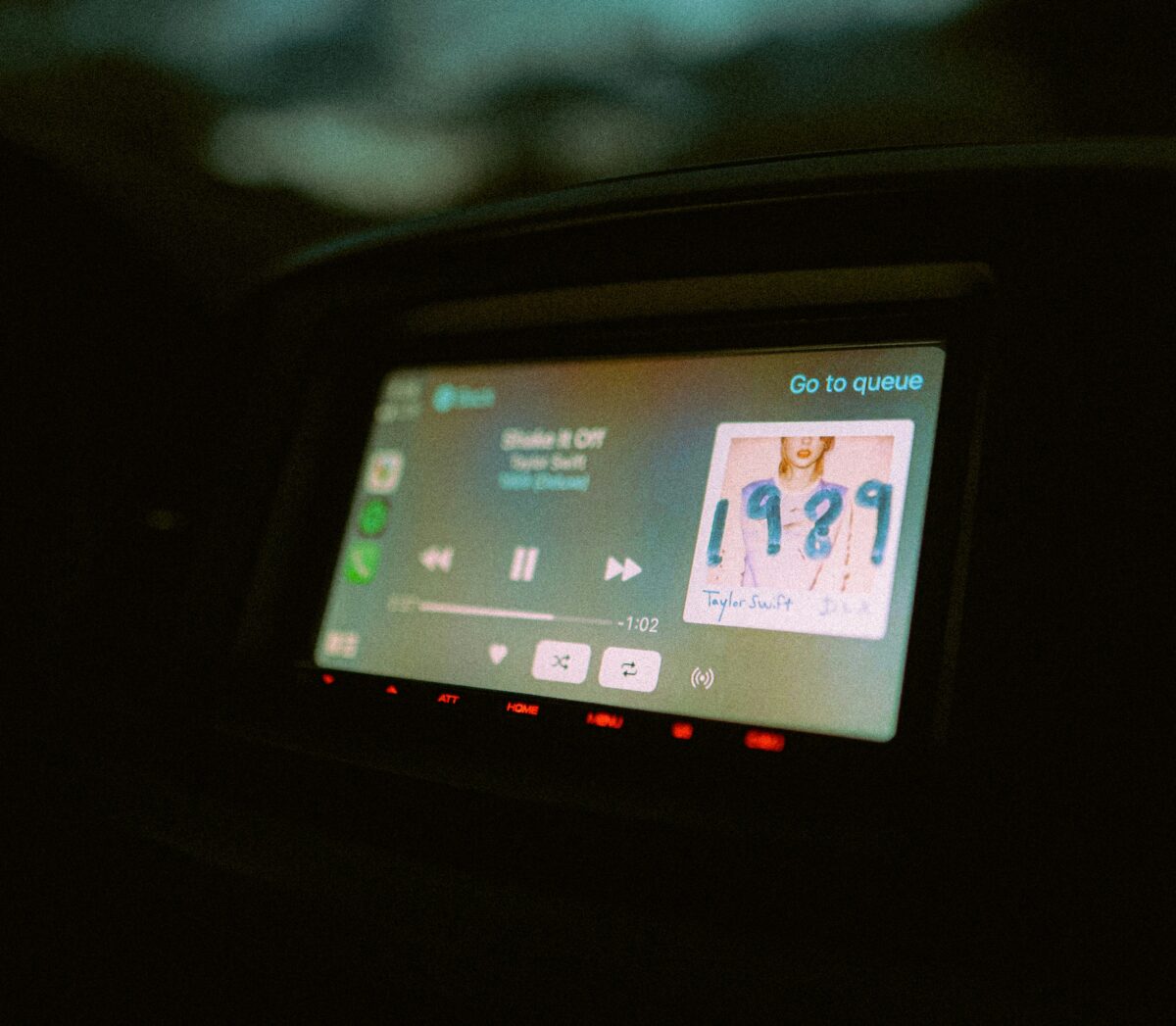
Photo by Leonie Zettl on Unsplash
Taylor Swift, Drake And Other Major Album Drops Were Tied To More Fatal Car Accidents
In A Nutshell
- Traffic deaths in the US rose by about 15% on days when major albums like Taylor Swift’s “Midnights” or Bad Bunny’s “Un Verano Sin Ti” dropped, according to a new study.
- Researchers tracked 233,809 traffic deaths from 2017 to 2022 and compared the 10 biggest album-release days to the days surrounding them.
- The spike hit younger drivers, male drivers, and solo drivers hardest, and was stronger on clear, dry days with sober drivers behind the wheel.
- Researchers say smartphone-driven distraction is the most likely explanation, though the study cannot prove any individual crash was caused by streaming.
Every few months, a major artist drops a new album, and millions of fans reach for their phones to stream it. That moment of excitement, it turns out, may come with a hidden cost. A new study in JAMA Network Open found that on days when the biggest music albums are released, US traffic deaths rise by roughly 15%. Researchers say smartphone-enabled distraction, including drivers interacting with streaming music, is the most plausible explanation, though the study cannot prove streaming while driving caused the deaths.
In the study, that 15% jump worked out to an estimated 18 extra deaths on the average album-release day. These weren’t days marked by unusual weather, holidays, or other risk factors. They were simply days when a popular album dropped and millions reached for their phones.
Texting and talking on the phone while driving have long been recognized as dangerous. This study adds evidence that smartphones now carry a newer, less regulated risk: streaming music and browsing song selections through in-car entertainment screens.
Album Drops Gave Scientists an Accidental Experiment
Studying distracted driving in the real world is notoriously difficult. Researchers can’t ethically distract drivers on public roads, and asking people whether they use phones while driving produces unreliable answers. So a team from Harvard Medical School built its study around a quirk of timing: album release dates are planned far in advance to maximize fan excitement, but have nothing to do with traffic conditions, making release timing essentially random for road safety. Comparing deaths on release days to the 10 days before and after let researchers isolate whether something unusual was happening on those specific days.
Using a federal registry of every fatal US car crash, the team identified the 10 albums whose release days generated the most single-day streams between 2017 and 2022, including Taylor Swift’s “Midnights,” Drake’s “Certified Lover Boy,” and Bad Bunny’s “Un Verano Sin Ti.” Daily Spotify totals confirmed streaming surged on those days. The team then compared those dates against the 233,809 traffic deaths recorded nationwide over that same six-year window.

Traffic Deaths Rose 15% as Streaming Jumped 43% on Release Days
On album release days, streaming volume climbed from about 86 million daily streams to about 123 million, a 43% increase. The adjusted number of traffic deaths rose from about 121 on surrounding days to about 139 on release days. Simulation tests using random dates instead of actual releases found an effect that large in as few as 14 out of 1,000 tries, making chance an unlikely explanation.
To rule out simpler explanations, researchers compared release-day Fridays against surrounding Fridays, since albums usually drop on Fridays when traffic already runs higher. Deaths were still elevated. They also checked whether release dates just happened to fall near holidays or heavy travel periods, testing each album’s calendar date in other years when nothing was released. No spike appeared there, pointing back to the album release itself as the common thread.
Young, Male, and Solo Drivers Saw the Biggest Spikes in Deaths
Not all drivers appeared equally affected. Drivers under 40 showed a larger spike than drivers 65 and older, and male drivers showed a bigger increase than female drivers, patterns that align with who streams music most: 87% of US residents aged 12 to 34 streamed music monthly, versus 52% of those 55 and older, per industry survey data cited in the study.
Crashes involving only the driver showed a stronger link to the spike than crashes with multiple people in the car. A passenger can handle the phone or adjust the music; solo drivers don’t have that option.
Perhaps most telling, the spike was more pronounced among sober drivers and during clear weather, not rain or low visibility, when drivers might naturally be more cautious. That points toward distraction over alcohol or poor road conditions as the likelier explanation. When roads feel safe, drivers may let their attention drift toward their phone.
Among vehicles made in 2016 or later, those with infotainment platforms showed a larger fatality increase on release days, cutting against the assumption that dashboard controls make phone use safer. The data instead suggest those screens may make it easier, and more tempting, to interact with streaming apps while driving.
US Traffic Deaths Keep Climbing as Distraction Goes Unregulated
Traffic deaths in the United States have been rising even as car safety technology has improved, a trend that sets the country apart from many developed nations. The National Highway Traffic Safety Administration reported that 8% of fatal crashes in 2022 were classified as distraction-affected, a figure that likely undercounts the problem given how hard distraction is to identify after the fact.
This study doesn’t prove any one driver was streaming music at the moment of a crash. It does show major album-release days, when streaming surged, were also linked to a measurable rise in traffic deaths. As the authors write, “further actions by smartphone and vehicle manufacturers, software developers, and policymakers to improve driver safety surrounding streaming media may be warranted to reduce traffic fatalities.”
An album drop is, for most people, a small moment of joy. For road-safety researchers, it raises a less celebratory question: what happens when millions of people turn their attention to new music at once, including behind the wheel?
Disclaimer: This article is based on findings from a peer-reviewed observational study and reflects the interpretations and conclusions of the study’s authors. It is intended for general informational purposes and should not be taken as definitive proof that streaming music causes traffic fatalities.
Paper Notes
Limitations
The study has several important limitations the authors acknowledge. Because the research relies on observational data rather than controlled experiments, it cannot definitively prove that music streaming caused the increase in deaths, only that the two are associated. It’s possible that other unmeasured factors connected to album release days contributed to the findings, though the researchers conducted multiple tests to rule out the most obvious alternative explanations. Additionally, the study only captured fatal crashes, not non-fatal injuries or near-misses, so the full scope of any distraction-related impact may be larger than reported. Streaming data came from a single platform, Spotify, though researchers used it to identify popular albums and confirm streaming surges rather than to measure all music listening. Finally, while subgroup analyses by age, sex, race, and vehicle type offer suggestive patterns, those analyses were exploratory and were not corrected for the possibility of false positives that arise when many comparisons are made at once.
Funding and Disclosures
No external funding source is identified in the paper for this study. Regarding conflicts of interest, Dr. Worsham reported receiving fees in the past 36 months from several organizations including Alosa Health, Analysis Group Inc., Arnold and Porter Kaye Scholer, FVC Health, NuvoAir Medical, Substack, Tell Health Inc., the New York Times, TIME USA LLC, and the Wall Street Journal, as well as income from book rights from Doubleday Books and speaking fees from the Harry Walker Agency, all unrelated to this work. Dr. Jena reported receiving personal fees from Analysis Group Inc., Doubleday Books, the Los Angeles Times, the New York Times, the Wall Street Journal, Freakonomics MD, and the Harry Walker Agency, and holds an unpaid board membership with the United Network for Organ Sharing. No other disclosures were reported.
Publication Details
Authors: Vishal R. Patel, MD, MPH; Christopher M. Worsham, MD, MPH; Michael Liu, MD, MPhil; Anupam B. Jena, MD, PhD. All authors are affiliated with the Department of Health Care Policy, Harvard Medical School, Boston, Massachusetts. Dr. Patel and Dr. Liu are also affiliated with Brigham and Women’s Hospital, Boston. Dr. Worsham and Dr. Jena are also affiliated with Massachusetts General Hospital, Boston. Dr. Jena is additionally affiliated with the National Bureau of Economic Research, Cambridge, Massachusetts. | Journal: JAMA Network Open Paper Title: Smartphones, Online Music Streaming, and Traffic Fatalities DOI: 10.1001/jamanetworkopen.2026.29282 Published: August 17, 2026


