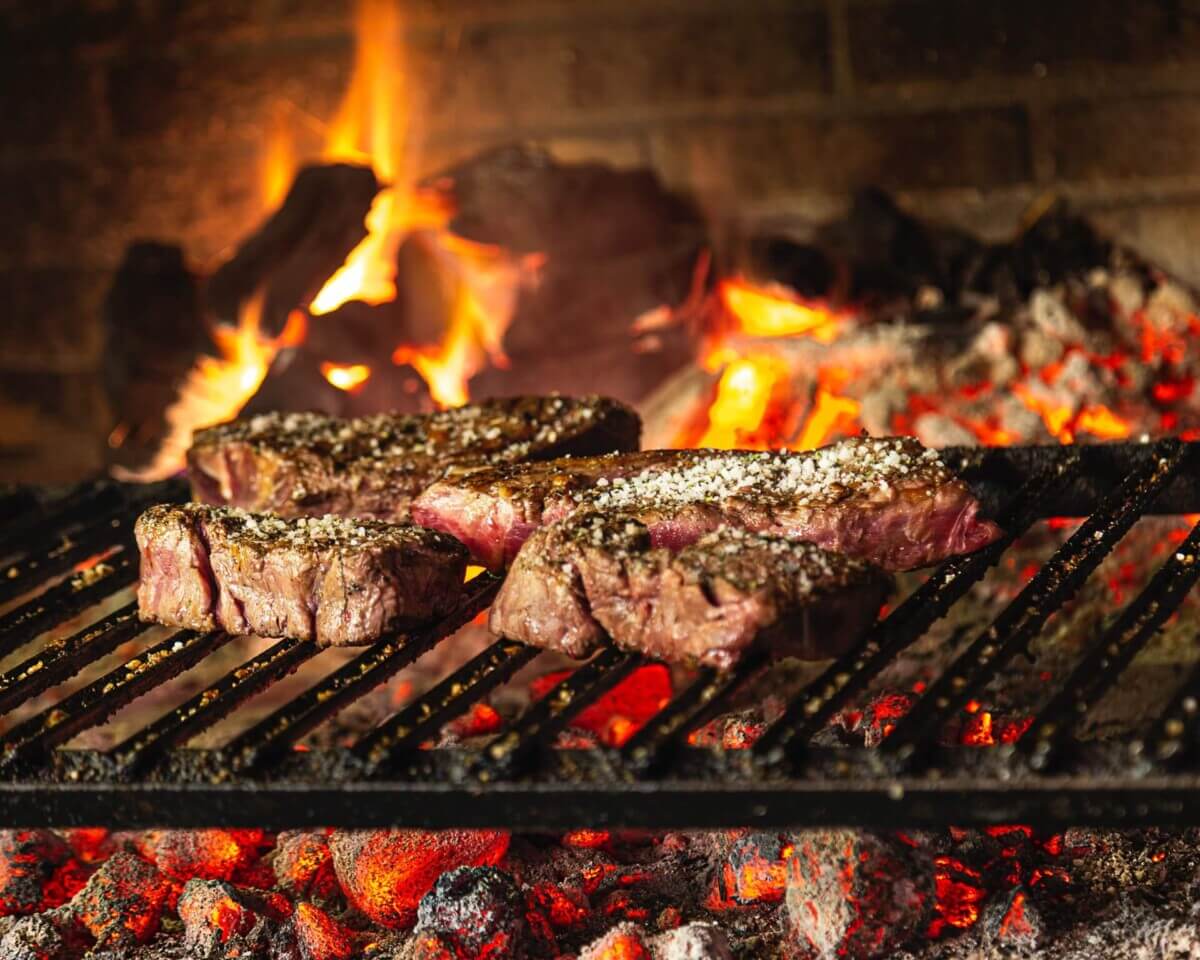
Steaks on a grill (Credit: Gonzalo Guzman from Pexels)
In A Nutshell
- Among older adults carrying the APOE ε4 gene variant, the predominant genetic risk factor for Alzheimer’s disease, those who ate the most meat had roughly 55 percent lower dementia risk and slower cognitive decline over 15 years compared with those who ate the least.
- In the lowest meat-consumption group, APOE ε4 carriers had roughly 2.5 times the dementia risk of noncarriers. In the highest meat-consumption group, that excess risk shrank to 1.17 times, a difference that was not statistically meaningful.
- The association with better cognitive outcomes in ε4 carriers held for unprocessed red meat and poultry. A higher proportion of processed meat in the diet was linked to modestly increased dementia risk across all participants, regardless of genetic group.
It’s a message that’s grown louder in recent years: eat less red meat. But is that really the best advice for all of us? Nutrition science has left little room for nuance. Now, however, a new study suggests meat may actually benefit certain individuals when it comes to cognition. The difference maker? Genes.
Research published in JAMA Network Open reports that among older adults carrying a specific gene variant called APOE ε4, the predominant genetic risk factor for Alzheimer’s disease, those who ate the most meat (roughly 870 grams per week on a 2,000-calorie diet, roughly two and a half times the Nordic dietary guideline target) had roughly 55 percent lower dementia risk compared with those who ate the least (about 250 grams per week). Their thinking skills also declined more slowly over 15 years.
For the majority of people who don’t carry this gene variant, meat consumption was not clearly linked to brain health one way or the other. About one in four people carries at least one copy of the APOE ε4 variant.
The finding raises the possibility that one-size-fits-all dietary advice may not be optimal for everyone, especially ε4 carriers, though confirmation in more diverse populations and, ideally, randomized trials would be needed before any guidelines change.
One detail worth pausing on is what happened at the top of the consumption scale. Among the highest meat consumers, the usual cognitive gap between people with the risk gene and people without it was not observed. Carriers of APOE ε4 normally face elevated Alzheimer’s risk, and the data reflected that at the low end of the scale: in the lowest meat-consumption group, ε4 carriers had roughly 2.5 times the dementia risk of noncarriers. But in the highest meat-consumption group, that excess risk was 1.17 times, which was not statistically different from noncarriers. Their cognitive performance also declined more slowly over 15 years.
How the Study Tracked Meat, Genes, and Dementia Risk Over 15 Years
Jakob Norgren, a researcher at the Karolinska Institutet in Stockholm, led the study alongside senior authors Erika Laukka and Sara Garcia-Ptacek. Their team drew on data from the Swedish National Study on Aging and Care–Kungsholmen, a long-running population study that recruited more than 2,100 adults aged 60 and older beginning in 2001. None had dementia at the start.
Participants completed detailed food questionnaires covering their diets over the past year, underwent cognitive testing at regular intervals scored across four domains (episodic memory, semantic memory, verbal fluency, and perceptual speed) and averaged into a single “global cognition” composite, and provided genetic information including their APOE status.
Over the 15-year follow-up, 296 participants developed dementia and 690 died without dementia. Roughly 26 percent of the group carried the APOE ε3/ε4 or ε4/ε4 genotypes, the variants linked to higher Alzheimer’s risk.
Researchers divided participants into five groups based on how much total meat they consumed relative to their calorie intake, from lowest to highest. They then tracked two outcomes: how quickly each person’s cognitive performance changed over time, and whether they eventually developed dementia. The analyses accounted for a long list of factors that could muddy the results, including age, sex, education, physical activity, smoking, alcohol, overall diet quality, chronic diseases, and total calorie intake.

Meat Consumption and Cognitive Decline: What the Data Found
Among carriers of the APOE ε4 variant, those in the highest meat-consumption group declined more slowly, and their cognitive trajectories looked similar to those of noncarriers. Episodic memory, the ability to recall specific events, words, or stories and the type of cognition most closely linked to Alzheimer’s pathology, showed the largest difference. When the team looked at dementia diagnoses, the pattern held: carriers who ate the most meat had about half the dementia risk of carriers who ate the least.
For the roughly three-quarters of participants without the risk gene, these associations were not observed. Meat intake, high or low, was not clearly linked to their cognitive trajectory or dementia risk. The statistical test for interaction indicating that APOE modified the relationship between meat and cognitive decline was significant (P = .004), but the corresponding test for dementia did not reach the conventional threshold (P = .10). In practical terms, the study’s evidence is stronger for ε4 carriers’ cognitive trajectories differing by meat intake than for their dementia incidence, so readers should treat the dementia subgroup finding as suggestive rather than settled.
Not all meat was equal, and two separate patterns emerged. The APOE-specific association with better cognitive trajectories held for total meat and, when individual meat types were analyzed separately using energy-adjusted intake, for unprocessed red meat and for poultry as well. Independently, when researchers examined the ratio of processed meat to total meat, a higher proportion of processed meat was linked to modestly increased dementia risk in the full sample, with no statistical difference between genetic groups. Across the board, the pattern was more favorable when the meat people ate was less processed, though the study did not directly test whether swapping processed for fresh meat would change outcomes.
Why APOE ε4 Carriers May Be Wired for Higher Meat Intake
Norgren’s team had predicted this finding before accessing the data, based on an evolutionary hypothesis about human diet. APOE ε4 is actually the oldest version of the gene, emerging roughly one to six million years ago during a period that may have coincided with early human ancestors eating large amounts of meat. APOE ε3, the most common variant today, appeared much later, around 200,000 years ago, as diets shifted back toward more plant-based foods.
One possible explanation is that people carrying the older ε4 variant may be metabolically tuned for higher meat intake, while ε3 carriers possess greater dietary flexibility. The idea is based on evolutionary theory, and the current findings are consistent with it. In an exploratory post hoc analysis, the team used the relationship between participants’ reported dietary B12 intake and their measured blood B12 levels as an indirect proxy for nutrient absorption.
Among ε4 carriers, this proxy suggested that higher meat consumption was associated with greater B12 absorption from the diet overall. Among people with the most common genotype (APOE ε3/ε3), absorption did not vary by meat consumption level, while APOE ε2 carriers showed the opposite pattern, with lower apparent absorption at higher meat intake. Because the analysis was indirect and exploratory, it suggests a possible mechanism rather than proving one.
Why Earlier Studies Missed the APOE-Meat Connection
Related evidence already existed in two of the world’s largest cohort studies, though it had not been emphasized. In the UK Biobank, with nearly half a million participants, unprocessed red meat was inversely associated with dementia among APOE ε4 carriers but showed no link in noncarriers.
A similar pattern appeared in supplementary analyses from the Nurses’ Health Study and Health Professionals Follow-up Study in the United States, covering more than 133,000 people. In both cases, the APOE interaction wasn’t the primary research focus and went largely unremarked upon.
Norgren’s study is the first to report interactions between meat consumption and APOE status for cognitive outcomes in support of a prespecified hypothesis. Additional post hoc analyses found that higher unprocessed meat consumption was also associated with lower risk of death from any cause, but again, only among ε4 carriers.
What The Research Can and Can’t Tell Us
The study population was predominantly Northern European, and the researchers acknowledge this limits how broadly the results can be applied to other ethnic groups, where APOE ε4 confers different levels of Alzheimer’s risk. Diet was self-reported through food questionnaires, which always introduces some measurement error, though the team argues this is unlikely to have specifically biased the gene-diet interaction. And because this is an observational study, it cannot prove that eating more meat directly caused the cognitive benefits, only that the two went hand in hand. Survival bias is also possible: the older adults who enrolled may have been unusually resilient.
Still, across this cohort, higher meat intake was linked to slower cognitive decline in ε4 carriers, while a higher processed-meat share was linked to higher dementia risk regardless of genotype. These patterns were similar to signals seen in the UK Biobank and the Nurses’ Health Study that previously went unremarked upon.

The Case for Personalized Dietary Guidelines Based on Genetics
Dietary guidelines today make no distinction based on APOE status. Everyone gets the same recommendation to limit red meat. For three out of four people, this study found no indication that meat consumption matters much for cognitive health in the absence of the ε4 variant. But for the quarter of the population carrying it, a blanket recommendation to cut back on meat could, if these observational findings hold up in randomized trials and more diverse populations, amount to removing a food that their biology handles differently.
A single observational study, even one published in a top medical journal, cannot prove that eating more meat directly protects cognition in this group. Unmeasured factors could still explain the pattern. But the finding is worth taking seriously in a field that has long issued uniform dietary advice while largely ignoring genetic variation.
The open question now is specific and testable: would a controlled trial assigning higher meat intake to older APOE ε4 carriers actually slow their cognitive decline, or would the association dissolve once confounders are stripped away?
Disclaimer: This article is based on an observational study and does not constitute medical or dietary advice. The findings have not been replicated in randomized controlled trials and apply specifically to populations of Northern European ancestry. Individuals should not change their diet based on this research alone. Anyone interested in genetic testing for APOE status or personalized dietary guidance should consult a qualified healthcare provider.
Paper Notes
Limitations
The study acknowledges several limitations. As an observational study, residual bias from unmeasured confounders cannot be ruled out. The authors note the potential for survival bias, as the cohort may include particularly resilient individuals. Generalizability is limited because the study population was ethnically homogeneous and predominantly of Northern European ancestry from urban Stockholm. Finally, self-reported dietary data is subject to potential measurement error, though the authors consider it unlikely to have biased the primary interaction findings.
Funding and Disclosures
Data collection was supported by the Swedish Ministry of Health and Social Affairs, participating local governments, and the Swedish Research Council (2021-00178), with additional support from numerous Swedish foundations. Dr. Eriksdotter reported receiving consulting fees from several pharmaceutical companies outside the submitted work; no other disclosures were reported. The funders had no role in the study design, data analysis, or publication decisions.
Publication Details
Norgren, Jakob, Adrián Carballo-Casla, Giulia Grande, Anne Börjesson-Hanson, Hong Xu, Maria Eriksdotter, Erika J. Laukka, and Sara Garcia-Ptacek. “Meat Consumption and Cognitive Health by APOE Genotype.” JAMA Network Open, published March 19, 2026. DOI: 10.1001/jamanetworkopen.2026.6489.
The study analyzed data from the Swedish National Study on Aging and Care–Kungsholmen (SNAC-K), including 2,157 adults aged 60 years and older recruited from 2001 to 2004 and followed for up to 15 years. All authors are primarily affiliated with the Karolinska Institutet and/or Stockholm University in Stockholm, Sweden.


