
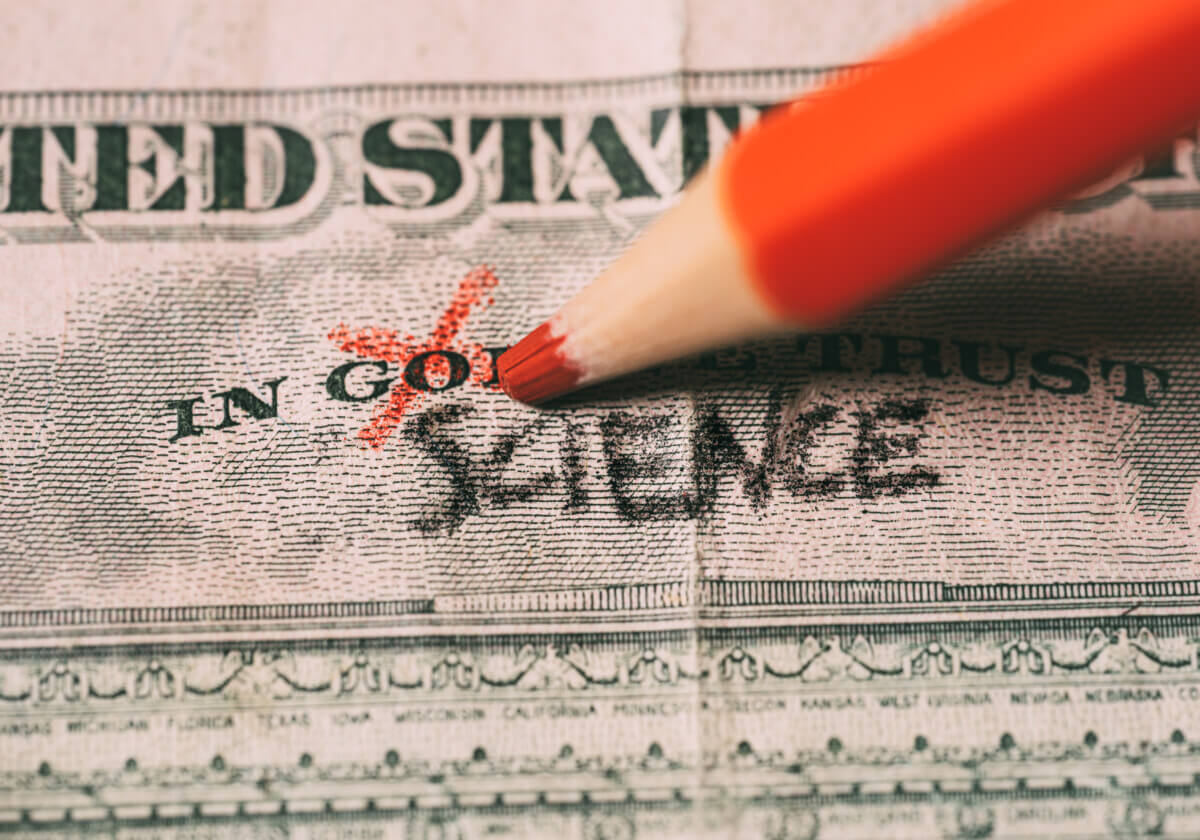
(Image by Jane0606 on Shutterstock)
In a nutshell
- Liberals consistently trust scientists more than conservatives across all 35 scientific fields studied, even in seemingly non-political areas like mathematics.
- Five different messaging strategies designed to increase conservatives’ trust in scientists all failed, suggesting the ideological divide reflects deeply rooted attitudes rather than simple misunderstandings.
- Building trust across political lines likely requires sustained dialogue and deeper engagement rather than quick messaging fixes—challenging but necessary for addressing issues requiring broad public support.
AMSTERDAM — Most Americans claim to respect science, but research shows a troubling trust gap exists—one with real consequences for public health and policy. A new study reveals that conservatives consistently trust scientists less than liberals do, and bridging this divide appears remarkably difficult.
Researchers from the University of Amsterdam found this ideological gap runs deeper than previously understood. Examining trust across 35 scientific fields, their study of 7,800 Americans discovered conservatives showed lower trust in scientists across virtually all domains compared to their liberal counterparts.
This difference matters in everyday life. During the COVID-19 pandemic, liberals were significantly more likely than conservatives to get vaccinated (86% versus 60%), which researchers link to higher death rates among Republicans after vaccines became widely available.
The research team notes in their paper: “The ideological gap between conservatives and liberals in trust in scientists is problematic because it breeds polarization and hinders the success of scientific solutions.” This becomes especially critical when coordinated action is needed for issues like climate change.
The Political Divide in Scientific Trust
The findings, published in Nature Human Behaviour, challenge conventional wisdom about conservative attitudes toward science. Previous theories suggested conservatives might trust certain types of scientists more—particularly those whose work aligns with conservative values or supports economic growth.
This study turns that idea on its head. From climatologists to mathematicians, virologists to zoologists, liberals showed higher trust across every field examined. While the difference was most pronounced for environmental scientists, conservatives showed less trust even in fields like mathematics with no obvious political implications.
Failed Intervention Strategies
The research team then tried five different approaches to increase conservatives’ trust:
- Framing scientific work using conservative values
- Highlighting economic benefits of scientific advances
- Featuring respected conservative figures who trust science
- Emphasizing that many conservatives trust scientists
- Pointing out that many conservatives work as scientists
None of these strategies worked. Not a single approach made any measurable difference in conservatives’ trust levels.
This contradicts the hopeful idea that simply reframing scientific information to match conservative values would build trust. Instead, the results point to deeper psychological factors at work.
What This Means Going Forward
For science communicators, these findings offer a reality check: building trust across political divides requires more than clever messaging. The researchers recommend more intensive, dialogue-based approaches that engage more deeply with people’s values and worldviews.
The study aligns with growing evidence showing that changing minds on politically charged topics is extraordinarily difficult. Previous attempts to frame messages about mask-wearing or environmental issues in terms of conservative values similarly failed to shift behavior.
Despite these differences, it’s worth noting that overall trust in scientists remained relatively high for both groups. The average trust rating was above the midpoint for both liberals and conservatives, suggesting most Americans still place some faith in scientific expertise.
For scientists and policymakers facing challenges that require broad public support, these results highlight the need for patience and deeper engagement. Building trust across political lines may demand sustained dialogue rather than quick messaging fixes—a challenging but necessary path forward in our polarized society.
Paper Summary
Methodology
This study involved 7,800 US participants with diverse backgrounds. Researchers first examined how political beliefs related to trust in 35 different scientific occupations using a 7-point trust scale. They then tested five different messaging strategies designed to increase conservatives’ trust in scientists. Conservative participants were randomly assigned to either a control group or one of five intervention conditions that framed scientists in ways theoretically aligned with conservative values.
Results
Liberals trusted scientists more than conservatives across all scientific fields studied. The gap was largest for climatologists and environmental scientists but existed even for seemingly non-political fields like mathematics. None of the five interventions succeeded in increasing conservatives’ trust in scientists. These findings suggest that political differences in trust represent deeply rooted attitudes resistant to simple messaging approaches.
Limitations
While the study included attention checks, researchers couldn’t verify how thoroughly participants engaged with the intervention texts. The study focused only on the United States, which has particularly high political polarization, so results might differ in other countries. Political ideology is just one of several factors influencing trust in scientists, with religiosity, education, and psychological distance from science also playing important roles.
Funding and Disclosures
The research was funded by the European Research Council (ERC) under the European Union’s Horizon 2020 research and innovation program (grant agreement number 849125) awarded to B.T. Rutjens. The funders had no role in study design, data collection and analysis, decision to publish, or preparation of the manuscript. The authors declared no competing interests.
Publication Information
“Political ideology and trust in scientists in the USA” was authored by Vukašin Gligorić, Gerben A. van Kleef, and Bastiaan T. Rutjens from the University of Amsterdam. Published in Nature Human Behaviour on April 15, 2025 (DOI: https://doi.org/10.1038/s41562-025-02147-z).


