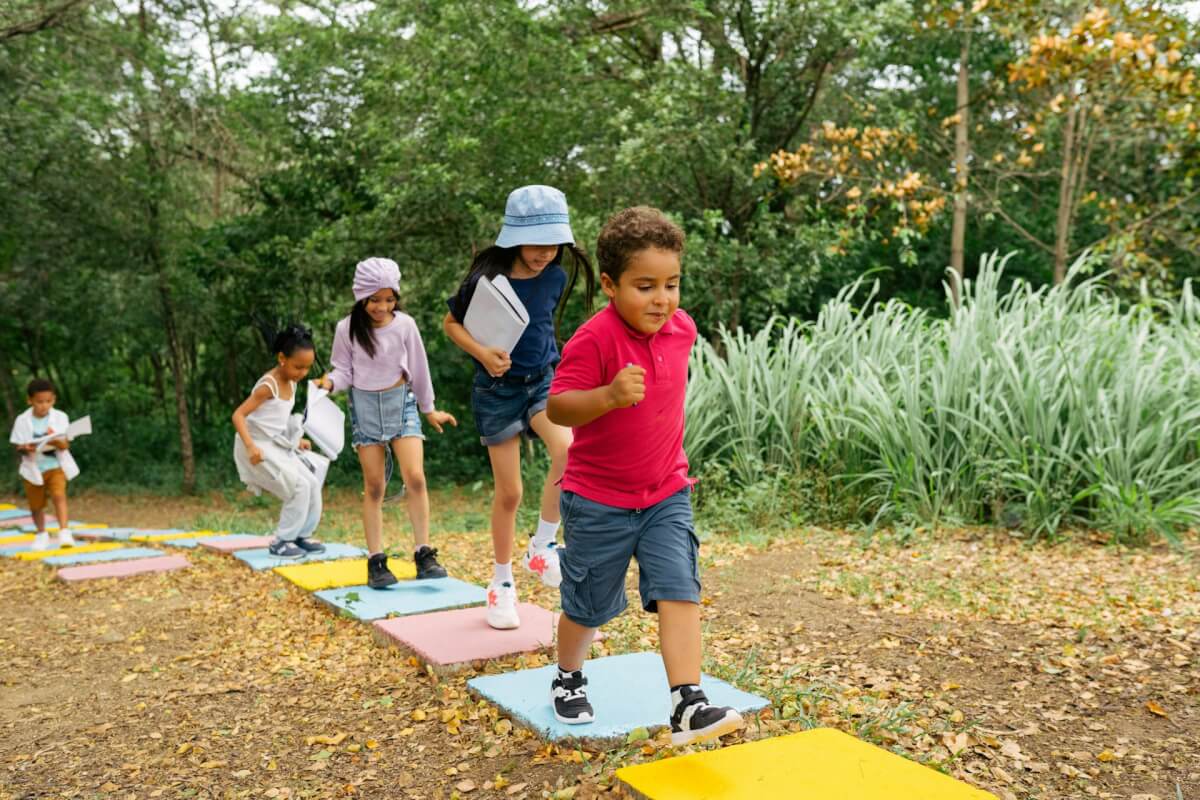
(Photo by Unsplash+ in collaboration with Andy Quezada)
In A Nutshell
- A Danish study surveyed 504 children ages 5 to 11 about their own memories of good and bad play, using survey statements drawn directly from kids’ own words.
- Seven core qualities emerged as the strongest markers of whether play felt good or bad, including a positive “play feeling,” social belonging, imagination, and having something meaningful to do.
- Mischief and rule-bending turned out to be neither clearly good nor bad (some kids loved it, others didn’t) and children sometimes excluded peers deliberately to protect a play dynamic they valued.
- Researchers developed the Play Qualities Inventory (PQI), a new self-report tool for children that may help educators evaluate whether play environments actually work for kids.
For decades, researchers and educators have been evaluating children’s play using tools built largely by adults. Checklists, observation guides, developmental scales, just to name a few example. All of those are rooted in adult theories about what play should look like and what it should produce. A new study from Denmark asked a different question. What if we just asked the kids?
When researchers surveyed more than 500 primary school children about their own memories of good and bad play, the results did not line up with the frameworks adults had been using. Kids described play in terms of how it felt, who was included, and whether there was room to be a little silly or rule-bending. Developmental milestones barely came up. Published in the journal Frontiers in Psychology, the research makes a pointed case that children are the most qualified authorities on what makes their own play work.
How Children’s Play Research Has Left Kids Out
Before a single survey went out, the research team sat down with 104 first- and second-grade students and asked them to recall a recent good or bad play experience. Those conversations generated a bank of phrases in the children’s own words, which researchers kept largely intact and used to build the survey itself.
A larger group of 504 children, ages 5 to 11, drawn from four suburban Danish schools representing different socioeconomic backgrounds, then reviewed those same statements on iPads while thinking about their own good or bad play memory. Adults read the items aloud; children responded on a five-point agree-disagree scale. Roughly half recalled a good memory, the other half a bad one. Researchers then ran a statistical method called principal component analysis, which groups related patterns to surface broader themes.
Two layers of findings came out. A detailed pass identified 22 distinct qualities of play, from “fantasy and creation” to “premise misalignment,” the term used for when someone is not playing the way they are “supposed to.” A simplified version produced seven broader factors that held steady across different ages, schools, and types of play.

What 500 Kids Said Makes Children’s Play Good or Bad
One of the strongest signals was what researchers called the “play feeling,” a general sense of enjoyment and engagement. Children described it in phrases like “you can laugh,” “it’s really, really good,” and “when you get a smile on your face.” Bad play showed up as “boring,” “annoying,” or “feeling sad inside.” Previous instruments rarely captured this quality directly in children’s own words.
Next came “social disharmony.” When children felt shut out, they said so plainly: “they said I could not join,” or expressed frustration when “someone ruins it.” Social belonging sat close to the center of what made play feel worthwhile, though its role turned out to be more layered than simple inclusion.
“Imagination and possibility” came in third, capturing open-ended experiences where kids could do things impossible in ordinary life. A vivid example from the researchers’ earlier interview work involved two boys playing zombie-apocalypse at recess. When an adult asked why they loved it, the boys responded: “Because you get to kill someone.” Jarring as that sounds, it illustrates exactly how imaginative play lets children explore well beyond the limits adults typically draw.
Rounding out the seven were “wild and exciting” physical play; “having something to do” (its absence was a strong predictor of bad play); “accessibility, competence and challenge,” meaning whether a child felt able to join in and succeed at their own level; and “silliness and transgression,” the shared appeal of mischief, cheekiness, and bending rules together.
Where Adult Play Assessments Miss the Mark
Adult-designed observation tools are built around what play is supposed to accomplish: cognitive development, social competence, age-appropriate behavior. What children actually care about, based on this data, is whether they felt good, whether they were genuinely part of things, and whether there was enough freedom to make participation feel real.
Some of the most telling findings came from the edges of the data. “Silliness and transgression,” the quality most tied to goofing off and rule-bending, turned out to be neither clearly good nor clearly bad. Some kids found it thrilling; others found it disruptive. The broader 22-factor analysis also surfaced something researchers labeled “our play!” in which children sometimes excluded others specifically to protect a dynamic they valued. From the outside, that looks antisocial. From inside the play, it works as quality control.
When educators try to force a child into an existing play activity, the data suggests a real risk: that child may end up in a socially precarious situation while also disrupting the play dynamic for everyone else. Creating situations where children can join at their own level and feel appropriately challenged was more strongly tied to positive experiences than adult supervision or imposed structure.
A New Tool Built From Children’s Own Words
Out of the study came the Play Qualities Inventory, or PQI, a self-report tool designed specifically for children ages 5 to 11. Built from the bottom up using children’s own language rather than adult theory, it offers educators a potential way to evaluate whether the play environments they create actually contain the qualities kids value.
In school settings, the “Play Feeling” and “Social Disharmony” scales may be especially practical, helping identify children who consistently report feeling excluded or bored during recess or after-school time. Used more broadly, the full inventory maps experiences across all seven dimensions, including factors that can be harder for adults to observe directly, such as whether a child felt imaginatively engaged or whether joining in simply felt out of reach.
Good play, as kids see it, is not always structured or what anyone would call “nice.” It just needs to feel right to the people playing, and for the first time, there is a way to ask them directly.
Disclaimer: This article is based on an observational study published in a peer-reviewed journal. The findings reflect associations identified within a specific sample of Danish schoolchildren and may not apply to all children or cultural contexts. The Play Qualities Inventory described in the study is a proposed tool that has undergone initial validation; it is not yet in widespread clinical or educational use.
Paper Notes
Limitations
The study was conducted in Denmark with children from four suburban schools selected to represent different socioeconomic backgrounds. Whether the seven qualities identified would look the same elsewhere is unresolved; the researchers noted that replications in other cultural contexts, including China, South America, or the Middle East, might yield different factor structures. The PQI scales have not yet been tested without adult supervision, and some measures showed smaller internal consistency than comparable instruments normed on adult populations. The authors also flagged known methodological challenges in fitting confirmatory factor analysis on the same dataset used to build the scales, identifying this as a priority for future validation work.
Funding and Disclosures
Financial support was provided by the LEGO Foundation and Independent Research Fund Denmark (grant 8091-00022B). Authors declared no commercial or financial relationships that could constitute a conflict of interest. Generative AI was not used in the creation of the original manuscript.
Publication Details
Lieberoth, A., Strand, P., Lehrmann, A., Skovbjerg, H. M., Jørgensen, H. H., Jensen, J.-O., Hansen, J. H., Sand, A.-L., and Roepstorff, A. (2026). Seven core qualities of good vs. bad play? A principal component analysis of 504 children’s play memories and development of a Play Qualities Inventory. Frontiers in Psychology, 17:1690952. DOI: 10.3389/fpsyg.2026.1690952. Authors are affiliated with the Danish School of Education (Aarhus University), Kolding School of Design, Via University College, the Center for Better Childhood (University College Copenhagen), and the Aarhus Institute of Advanced Studies.


