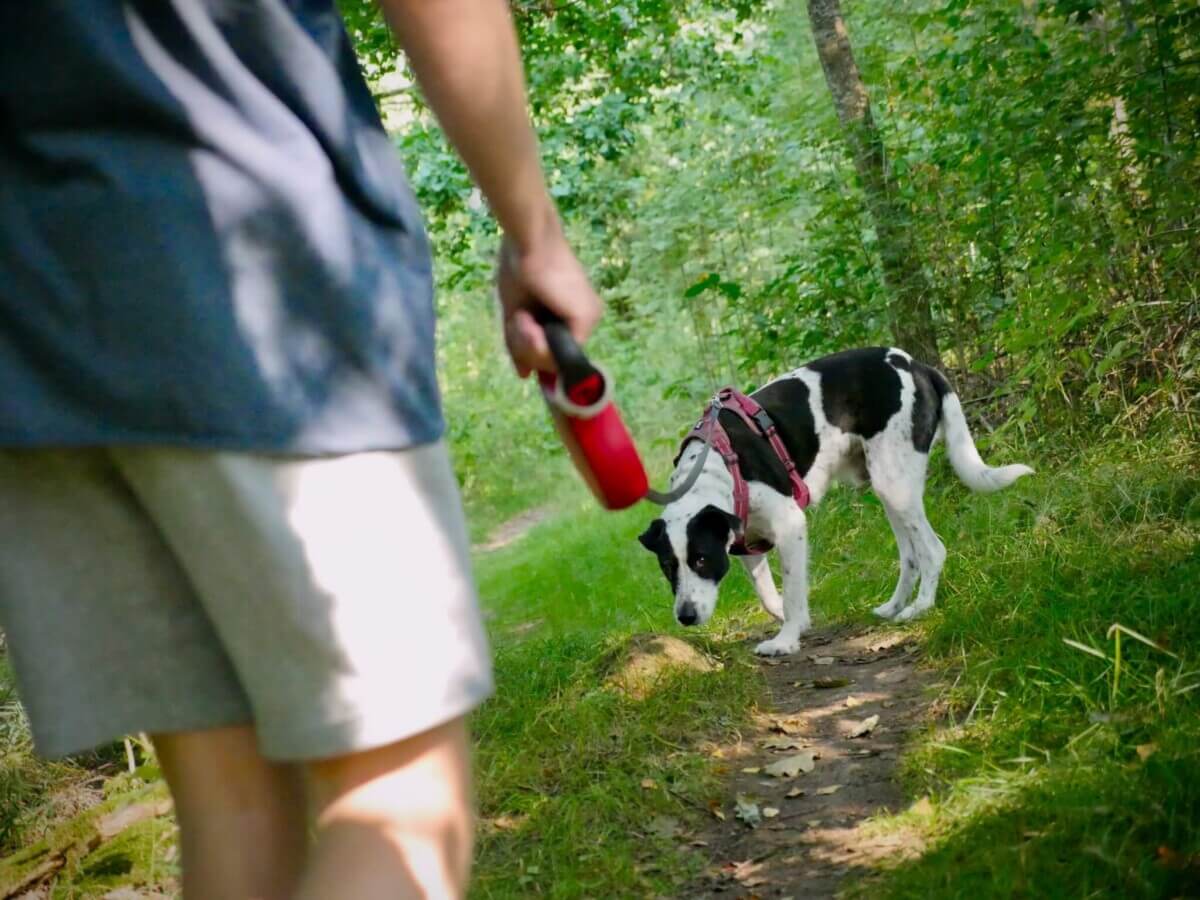
(Photo by Per Lööv on Unsplash)
The Distracted Dog Walker Problem, According to a New Study
In A Nutshell
- Researchers spent 40 hours watching dog walkers at four Surrey Hills sites without interfering, then brought the findings to a workshop with 15 land managers, farmers, and conservation staff.
- Eleven missed cleanups turned up across those 40 hours, almost all within 50 to 100 meters of parking areas, where distracted owners were least likely to notice or backtrack.
- Off-leash dogs flushed ground-nesting birds from cover and worried farmers about livestock disease, problems the study links to distraction rather than carelessness.
- Land managers rejected fines and policing as unworkable, favoring better signage, off-leash zones, and community efforts instead.
Four adults stand on a ridge path in England’s Surrey Hills. One names a birdsong drifting across the valley using an app, and the group falls silent, wrapped up in the moment. A few feet away, their dogs race in and out of the heather, in a stretch of ground where signs warn that nesting birds need protection. Nobody in the group looks up.
That scene, recorded while researchers observed dog walkers without intervening, anchors a new study published in Society & Natural Resources. With an estimated 13 million dogs in British households and about 30% of UK adults owning one, dog walking is the top reason people give for visiting the countryside. Researchers Thomas Roberts and Haeyoung Eun of the University of Surrey spent 40 hours watching walkers at four Surrey Hills sites, then brought their findings to a workshop with 15 land managers, farmers, and conservation staff.
What they found wasn’t a story of careless owners breaking rules on purpose. It was something more human: people who genuinely love nature, who stop to admire a view or photograph a bird, can end up causing the damage they’d say they oppose, without ever noticing. Researchers logged repeated missed cleanups and wildlife disturbances, almost none of it intentional. It happened because attention, once absorbed by a dog, a conversation, or a phone, had nowhere left to go.
Researchers Observed Walkers Without Interfering
To find out what actually happens on a dog walk, rather than what people say happens, the team watched from a distance, noting how walkers, dogs, wildlife, and features like paths and bins interacted in real time.
Fieldwork covered four sites in the Surrey Hills National Landscape, a protected area of chalk hills, heathland, and farmland southwest of London: a heathland common favored by ground-nesting birds, a wooded ridge, a livestock farm, and a vineyard estate. Researchers logged roughly 10 hours at each site between April and June 2025, spread across mornings, lunch hours, and evenings on weekdays and weekends, to capture the full range of dog walkers.
Afterward, the team brought its observations to farmers, land managers, business owners, and conservation rangers, and asked what might cut down on conflicts.

Three Types of Dog Walkers, Three Different Risks
Dog walking isn’t one behavior. It splits into at least three routines, each carrying its own risks.
Functional walks were quick, near parking areas, meant to let a dog relieve itself. Many walkers wore headphones or scrolled their phones, barely looking up. Recreational walks ran longer, with families chatting while their dogs wandered ahead or vanished into the brush. Professional walkers managed three to eight dogs at once; researchers saw cases where they spotted a dog relieving itself but couldn’t grab a bag in time with both hands full of leashes.
In every category, distraction, not indifference, was the reason things went wrong.
Wildlife Disturbance and the Waste Problem
Dog waste was the most persistent problem documented, with eleven missed cleanups recorded across the 40 hours, almost all within 50 to 100 meters of parking areas. That matches how functional walks work: dogs relieve themselves early on, and owners eager to keep moving don’t always notice or want to carry a filled bag the rest of the walk. “People don’t mind picking it up, but they don’t want to carry it for the next hour if there’s nowhere obvious to put it,” one land manager said.
Wildlife disturbance followed a similar pattern. Off-leash dogs followed scent trails into sensitive habitat and flushed birds from cover, especially where ground-nesting species were present. Livestock encounters carried extra weight for farmers in the workshop. “People often don’t realize the risk dog feces can pose to livestock,” one farmer said.
Stakeholders Favor Persuasion Over Punishment
Perhaps the most useful finding came out of the workshop itself: nobody wanted stricter enforcement. Conservation staff, farmers, and business owners pushed back against fines and policing, arguing these tactics were hard to carry out and likely to alienate the people whose cooperation they needed. “You can’t police every footpath in the Surrey Hills,” one conservation manager said. “You need to get people on side rather than threaten them.”
Signage offered a partial lesson in what works, at least for a while. New seasonal signs explaining why ground-nesting birds needed protection drew visible attention at first, with walkers slowing to read them, though the effect faded within weeks as the signs blended into the background. Generic warnings like “no dogs off lead” drew far less attention. Participants suggested placing messages at decision points, meaning junctions between habitats, rather than after walkers had already committed to a path.
Dedicated off-leash zones, better bin placement, and community ideas like volunteer wardens came up as more promising than punishment.
None of this means dog walking is bad for the countryside, or that owners fail some test of character. If anything, the opposite is true: the same affection that pulls people outdoors with their dogs is exactly what can blind them to the small damage piling up a few feet away. Rules built around blame miss that entirely. What this research points to instead is simpler: meet people where their attention actually is, not where a sign hopes it will be.
Disclaimer: This article summarizes findings from a peer-reviewed study and is intended for general informational purposes. It is not environmental, legal, or veterinary advice. Dog owners with questions about local wildlife protections or leash rules should consult the relevant land management authority.
Paper Notes
Limitations
The authors note that their findings come from a single protected landscape, the Surrey Hills National Landscape in southeast England, and the four observation sites were deliberately chosen because they represented locations where tensions between dog walking and conservation were especially visible, not because they were meant to represent all dog-walking environments. The authors describe their goal as providing analytical insight rather than statistically representative findings, and they call for future research in different geographic and social settings to see how these patterns might vary elsewhere.
Funding and Disclosures
The study was supported by the Surrey Hills National Landscape. The authors reported no conflicts of interest.
Publication Details
“Love Dogs, Love Nature: Rethinking Environmental Responsibility Through Everyday Dog-Walking Practices” by Thomas Roberts and Haeyoung Eun, published in Society & Natural Resources (2026). DOI: 10.1080/08941920.2026.2724506. Roberts is affiliated with the Department of Sociology and Institute for Sustainability, University of Surrey; Eun is affiliated with the Institute for Sustainability, University of Surrey. The research was approved by the University of Surrey Ethics Committee.


