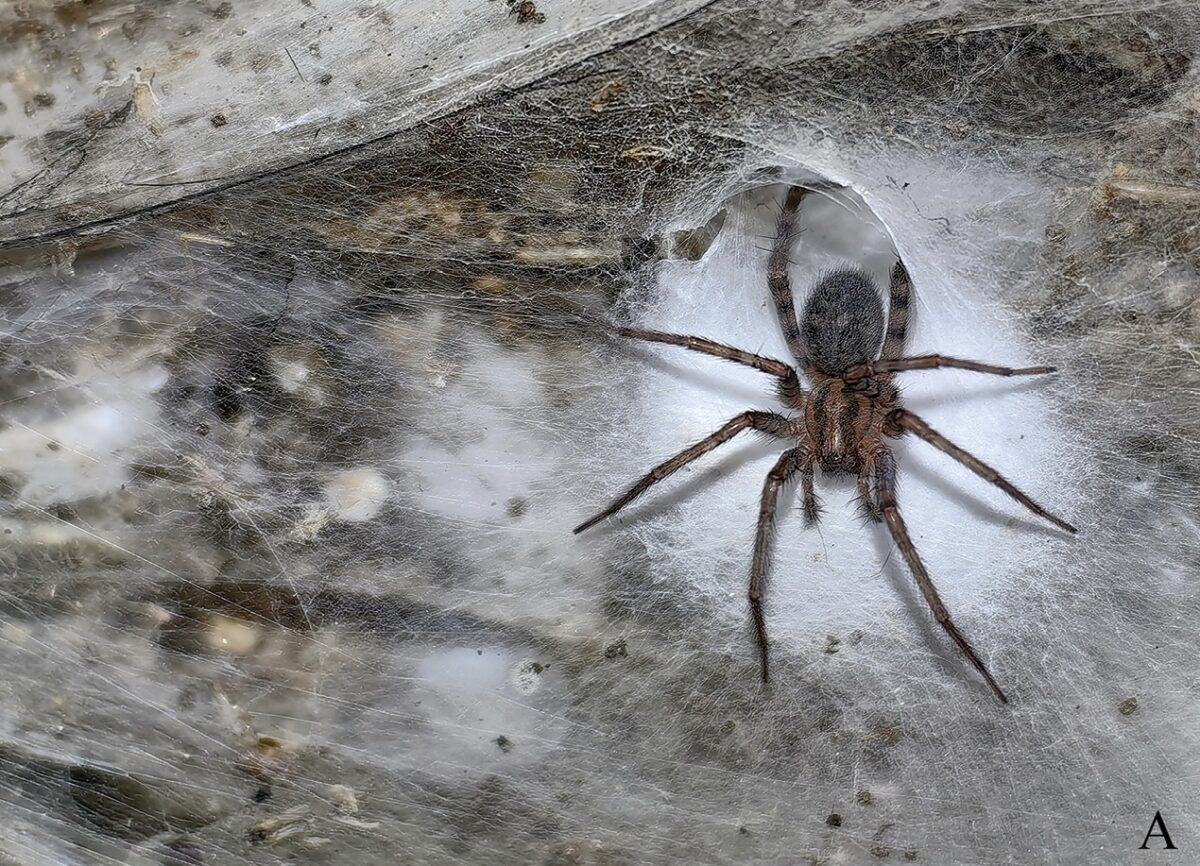
Tegenaria domestica in Sulfur Cave. A female next to a funnel shaped hole in the colonial spider web. (Credit Marek Audy / Subterranen Biology)
In A Nutshell
- An Estimated Colony: A 2025 study in Subterranean Biology estimated more than 111,000 spiders on one connected web covering roughly 1,140 square feet of cave wall, with counts extrapolated from photographed patches rather than tallied individually.
- A Sulfur Food Chain: A 2024 survey in Diversity and the 2025 study point to a food chain running from sulfur-oxidizing microbes to midges to spiders, though some of the supporting data are labeled preliminary.
- A Familiar Species, A Local Result: Most of the spiders are barn funnel weavers, which extension services place in sheds, basements and garages, but the colony does not show that the species forms colonies anywhere else.
Roughly 164 feet inside a cave on the Greece-Albania border, where daylight never reaches, a wall is blanketed in silk. Thousands of funnel-shaped webs overlap and join into one structure covering about 1,140 square feet.
A 2025 study in Subterranean Biology estimates that about 111,000 spiders live there, roughly 69,000 of them a species found in sheds, basements and garages. Normally solitary, the species may be sharing the wall because a food chain that starts with sulfur-eating microbes supplies plenty of prey, researchers say, though the totals are extrapolated from photographs and several questions remain open.

What Did Cavers Actually Find?
Cavers with the Czech Speleological Society came across the structure in Sulfur Cave, observing it by 2021 and reporting it in 2022. Sulfur Cave opens in Greece, and its deepest passages lie in Albania.
An international team led by István Urák of Sapientia Hungarian University of Transylvania then studied the web during visits between 2023 and 2025, and published its findings in Subterranean Biology. Researchers found thousands of small funnel-shaped webs, each a patch of silk narrowing into a tube where a spider hides, joined into one structure across about 106 square meters of wall.
Most of the spiders were Tegenaria domestica, known as the barn funnel weaver or domestic house spider. Penn State Extension says the species turns up across most of the United States, most often in sheds and barns, though it is not commonly encountered in some areas. University of Minnesota Extension lists corners of basements and garages and other dark, damp spots in and around buildings, and Colorado State University calls it an extremely common resident of homes. Belgian researchers at the Brussels Laboratory of the Universe, who worked on the cave study, write that it is frequently found in garages, basements and attics in Belgium.
A much smaller sheet weaver, Prinerigone vagans, lives in the same web. Neither species had been documented building colonial webs before, according to the study.

How Can So Many Solitary Spiders Share One Wall?
Abundant food is the leading explanation, though the authors frame it as likely rather than proven.
Sulfur Cave runs without sunlight. Springs deep inside feed a stream rich in hydrogen sulfide, and slimy films of sulfur-oxidizing bacteria (microbes that get energy by reacting that gas with oxygen) coat its bed. Researchers who surveyed the cave in 2023 and 2024, writing in a 2024 paper in Diversity, reported those films dominated by such microbes and a surprising abundance of cave animals. Preliminary isotope tests on a centipede and a beetle gave unusually light carbon and nitrogen values, and midge and beetle larvae may feed on the films. Adult midges stop feeding soon after emerging and often become food for land predators.
Stable isotope measurements, chemical fingerprints in body tissue that reveal where a food chain starts, came next in the 2025 study. Midges and both spider species carried fingerprints unlike those of surface-dwelling relatives, which the authors treat as consistent with a food chain fueled by the cave’s microbial films. A dense midge population fills the cave air, and the team extrapolated about 2.4 million midges resting on the wall from photographed squares averaging 45,500 per square meter.
Barn funnel weavers wove the web, the paper says, and the smaller sheet weavers live in it. Larger spiders apparently left the smaller ones alone. Darkness may impair the larger spiders’ vision, the authors hypothesize, leaving the small ones, which wait to ambush prey and move only briefly, hard to detect. No test of that idea is reported.
How Were More Than 111,000 Spiders Counted?
By extrapolation, not by census. For the barn funnel weavers, they photographed 30 randomly chosen patches, each 15 by 15 centimeters (about 6 inches square), and counted funnel webs in each as stand-ins for spiders. Surveys ran in October 2023, April 2024 and March 2025. Density averaged about 652 per square meter (range: 178 to 2,756). Multiplied across the colony’s estimated 106 square meters, that produced 69,113.
For the sheet weavers, researchers photographed 30 patches measuring 15 by 10 centimeters in March 2025 and counted visible spiders. Density averaged 823 per square meter, but counts swung widely from patch to patch (133 to 2,200). Researchers applied the density to half the colony’s area, matching where the small spiders were observed, and reported a total of 42,400, a figure that sits slightly below what the stated density and area would give.
Two caveats sit with those figures. Abandoned funnels are hard to tell apart from occupied ones, so the barn funnel weaver total may run high, the authors say. Area was calculated by multiplying the web’s length and width, assuming a roughly rectangular patch.

What Does the Evidence Actually Support?
An unusual local population, with important questions unresolved.
DNA results point to a cave population cut off from surface spiders, with limits. Researchers sequenced a short stretch of mitochondrial DNA (a fragment used in DNA barcoding) and reported that every cave barn funnel weaver tested shared one version. That version sits one mutation away from a version found across North America, Europe, Turkey, Pakistan and New Zealand, which also turned up in a spider collected a few kilometers from the cave. Based on that pattern, the authors say the cave population does not appear to exchange individuals with the surface. A single gene fragment cannot say when or how the separation began.
A comparison of body microbes, the bacteria living inside a spider, was labeled preliminary by the authors. Researchers compared 29 cave spiders that had enough usable data against a single surface spider. Cave spiders carried far less bacterial variety than the lone outsider, which hosted about 30 bacterial genera. With one surface comparison, the result cannot show how typical that spider is.
“Largest” needs context. Within the paper, the claim is a first for these two species, not a record. Urák told reporters the web likely is the largest in the world, and Guinness World Records lists it as the largest web built collectively by more than one spider species. Spider colonies of any kind sometimes exceed 100,000 individuals, the paper notes, usually where food is plentiful.
Back to the headline: a spider species found in sheds, basements and garages forms a colony here, but nothing in the study shows it does so elsewhere. Facultative coloniality, meaning colony living that is optional, is how the authors describe the behavior, and they tie it to abundant food. No tests separating darkness, isolation and the sulfur-fed prey supply are reported, so which factor matters most remains open.


