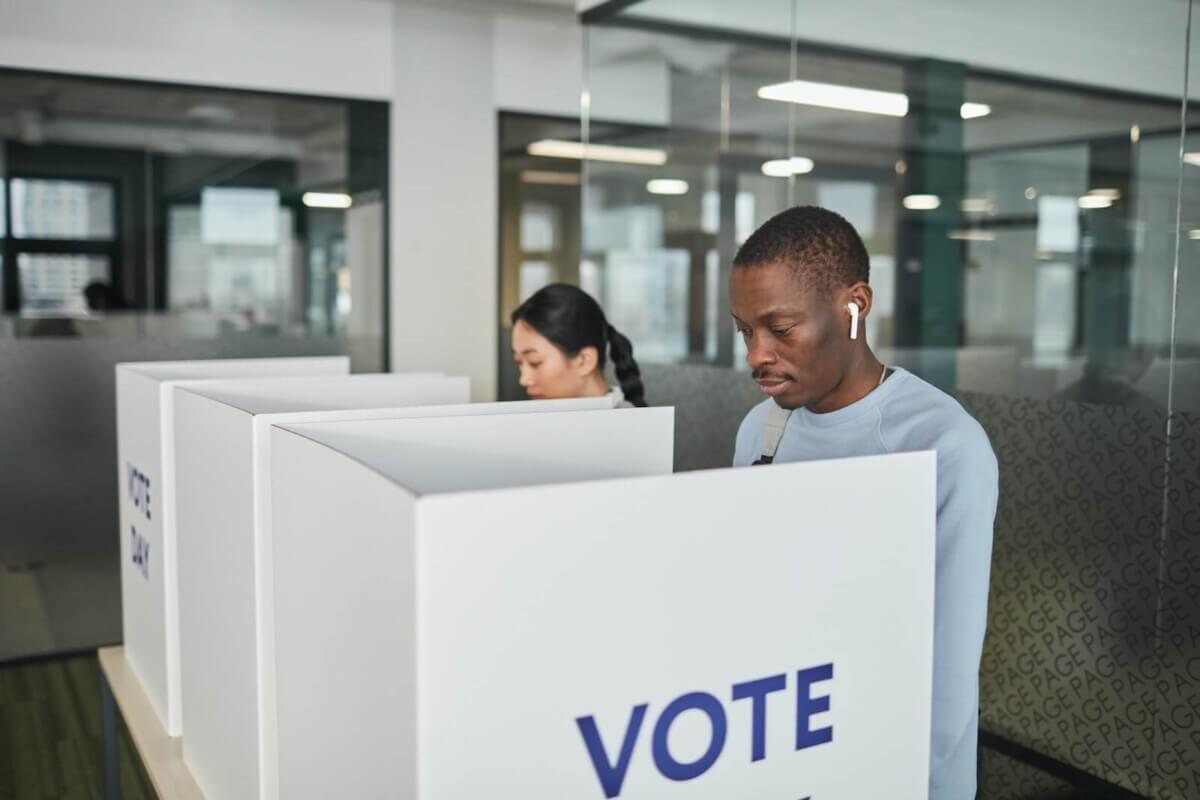
Photo by Edmond Dantès from Pexel
Voting Doesn’t Make Us Better People. It Might Make Us Pettier
In A Nutshell
- Across two experiments with 1,750 people, participants got significantly more likely to make spiteful, equalizing choices when voting in a group than when deciding alone.
- The gap held up in a formally pre-registered second study, climbing from about 57% choosing the envious option solo to about 68% when voting.
- The effect showed up specifically when someone else had more money and mostly disappeared when equalizing things came at a steep personal cost.
- Researchers point to diffusion of responsibility, the sense of being less personally accountable in a group, as a likely explanation, though the studies can’t confirm what participants consciously felt.
Most of us carry a quiet faith that voting brings out something decent in people, that marking a ballot connects us to something larger than ourselves and nudges us toward fairness. A new study puts that assumption to the test, and the results are not reassuring. When people vote as part of a group, they become significantly more likely to make spiteful choices, ones that close the gap between themselves and someone better off, even when doing so reduces the total amount of money available to everyone involved.
Researchers ran two experiments with a total of 1,750 participants to see whether voting changes how people decide to split money. It did, but not in a flattering direction. The study, published in the journal European Economic Review, argues that diffusion of responsibility, the tendency for individuals to feel less personally accountable when a decision is shared among many people, may help explain the shift.
Shared Responsibility Appears to Loosen the Brakes on Envy
Participants in both experiments were asked to choose between two ways of splitting money with an anonymous partner. In what researchers called the “envy game,” the partner was always going to receive more money than the participant. Participants could either accept that unequal arrangement or choose a perfectly equal split, which meant the partner got less. Choosing equality here was not generous. It was a deliberate choice to pull the other person down, even though it shrank the total pot.
Study 1 recruited 574 undergraduate students at a Swedish university. They made these choices either alone or as part of a majority vote among groups of 49 people. Researchers chose that group size deliberately to reflect real-world elections, where an individual vote rarely decides anything. Study 2 brought in a larger and more diverse group of 1,176 English-speaking participants online and added a third setup, where one randomly picked person’s choice was applied to the whole group instead of a vote. That let researchers separate the effect of simply being in a group from the effect of majority voting specifically, and the results lined up with the diffusion-of-responsibility idea, though they can’t prove participants consciously felt less accountable.

Envy-Driven Choices Rose by Roughly 10 Points Under Voting
In Study 1, about 41% of participants chose the envious, equalizing option when deciding alone. That number climbed to about 50% when they voted as part of a group, a gap of nearly 10 percentage points. Study 2 repeated the experiment with a fresh, larger sample and, unlike Study 1, was formally pre-registered before data collection began, meaning researchers committed to their methods and hypotheses in advance to prevent selectively reporting favorable results. The pattern held up almost exactly: about 57% of solo decision-makers chose the envious option, compared to roughly 68% of voters, again a gap of about 11 percentage points.
In the random-selection condition, about 62% chose the envious option, landing between the solo and voting numbers and pointing to majority rule as an extra push beyond just being in a group.
Researchers also tested what happened when the cost of choosing equality was tiny. Voting still pushed people toward envy. But when pulling the other person down came at a steep price to the participant too, that voting effect shrank and was no longer reliable enough to call a real pattern.
Voting did not make people more generous in scenarios where they had the advantage. Its influence was specific to situations involving disadvantageous inequality, where someone else was ahead.
Political Ideology Did Not Reliably Change the Effect
Participants completed a survey measuring where they fell on a scale from individualist, favoring personal freedom and limited government, to collectivist, favoring community and shared responsibility. Descriptively, collectivist participants showed a bigger jump in envy-driven behavior when voting compared to deciding alone, an ironic pattern given that collectivists tend to express support for policies that benefit communities broadly. But when researchers ran formal statistical tests, this difference did not hold up reliably in either study. The envy-boosting effect of voting appeared broadly consistent regardless of political ideology, though the researchers acknowledge more work is needed to confirm that.
Women were more likely than men to choose the envious, equalizing option across both studies. Researchers note this appeared to be driven more by aversion to being at a disadvantage than by a broader concern for fairness.
Economists have long tried to explain why democracies sometimes redistribute less than standard models predict. The researchers suggest that concerns about relative standing, and the way responsibility is shared when people vote, could be one piece of that puzzle. In these experiments, when responsibility was spread across a large group, participants leaned harder into competitive impulses rather than cooperative ones.
It’s worth being precise about what these games measured. Participants were splitting money in a lab or online setting, not casting real ballots on taxes or welfare policy. As the paper puts it, “when responsibility is shared, voters may be more inclined to endorse choices that prioritize relative standing over collective welfare.” Democracy remains worth defending, but the experiment suggests group decision-making itself can tilt behavior toward spite, a pattern worth remembering the next time a vote involves splitting up something scarce.
Disclaimer: This article summarizes findings from a peer-reviewed study and is intended for general informational purposes. It is not a statement on the merits of voting or any political system, and readers should consult the original research for full methodological detail.
Paper Notes
Limitations
Researchers acknowledge that the study examined only one stage of democratic participation: the act of voting itself. Researchers did not account for pre-vote discussion or the social signaling that follows a vote, both of which could influence behavior differently. Additionally, the worldview scale used in the study has been tested primarily in Western populations, raising questions about how well the findings might translate to non-Western cultural contexts where social structures and concepts of collective responsibility may differ significantly.
Funding and Disclosures
This work was supported by the Swedish Research Council (grant numbers 2018-01755 and 2024-01310). Funders had no role in study design, data collection, analysis, the decision to publish, or manuscript preparation. Authors declare no competing financial interests. Authors note that OpenAI’s ChatGPT (GPT-5) was used to assist with language editing, text refinement, and reference formatting during manuscript preparation, but was not used for data analysis, interpretation of results, or generation of scientific content.
Publication Details
Authors: Kajsa Hansson, Kinga Barrafrem, Lewend Mayiwar, Emil Persson, and Gustav Tinghog. Affiliations include Linkoping University (Sweden), OsloMet, Oslo Metropolitan University (Norway), and the University of Gothenburg (Sweden). | Journal: European Economic Review, Volume 188 (2026), Article 105389 | Paper Title: “Envy in the ballot box: How voting influences distributive preferences” | DOI: https://doi.org/10.1016/j.euroecorev.2026.105389 | Availability: Published open access under CC BY license. Data and materials available at https://osf.io/xgtsv/


