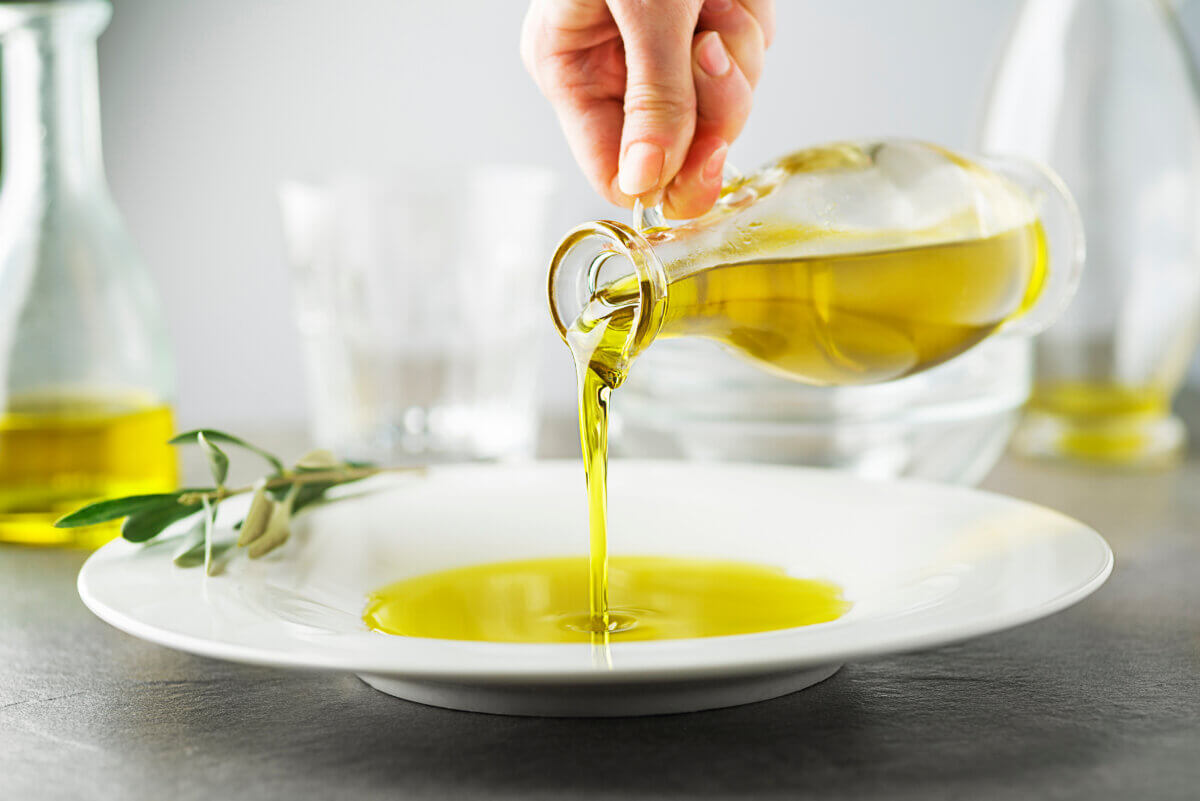
(Credit: DUSAN ZIDAR/Shutterstock)
Virgin Olive Oil May Protect Aging Brains. Refined Oil May Not.
In A Nutshell
- A two-year study of 656 older adults found that higher virgin olive oil intake was linked to more favorable cognitive changes, while higher intake of refined “common” olive oil was linked to faster decline.
- Virgin olive oil is made through mechanical pressing alone, keeping antioxidants and anti-inflammatory compounds that refining strips away.
- Virgin olive oil consumption was tied to a more diverse gut microbiome, and one bacterium, Adlercreutzia, accounted for about 20 percent of its link to improved general cognitive function.
- The study is observational, so it cannot prove that switching oils changes cognitive outcomes, only that the two are linked.
Brain health researchers have long championed the Mediterranean diet as protection against cognitive aging, but a closer look at one of its most celebrated ingredients reveals a somewhat counterintuitive split. Olive oil choices appear to matter tremendously. Depending on how it’s processed, it may be associated with more favorable cognitive changes in older adults, or with faster decline.
A study published in the journal Microbiome tracked 656 older adults over two years and found that higher virgin olive oil consumption was associated with more favorable cognitive changes, while higher consumption of what researchers classified as common olive oil, a category combining refined olive oil and olive-pomace oil, was associated with faster decline. Researchers say the gut microbiota may help explain part of this association.
Olive oil is often treated as a single, interchangeable ingredient, but this study suggests the type matters quite a bit for the brain.
Refining Strips Away the Compounds That May Protect the Brain
Virgin olive oil and common olive oil may look similar in the bottle, but they are made differently and have different nutritional profiles. Virgin olive oil is extracted from olives using only mechanical means, preserving a rich collection of natural plant compounds, including antioxidants and substances that reduce inflammation. Common olive oil, by contrast, combines refined olive oil and olive-pomace oil, a process that strips away most of those beneficial compounds, even though the fat content ends up being similar.
Researchers drew their 656 participants, all between the ages of 55 and 75, from a larger Spanish clinical trial called PREDIMED-Plus. Every participant had overweight or obesity and a cluster of conditions, including high blood pressure, high blood sugar, and excess body fat, putting them at elevated risk for both heart disease and cognitive decline. None had dementia or significant cognitive impairment at the start of the study. About 48 percent of participants were women, and the average age was 65.
At the start, participants completed a detailed dietary questionnaire and provided stool samples so researchers could analyze the makeup of their gut bacterial communities. They also underwent a battery of cognitive tests covering memory, attention, language, and higher-order thinking skills like planning and problem-solving. Those same tests were repeated two years later.

Virgin Olive Oil Was Tied to a More Diverse Gut Microbiome
Trillions of microbes living in the digestive tract have increasingly been recognized as major players in overall health, including brain function. Researchers refer to the communication network between the gut and the brain as the gut-brain axis, a two-way signaling system involving nerves, immune pathways, and chemical messengers.
In this study, higher consumption of virgin olive oil was associated with a more diverse gut bacterial community at baseline. Greater microbial diversity is generally considered a marker of a healthier gut. Higher consumption of common olive oil, by contrast, was linked to lower microbial diversity.
Specific bacteria stood out as varying by olive oil type. One in particular, Adlercreutzia, was identified as a possible partial explanation for the association between virgin olive oil intake and improvements in general cognitive function, accounting for about 20 percent of that relationship in the researchers’ analysis. That suggests the gut may help explain part of how diet connects to brain outcomes in this population.
Higher virgin olive oil consumption was tied to favorable changes across most of the cognitive measures tracked, though the exact pattern differed depending on how researchers analyzed intake. Higher common olive oil consumption was associated with decline in several of the same areas, most consistently in overall cognitive scores.
The Findings Can’t Prove Olive Oil Type Causes Cognitive Change
Researchers were careful about what the study can and cannot show. Because it was observational, causation cannot be established. The population was older, Spanish, and living in a culture where olive oil is a dietary staple, which may limit how broadly the results apply to people in other countries. Participants who consumed more common olive oil also tended to have lower education levels and higher rates of smoking, and while the statistical models adjusted for these factors, some residual influence cannot be fully ruled out.
Dietary information relied on self-reported questionnaires, which carry the usual risks of imprecision. Olive oil consumption data and stool samples were also collected at the same time point, making it harder to establish a clear sequence of events between diet, gut bacteria, and brain outcomes. Researchers also noted that participants consumed considerably less common olive oil than virgin olive oil overall, which may affect how strongly the common olive oil findings should be interpreted.
These results point toward olive oil quality, not just quantity, as a factor worth considering in brain aging. For the millions of older adults seeking practical ways to support cognitive health, this study raises the possibility that the choice between a minimally processed oil and a heavily refined one may be worth paying attention to, though the observational nature of the research means that question remains open.
Disclaimer: This article is based on findings from a peer-reviewed observational study and is intended for general informational purposes. It is not medical advice. Readers with questions about diet, cognitive health, or aging should consult a qualified healthcare provider.
Paper Notes
Limitations
As the authors acknowledge, the observational nature of this study prevents any conclusions about direct causation. All participants lived in Spain and had overweight or obesity combined with metabolic syndrome, which may make the results less applicable to other populations or those in different cultural or dietary contexts. Dietary assessments relied on self-reported food frequency questionnaires, which are susceptible to recall error. Because gut microbiota data and dietary data were collected at the same time point at baseline, the study cannot definitively establish the sequence of cause and effect in the olive oil-gut-brain relationship. Additionally, the sequencing method used to analyze gut bacteria has limitations in accurately identifying microbes at finer classification levels, which may have introduced some misclassification. The researchers also noted that participants who consumed more common olive oil were more likely to have lower education levels and higher smoking rates, and despite adjustments for these variables, some residual confounding cannot be excluded.
Funding and Disclosures
This work was supported by Spanish public research institutions including the CIBER Fisiopatología de la Obesidad y Nutrición (CIBEROBN) and the Instituto de Salud Carlos III through the Fondo de Investigación para la Salud, co-funded by the European Regional Development Fund. Additional funding came from the NIH (grant R01DK127601), the Eat2beNICE/H2020-SFS-2016-2 EU grant, and the Horizon 2020 PRIME study. The first author received support from a predoctoral grant from the Ministerio de Ciencia, Innovación y Universidades. One co-author received a postdoctoral fellowship from the Canadian Institutes of Health Research. The senior author was partially supported by the ICREA Academia program. In-kind food donations for the larger PREDIMED-Plus trial were provided by food and nut industry companies. The senior author, Jordi Salas-Salvadó, disclosed serving on the board of and receiving grant support through his institution from the International Nut and Dried Fruit Council, and serving on the board of the Instituto Danone Spain and the International Danone Institute. No other authors declared competing interests. None of the funding sources had any role in study design, data collection or analysis, interpretation of results, or the decision to publish.
Publication Details
Title: Total and different types of olive oil consumption, gut microbiota, and cognitive function changes in older adults Authors: Jiaqi Ni, Stephanie K. Nishi, Nancy Babio, Clara Belzer, Jesús Vioque, Dolores Corella, Javier Hernando-Redondo, Josep Vidal, Isabel Moreno-Indias, Laura Compañ-Gabucio, Oscar Coltell, Montse Fitó, Estefanía Toledo, Dong D. Wang, Francisco J. Tinahones, and Jordi Salas-Salvadó Journal: Microbiome (2026), Volume 14, Article 68 DOI: 10.1186/s40168-025-02306-4


