(Credit: spatuletail/Shutterstock)
In a Nutshell box
- Researchers matched the moon, Venus, and a star cluster in “Starry Night” to a real sky that appeared at dawn around July 22, 1889, not the June date long accepted by art historians.
- A shape-matching technique applied to the group of stars at the painting’s center shows it closely mirrors the real pattern of a cluster called the Hyades, found in the constellation Taurus.
- Old weather records, letters Van Gogh wrote to his brother, and even mentions of cicadas helped the team argue that his second mental health crisis, and possibly the painting’s completion, happened later in the summer than historians believed.
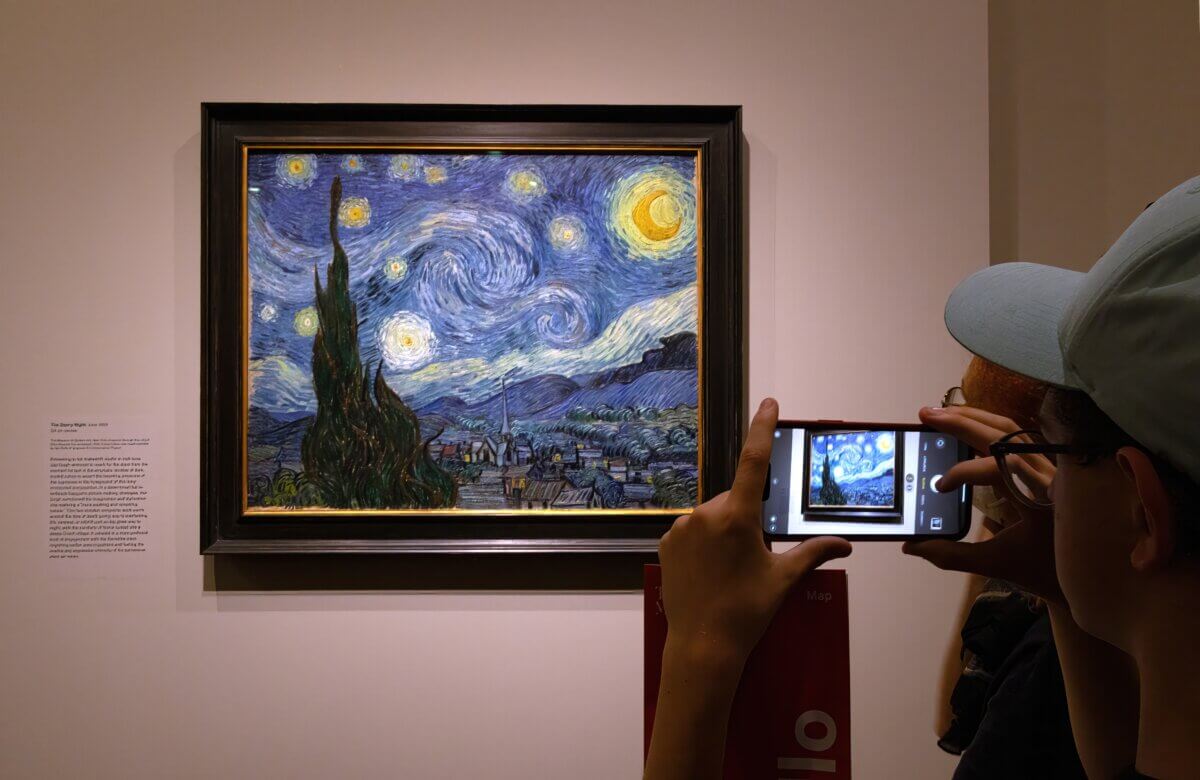
For more than a century, art historians have argued about one simple question: did Vincent van Gogh actually see the swirling sky in “Starry Night,” or did he dream it up? A new study argues that the sky was real, drawn from an actual dawn.
Using star charts, 1800s weather logs, geometry, and Van Gogh’s own letters, a team reporting in the journal Scientific Reports matched the moon, Venus, and a star cluster in the painting to a specific dawn sky that appeared around July 22, 1889, not the mid-June date art historians have long accepted. If that holds up, Van Gogh wasn’t inventing a sky out of thin air. He was looking at one, weeks later than everyone assumed.
That distinction matters more than it might seem. Whether “Starry Night” is pure imagination or a record of something Van Gogh actually witnessed changes how people understand one of the world’s most reproduced paintings, and the mind that made it. A spontaneous fantasy and a grounded observation tell two very different stories about an artist often remembered mainly for his mental illness.
How Researchers Uncovered the Real Sky Behind Starry Night
Rather than stare at the painting and guess, the team built a detective case, pulling in tools from astronomy, geography, and climate records. They started by testing their approach on two paintings where the truth was already easier to pin down. One was a 1600s night scene by German painter Adam Elsheimer. The other was an 1800s piece, also called “Starry Night,” by French painter Jean-François Millet, who has no connection to Van Gogh’s famous version.
Elsheimer’s stars didn’t match any real moment in the sky, suggesting a scene built from memory and imagination rather than observation. Millet’s painting told a different story. Orion and the bright star Sirius lined up closely enough with real positions that researchers concluded he was likely working from a sky he had actually watched, even though he made some stars look brighter than they really were.
With the method proven, researchers applied it to two of Van Gogh’s 1888 night paintings, “Starry Night Over the Rhone” and “Cafe Terrace at Night.” Both locations still exist in France, so the team visited them in person, took photos, and compared the angles and star placement in the paintings to what someone standing there would actually see. Both paintings checked out as grounded in real skies. That gave the researchers confidence to point the same process at the far more puzzling 1889 masterpiece.
A Narrow Window Onto Van Gogh’s Starry Night Sky
A major obstacle for earlier researchers was that nobody could agree on exactly where Van Gogh stood, or how much sky he could see, when he looked out his window at the asylum where he was staying. The team got around this by using an earlier pencil sketch Van Gogh made of the same landscape. That sketch let them estimate the field of view he likely used: a narrow slice of sky, closer to looking through a zoom lens than taking in a wide panorama.
Once researchers mapped that narrow window onto the real sky of 1889, something clicked. At dawn on July 22, a crescent moon, the planet Venus, and a cluster of stars called the Hyades all lined up within that same narrow frame, with the moon above Venus just as in the painting.
To check whether the central group of stars in the painting really matched the Hyades, researchers used a statistical shape-matching method and compared it against the real positions of five stars in that cluster. The match held up even after researchers tested alternative arrangements of those painted stars, along with rival constellations, as competing explanations. Once they factored in brightness, direction, and Venus’s position, the Hyades emerged as the strongest fit.

(b) The stars in Café Terrace at Night (1888), left, and the stars around the Summer Triangle, center. The panel at right follows the same layout as in (a). (Credit: Kim et al., Scientific Reports (2026), Figs. 2, 4 and S1)
Weather, Cicadas, and Dating the Starry Night Sky
Researchers didn’t stop at the stars. They dug through old weather archives from towns near the asylum in southern France, checking cloud cover and wind patterns against the days in question. They also studied Van Gogh’s letters to his brother Theo, including one describing a seizure that struck him while he was painting outdoors “on a windy day.” Matching that detail against the weather logs pointed to a burst of strong wind recorded in late July, not mid-July as people had long assumed.
Letters mentioning cicadas singing in the summer heat added another clue. Temperature records show mid-June 1889 simply wasn’t hot enough, or hot enough for long enough, to match the sweltering, insect-filled scene Van Gogh described in letters written around the same time as “Starry Night.” July fit far better, with more than two weeks of sustained heat above 86 degrees Fahrenheit.
Put together, these separate clues, the narrow sky window, the star shape match, the wind record, and the heat pattern, all pointed to the same stretch of time in late July 1889 rather than the June date long printed on museum placards and in art history books.
What the Real Starry Night Means for Van Gogh’s Legacy
None of this proves Van Gogh sat down with a star chart and planned his composition like an astronomer. The researchers argue the opposite: he likely watched the sky over several nights, absorbed the impression, then stretched and reshaped it at the easel, the same way he curled the lines of the hills and the cypress tree in the foreground. Exaggerating something, as the researchers point out, still requires a real starting point.
This goes beyond calendar trivia. It takes a tired, century-old argument, fantasy versus reality, and gives it something it never had before: a testable answer backed by physical evidence. For a painting this closely studied, that’s no small thing. The sky in “Starry Night” looks like more than Van Gogh’s imagination. It reads as a real summer dawn in southern France, filtered through the eyes of a painter who happened to be a genius.
Paper Notes
Limitations
Researchers note several boundaries on their own conclusions. Their findings speak to whether the celestial arrangement in the painting matches a real sky, not to exactly when Van Gogh started the canvas or whether he reworked it later. They treat the sky as possibly built from impressions gathered over several nearby nights rather than a single frozen moment. The shape-matching technique used to identify the central star cluster isn’t foolproof on its own, since other star patterns can produce similarly close matches; the researchers relied on outside clues like brightness and the identified position of Venus to rule those alternatives out, and this limitation grows more serious when fewer reference points are used. The weather records relied upon predate modern standardized instruments, so some entries are incomplete or only roughly graded. Finally, no medical record from the time documents exactly when Van Gogh’s seizure began, so the researchers use timeline clues from letters and weather data to clear away a historical objection rather than to prove a new fact outright.
Funding and Disclosures
No external funding supported this study, the authors state. They disclose that the lead author is the founder and CEO of a company called SLLAB, INC., and that two other authors hold positions at that same company, which the paper notes may pursue commercial activities connected to the research. One author, affiliated with Kyung Hee University, reported no competing interests.
Publication Details
Paper Title: “The actual sky of Van Gogh’s Starry Night: a multidisciplinary reconstruction”
Authors: Elijah Jeong-hyun Kim, Suna Kang, Jungwoo Song, and Ho Jin, affiliated with SLLAB, INC. and the School of Space Research at Kyung Hee University in the Republic of Korea
Journal: Scientific Reports (2026, volume 16, article 31109)


