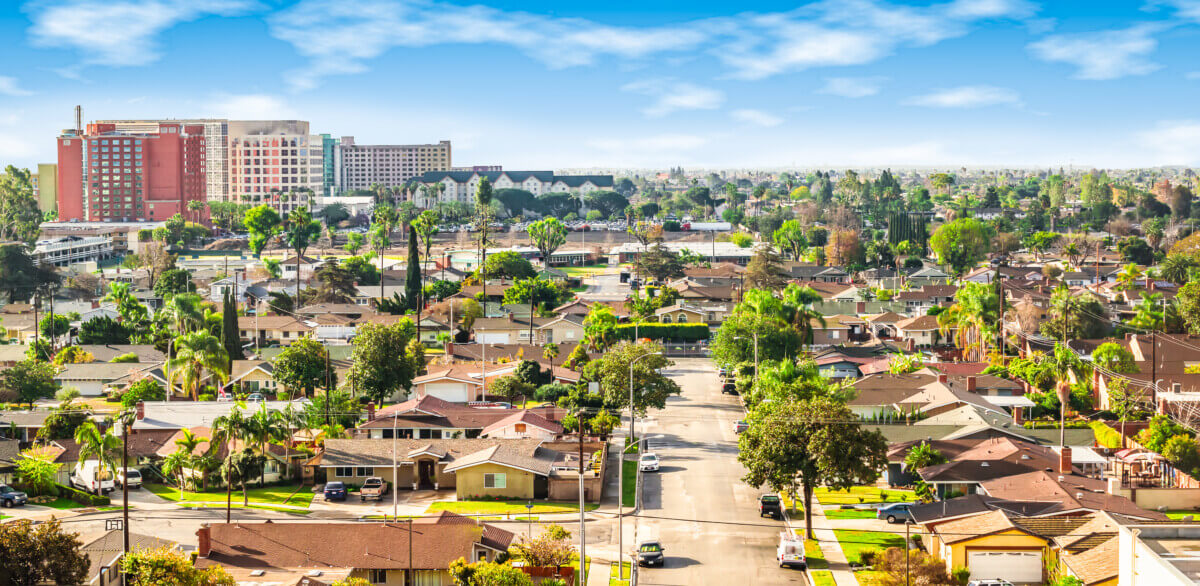
(Photo by Nancy Pauwels on Shutterstock)
Buildings, Trees, and Better Sleep: What a Tokyo Study Found About Street Design
In A Nutshell
- A study of over 1,000 Tokyo-area adults found that streets visually “enclosed” by buildings and trees were linked to less insomnia and about 15 more minutes of sleep a night.
- Streets with more sidewalks and pedestrian fences, a narrow measure of walkability, were linked to worse sleep, likely because they read as busier rather than safer.
- Greenery alone wasn’t linked to sleep, but leafier streets scored higher on predicted safety, and that safety score was tied to longer sleep.
- The study can’t prove any of these street features cause better or worse sleep, since it only captured a single snapshot in time.
Picture a walk home along two distinct streets. One is wide and open, more parking lot than sidewalk, with a low chain-link fence and a clear view of the sky. The other is narrower, closed in by buildings on both sides and tree branches nearly meeting overhead, the kind of street that feels like walking through a hallway. A new study out of Japan suggests that second, closed-in street might come with a hidden perk: better sleep for the people who live along it.
Researchers analyzed more than 214,000 street-level photos across the Greater Tokyo Area, then compared what those streets looked like to the sleep habits of over a thousand employed adults in their 40s and 50s. Streets that felt boxed in by buildings and trees were tied to less insomnia and longer sleep. More surprising, streets with heavier sidewalk and pedestrian-fence infrastructure, the features researchers used to measure walkability at street level, were tied to worse sleep. The study, published in Building and Environment, complicates the assumption that open, walkable neighborhoods are automatically the healthier choice.
Poor sleep is already a massive problem. A 2024 survey by the American Academy of Sleep Medicine found more than 36% of Americans have been diagnosed with a sleep disorder, and insomnia alone costs the country upward of $150 billion a year. Most research into how neighborhoods affect sleep has focused on noise, pollution, or nearby parks. This study, led by researchers from Osaka Metropolitan University and Tsinghua University, instead asked a simpler question: whether the way a street looks shapes how well the people living on it sleep at night.
Over 1,000 Tokyo Commuters Slept Under Six Hours a Night
All 1,089 participants were employed, between 40 and 59, living no higher than the third floor, and commuting into Tokyo at least five days a week. Researchers picked this age group because sleep patterns tend to be steadier in midlife, even as work and family demands pile on. On average, these commuters slept just 5.9 hours a night, well short of the seven to nine hours doctors recommend.
To measure the streets, the team pulled photos from a street-view mapping service at over 54,000 spots around the region. A computer program scanned each image pixel by pixel, tallying how much greenery was visible, how many sidewalks and pedestrian fences lined the road, and how enclosed the street felt based on the ratio of buildings and trees to open sky and pavement. These were neighborhood averages, not a measurement of any one person’s actual front step.
A second AI model, trained on more than 100,000 street photos rated by nearly 95,000 people worldwide, estimated how safe, lively, or beautiful each Tokyo street was likely to seem. Those scores are estimates from a model, not surveys of how Tokyo residents actually feel about their block.

Enclosed Streets Were Linked to Noticeably Better Sleep
Enclosure was the clear standout. People on streets that felt more boxed in by buildings and greenery reported less insomnia and longer sleep, and that held even after accounting for income, housing, age, gender, and commuting habits. In concrete terms, neighborhoods with notably more enclosure than average were linked to modestly lower insomnia scores and about 15 extra minutes of sleep a night.
Researchers can’t say for certain why, since the study wasn’t designed to prove cause and effect, but they floated a few reasonable ideas. A more closed-in street might create a subtle feeling of order and safety that eases people into sleep. Taller, denser buildings might also block traffic noise from carrying as far. And streets that feel more enclosed often have more foot traffic and community life, which other research has tied to better sleep. These are educated guesses, not proven mechanisms, since the study didn’t directly measure noise, stress, or street activity.
Greenery, on its own, wasn’t linked to sleep at all. But the data hinted at an indirect path: leafier streets scored higher on the model’s safety estimate, and that higher predicted safety was linked to longer sleep. Sidewalks and pedestrian fences told the opposite story: more of these features meant lower predicted safety, which tracked with shorter sleep. The researchers suspect that in a crowded, high-traffic city like Tokyo, heavy pedestrian infrastructure might read less as “walkable” and more as “busy.” That distinction matters: this is not evidence that walkable neighborhoods in the everyday sense, with shops and destinations within easy reach, are bad for sleep. The study measured something narrower, just the ratio of visible sidewalks and fences to road space, and that should not be mistaken for walkability as most people use the word.
Sensitivity Tests Held Up, But Cause Remains Unproven
Researchers ran the numbers through extra checks, testing whether streetlights at night or unusual data points were skewing things. The overall pattern survived, though a few results grew shakier under scrutiny. None of this proves that living on an enclosed street will fix anyone’s sleep. This was a single snapshot in time, the group studied was mostly middle-aged, employed men in one Japanese megacity, and the photos were snapped at intersections rather than the quieter stretches in between, where people actually spend their days.
Still, long before anyone builds another crosswalk or clears a lot for parking, it’s worth asking what that choice does to the people trying to sleep afterward.
Disclaimer: This article summarizes a single observational study and is intended for general informational purposes. It does not constitute medical advice. Anyone with ongoing sleep problems should consult a doctor or sleep specialist.
Paper Notes
Limitations
This was a cross-sectional study, meaning causal conclusions cannot be drawn. Participants were middle-aged, employed adults living in an East Asian megacity, so findings may not generalize broadly to other populations or urban contexts. Because the sample consisted of employed adults, commuting time could be relevant to sleep duration but was not included as a covariate due to insufficient location and scheduling data. The statistical models explained a relatively small proportion of variance in sleep outcomes, indicating that many individual-level factors were not captured. Street photos were collected only at road intersections, which may differ visually from midblock segments. The perceptual judgment models were trained on a global crowdsourced dataset rather than Japanese-specific rating data, so perceptual scores should be treated as informative proxies rather than precise local measures. Street view images were not filtered by capture year or season, potentially introducing variability, particularly for greenness measures. Nighttime factors such as traffic noise were not included due to data limitations.
Funding and Disclosures
This study was supported by JSPS KAKENHI (Grant Number 24K01053) and JST SPRING (Grant Number JPMJSP2139). The authors declare no competing financial interests or personal relationships that could have influenced the work. The Place Pulse 2.0 dataset was provided by the Center for Collective Learning. Nighttime light data came from cloud-free monthly NOAA VIIRS composites accessed through Google Earth Engine.
Publication Details
Authors: Xiaorui Wang, Jihui Yuan, Weixin Huang, Daisuke Matsushita | Affiliations: Wang, Yuan, and Matsushita are affiliated with the Department of Living Environment Design, Graduate School of Human Life and Ecology, Osaka Metropolitan University, Osaka, Japan. Huang is affiliated with the School of Architecture, Tsinghua University, Beijing, China. | Journal: Building and Environment, Volume 300 (2026), Article 114711 | Paper Title: Urban Eye-Level Landscapes and Sleep Health: Cross-Sectional Evidence from a Megacity Using Machine Learning for Objective and Perceptual Assessment | DOI: 10.1016/j.buildenv.2026.114711 | Published online: May 7, 2026


