
Credit: Getty Images For Unsplash+
The Marlboro Connection: Philip Morris Used Cigarette Science to Engineer Ultraprocessed Food Staple
In A Nutshell
- Philip Morris Companies, the tobacco giant behind Marlboro, owned Lunchables for 23 years and used cigarette research strategies to shape the brand.
- Internal documents show Philip Morris shared scientists, technology, and product development methods across its tobacco, food, and alcohol divisions, with Lunchables serving as a model example of that strategy.
- Lunchables was engineered to appeal to kids’ desire for autonomy and to ease mothers’ guilt, using the same consumer psychology approach Philip Morris developed for cigarettes.
- Researchers say tobacco-style regulations, including warning labels, taxes, and restrictions on child-focused marketing, may be worth applying to ultraprocessed foods like Lunchables.
Every parent who has tossed a Lunchables tray into a child’s lunch bag probably wasn’t thinking about cigarettes. But according to a new analysis published in the American Journal of Public Health, maybe they should have been. Newly disclosed internal company documents reveal that Philip Morris Companies, the tobacco giant behind Marlboro cigarettes, owned the Lunchables brand during its rise and helped shape it using research strategies first developed for cigarettes.
Philip Morris bought General Foods in 1985, where Lunchables was already in development. Two years later, it merged General Foods with Kraft to create Kraft General Foods, the second-largest food corporation in the world. Philip Morris brought Lunchables to national shelves in 1988 and built the brand for 23 years before selling Kraft in 2007. Throughout, the tobacco company systematically shared its research and technology across its cigarette, food, and alcohol divisions. Lunchables, the documents suggest, became a model example of that strategy in action.
Laura A. Schmidt, a researcher at UC San Francisco, built the case from previously undisclosed internal records made public after tobacco litigation. Those documents show Philip Morris leadership explicitly sought “technical synergies,” meaning shared researchers, methods, and technology across product lines.
How Cigarette Science Came to Lunchables
In 1988, Philip Morris launched a Technical Synergies Committee to “increase effectiveness and reduce costs” of R&D across tobacco, alcohol, and food divisions. Roughly 2,840 engineers and scientists were at work globally, about one-third on tobacco and the rest on food and beverages.
One standout project traced a single extraction technology across three products. A pressurized CO2 process first used to decaffeinate Maxwell House coffee was adapted to pull nicotine from tobacco for a low-nicotine cigarette, then turned toward food to strip fat from processed meats and cheeses for Low-Fat Lunchables.
Another cross-division effort brought Philip Morris brain-and-senses researcher Frank Gullotta, who had been conducting secret research in Germany on how the brain perceives nicotine and flavor, into collaboration with Kraft’s laboratory. Kraft’s fat-reduction team viewed him as “an absolutely key resource for us in this task.” Electronic nose sensors and brain-wave monitoring tools from his lab were later used at Kraft to study how fat affects taste perception.
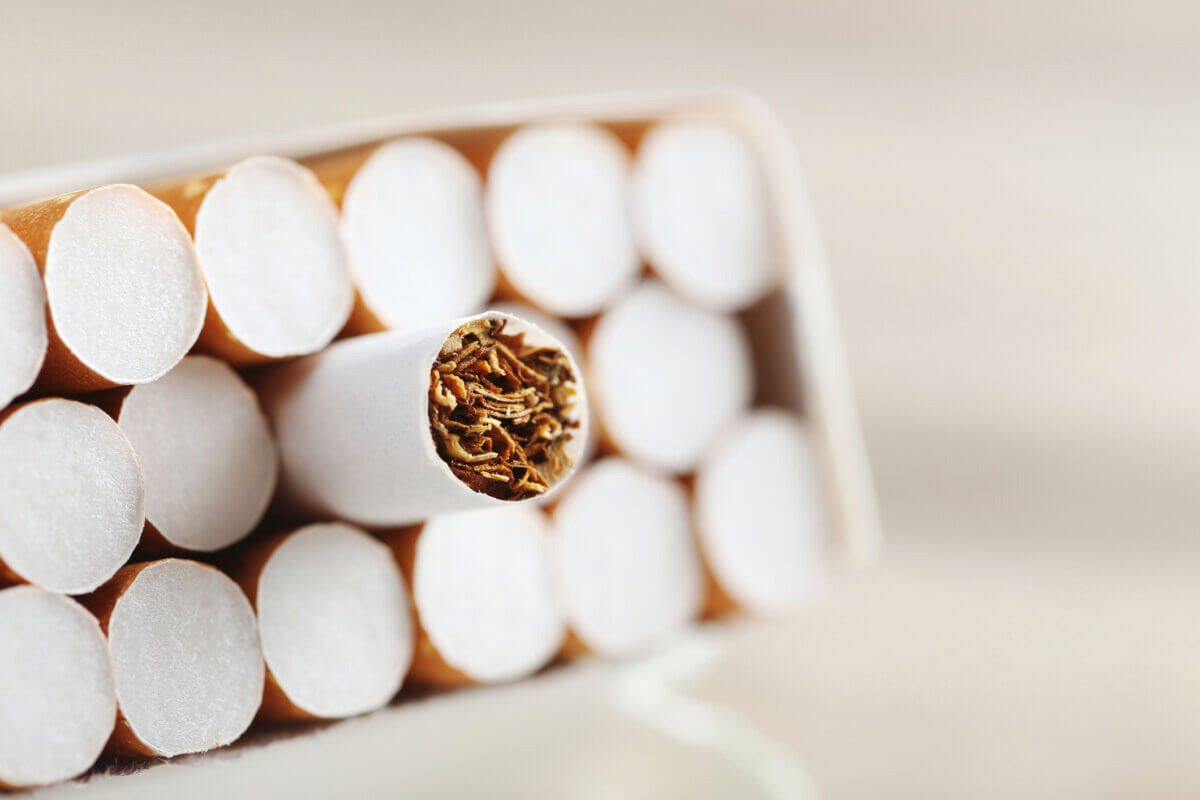
Philip Morris Designed Lunchables Like a Cigarette
Philip Morris applied “consumer-driven product development” to Lunchables, embedding market researchers alongside engineers at every design stage. As Kraft General Foods’ CEO Geoff Bible put it at a 1990 company-wide research event: “We don’t create demand. We excavate it. We prospect for it. We dig until we find it.”
For Lunchables, that excavation led to children. Focus groups found kids wanted “control over their lunch” and “permission to play with their food.” Early prototypes came out of a “Food Playground” approach, with a design team building 17 versions through interactive play in a “room full of food” with “plastic and scissors.” Consumer testing also focused on “busy mothers/working women 25–49,” who wanted convenience but worried about nutrition. Lunchables’ packaging was designed to ease that tension, with a bright yellow band evoking a gift and a clear plastic window showing familiar Oscar Mayer and Kraft contents.
The Low-Fat Playbook: From Marlboro to Lunchables
By the 1990s, public concern about childhood obesity was threatening the brand. A prominent pediatrician called Lunchables a “nutritional disaster” in 1994, and the American College of Cardiology called them a “blood pressure bomb” in 1997. Philip Morris had faced the same kind of backlash with cigarettes and answered it with filtered and low-nicotine Marlboros, products designed to let smokers feel better about their habit without quitting. Internal documents show that playbook became a direct blueprint for food.
A competitor analysis commissioned by British American Tobacco concluded that Marlboro’s success came from “getting the guilt out of the product.” Philip Morris’s chairman believed the “better-for-you” market was “the most powerful driving force in the cigarette market since 1954.”
That same pressurized CO2 technology, refined through coffee and tobacco research, was applied to processed meats and cheeses. When early low-fat formulations failed taste tests because the flavor wasn’t “up to standards,” scientists turned to the same brain-and-senses tools developed for cigarettes to find chemical flavor additives that could fill the gap. Low-Fat Lunchables launched in 1995. That year, CEO Geoff Bible celebrated a “700-million-dollar fat-free food business” in his annual address to shareholders.
Lunchables kept expanding through the 1990s and 2000s, adding pizza versions, pudding versions, and jumbo-sized iterations, until Philip Morris sold Kraft in 2007. In 2023, two new versions qualified for the National School Lunch Program, feeding 30 million low-income children. Kraft-Heinz described it as a “$25 billion growth opportunity.” A year later, the company withdrew Lunchables from the program, citing poor market performance, after a Consumer Reports study found high sodium and heavy metals in the product and some school districts expressed hesitation over nutrition concerns.
Schmidt argues the tobacco industry’s fingerprints on Lunchables are not merely historical curiosity. Legal actions in the 1990s forced tobacco companies’ internal records into public view and drove major advances in regulation. Those same archives, examined for what they reveal about food, suggest the same corporate logic was applied to Lunchables. If the same machine built both, the same tools that reined in Big Tobacco, warning labels, taxes, and restrictions on marketing to children, may be what the ultraprocessed food industry needs next.
Disclaimer: This article is based on an analytic essay published in a peer-reviewed journal. The findings draw on internal company documents and do not establish a direct causal link between Lunchables and specific health outcomes. Readers should consult a qualified health professional for dietary guidance.
Paper Notes
Limitations
Schmidt’s analysis is based on previously undisclosed internal company documents archived in the UCSF Industry Documents Library, cross-referenced with public-facing sources such as corporate communications and journalism. As an analytic essay, the paper does not involve human research participants or controlled trials. Its findings are specific to Lunchables and Philip Morris Companies between 1985 and 2007 and may not generalize to other ultraprocessed food brands or manufacturers. The paper does not quantify health outcomes directly attributable to Lunchables, nor does it establish a precise causal link between the product development strategies described and specific rates of childhood obesity or other health conditions.
Funding and Disclosures
According to the paper, the author’s research is funded by the US National Institutes of Health, the National Science Foundation, the Department of Agriculture, and private philanthropies. The author discloses that she consults as an expert witness for plaintiffs in litigation involving necrotizing enterocolitis and infant formula marketing. No other conflicts of interest are noted.
Publication Details
Author: Laura A. Schmidt, PhD — Institute for Health Policy Studies and Department of Humanities and Social Sciences, School of Medicine, University of California, San Francisco. | Paper title: ‘Tobacco Industry Contributions to the Development of Ultraprocessed Food in the United States, 1985–2007: A Case Study of Lunchables’ | Journal: American Journal of Public Health | Published: Online ahead of print, June 3, 2026 | DOI: https://doi.org/10.2105/AJPH.2026.308491 | ORCID: Laura A. Schmidt — https://orcid.org/0000-0003-4346-7260


