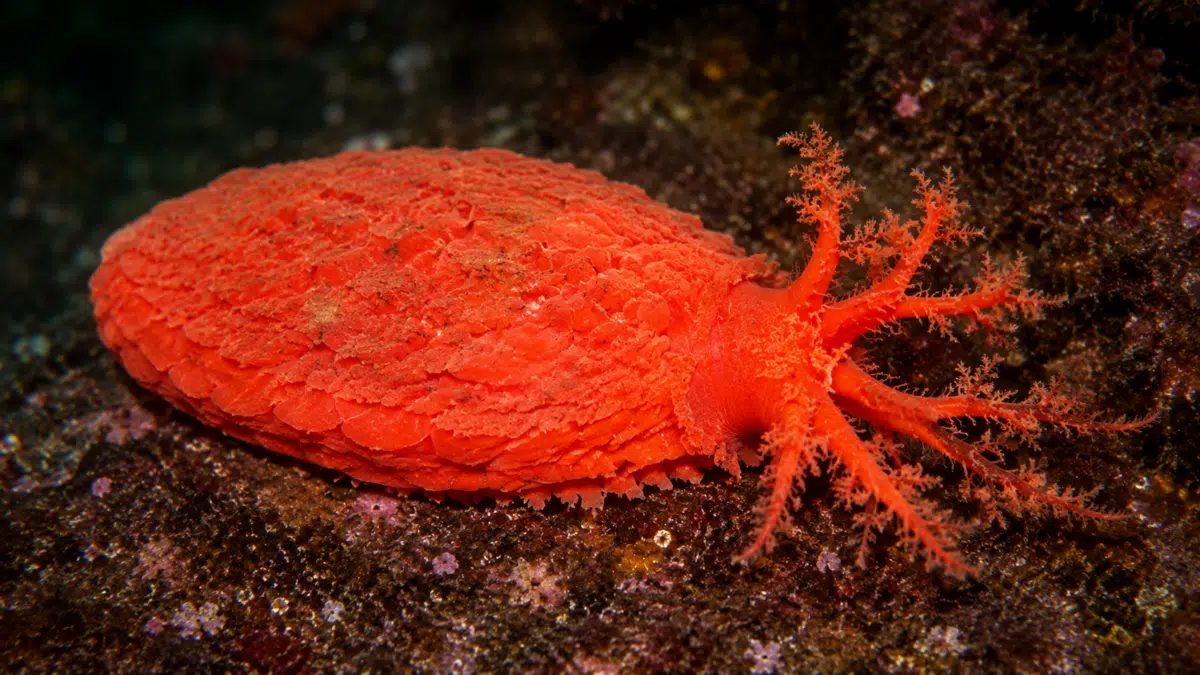
Graphic by StudyFinds
This Sea Cucumber’s Detached Tissue Has Been Living in Seawater for Three Years and Counting
In A Nutshell
- Researchers cut small pieces of tissue from a sea cucumber species called Psolus fabricii and placed them in natural seawater with no special nutrients or lab conditions, and the tissue healed itself and kept living for more than three years.
- Unlike any other species tested, including sea stars, sea urchins, and other sea cucumbers, P. fabricii tissue showed active immune responses, cell division, and nutrient absorption long after being separated from the animal.
- Scientists believe a family of chemical compounds unique to this species, known as psolusosides, may act as a built-in shield against bacterial infection, though that hypothesis still needs to be confirmed.
- The discovery could open a new class of ethical, low-maintenance biological research models for studying healing, drug effects, and environmental pollutants.
Cut off a piece of a sea cucumber, place it in flowing natural seawater, and watch what happens. Most people would expect a rotting blob within a few days. What researchers found instead was something with no parallel in the scientific literature. The tissue healed itself, kept growing, and more than three years later, was still alive.
That is the central finding of a study published in Science Advances, and it upends one of the most basic assumptions in biology: that tissue cut away from a living body will, sooner or later, die. Small pieces snipped from a cold-water sea cucumber species called Psolus fabricii did not die. They kept going, with no special nutrients, no sterile conditions, and no lab support of any kind. Scientists liken the thriving tissue to a “real-life zombie.”
Getting human or animal tissue to survive outside a body has been one of biology’s great challenges for two centuries. Even the most successful lab techniques require carefully controlled, bacteria-free environments loaded with nutrients and growth-promoting chemicals. HeLa cells, the immortal human cell line that has powered cancer research since the 1950s, are a single cell type grown under strict lab conditions. What these sea cucumber tissue pieces appear to be doing is far more involved: surviving as organized, multi-layered tissue.

Psolus fabricii: A Sea Cucumber Built for Losing Pieces of Itself
Psolus fabricii lives in cold Atlantic and Arctic waters, clinging to hard surfaces while its feathery tentacles filter food from the water above. Its tube feet, the small suction-cup-like structures it uses to grip surfaces, are constantly at risk of damage or loss. In evolutionary terms, this is tissue from a body part that may be unusually prepared for injury and repair.
Working out of Memorial University in Newfoundland, Canada, researchers cut individual tube feet from adult sea cucumbers and placed them into culture plates submerged in tanks of flowing, unfiltered natural seawater. No special nutrients. No antibiotics. No temperature controls beyond the cold-water conditions the animals already lived in.
What followed was a precise, step-by-step repair process. Within the first two days, each severed piece shed the damaged tissue at its cut edge. By day six, surrounding healthy tissue had curled inward to seal the wound completely. Researchers named these surviving pieces “LiPfe,” short for living immortal P. fabricii explants.

How Sea Cucumber Tissue Keeps Itself Alive
To confirm the tissue was genuinely alive and not just decaying in an organized way, the team ran a battery of tests over the following year.
Chemical dyes tracked cell division and programmed cell death, the body’s controlled way of clearing out damaged or unnecessary cells. Both processes were active from the moment the tissue was cut, working in roughly synchronized pulses that surged and dropped about every 24 hours, a hallmark of active, living tissue.
Immune cells called coelomocytes, which play a defense role somewhat like white blood cells do in humans, flooded the wound site in the first days after cutting. These cells clustered near the cut edge, packaged up debris, and cleared it through what appeared to be a remnant of the animal’s internal fluid transport system. Their numbers stayed elevated for weeks, then gradually fell as the wound closed, mirroring how immune responses work in intact animals.

Researchers also tested nutrient uptake. Tube foot pieces were exposed to water containing specially labeled amino acids that could be tracked as they moved into the tissue. After the first six days, the explants showed a significant spike in amino acid absorption compared to control samples, suggesting the tissue was capable of pulling dissolved nutrients directly from the water.
How Psolus fabricii Outlasted Every Other Species Tested
To rule out the possibility that this was simply a property of all sea cucumbers or related animals, the team ran parallel experiments on tissue from several other species: two types of sea stars, a sea urchin, two other sea cucumber species, and a brittle star. All of them healed their wounds in the first week. But none survived long-term. The longest any non-P. fabricii tissue held on was about 104 days, and most fell apart within two months.
Something about P. fabricii specifically keeps its detached tissue alive for an astonishingly long time. A formal one-year experiment confirmed healing and ongoing cellular activity. Follow-up monitoring, described by the researchers as opportunistic rather than part of the controlled trial, found some explants still intact beyond three years. Researchers point to a family of chemical compounds unique to this species, known as psolusosides, previously shown to kill bacteria and other cells. Their hypothesis is that these compounds may give the explants a built-in chemical shield against infection, though that mechanism still needs to be confirmed.
Tentacle pieces added another layer of surprise: the branching tips kept extending and retracting in response to touch throughout the study period. That kind of response suggests neural networks inside the explants were preserved well enough to keep sending signals.
As the authors put it, these findings “challenge the boundary between organismal life and cellular autonomy, compelling a redefinition of what it means for tissue to be alive.” A piece of a sea cucumber, floating in cold seawater for three-plus years, still reorganizing and taking up nutrients, may also turn out to be a practical research tool, one with fewer ethical complications than many experiments requiring whole animal subjects.
Disclaimer: This article is based on a single peer-reviewed study and should not be interpreted as established medical or biological consensus. The research is exploratory in nature, and the authors note that key questions, including whether true cellular immortality is occurring, remain unanswered. Future studies are needed to confirm the proposed mechanisms.
Paper Notes
Limitations
The authors describe this study as a broad, exploratory investigation rather than a mechanistic one. While multiple lines of evidence point toward genuine long-term tissue survival, the underlying biological reasons why P. fabricii tissue can survive indefinitely remain unclear. Telomere length, a key indicator of cellular aging, was not measured over time, which would be an important step in confirming whether meaningful cellular aging is or is not occurring. The role of the psolusosides unique to P. fabricii, proposed as a possible explanation for infection resistance, has not been directly tested in this context. Additionally, longer-term observations beyond one year were described by the researchers as “opportunistic” rather than part of the formal controlled study, making those findings more observational in nature.
Funding and Disclosures
Funding was provided by the Natural Sciences and Engineering Research Council of Canada through a Discovery Grant and Doctoral Scholarship, and by start-up funding from Bigelow Laboratory for Ocean Sciences. The authors declared no competing interests.
Publication Details
Authors: Sara Jobson, Emaline M. Montgomery, Jean-François Hamel, Rachel E. Sipler, and Annie Mercier | Affiliations: Department of Ocean Sciences, Memorial University, St. John’s, Newfoundland and Labrador, Canada; Department of Biology, Vancouver Island University, Nanaimo, British Columbia, Canada; Society for Exploration and Valuing of the Environment (SEVE), Portugal Cove-St. Phillips, Newfoundland and Labrador, Canada; Bigelow Laboratory for Ocean Sciences, East Boothbay, Maine, USA | Journal: Science Advances, Volume 12 | Paper Title: “Natural tissue immortality: Indefinite survival of sea cucumber explants” | DOI: 10.1126/sciadv.aeb1394 | Publication Date: May 27, 2026


