(Credit: © AI Dream Studio -stock.adobe.com)
In a Nutshell
- Wearable face and neck fans delivered whole-body cooling comfort comparable to a bladeless desk fan and a low-speed bladed desk fan.
- Cooling just the face and neck, which together make up only about 5.5% of the body’s surface area, produced surprisingly large improvements in overall thermal comfort.
- Wearable fans use far less energy than conventional desk fans and sharply reduce the “spillover” problem of blasting air onto nearby coworkers.
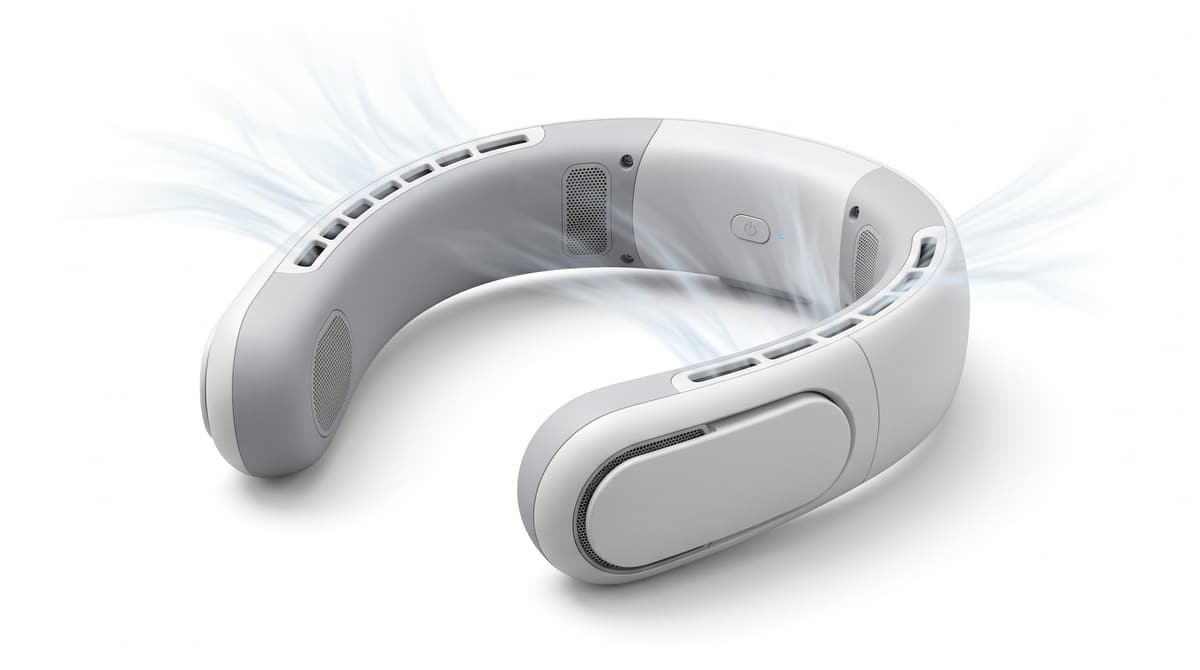
Anyone who has ever sat at a shared office desk and watched a coworker hog the only fan in the room knows the frustration. Short of starting a thermostat war, there has never been a clean solution. A new study out of Concordia University finds that small, wearable fans worn around the face or neck can match a bladeless desk fan, and even a low-speed traditional one, for whole-body cooling comfort, with far less air spilling onto nearby coworkers.
Researchers tested four personal cooling devices in a controlled office setting and found a result that upends a common assumption: bigger airflow does not necessarily mean better comfort. Targeting just the face and neck, two of the body’s most heat-sensitive areas, proved surprisingly effective at making a person feel comfortable overall, even though those two zones account for only about 5.5% of the body’s total surface area. The work, published in E3S Web of Conferences and presented at the IAQVEC 2026 conference, put each device through a battery of controlled tests before reaching that conclusion.
That offers a practical fix for one of modern office life’s most stubborn problems: keeping individuals comfortable without making everyone around them miserable. For workers wilting at a desk on a summer afternoon, a fan that hangs around the neck may do the job of the bulky one plugged in at the desk.
How the Study Actually Tested Wearable Fans
Researchers set up experiments in a small, controlled office room at Concordia University in Montreal, Canada. Rather than using human volunteers, the team relied on a 23-segment heated mannequin, a life-size scientific instrument that mimics how a human body gains and loses heat. Dressed in standard summer office clothing, a short-sleeve shirt and thin trousers, the mannequin was seated at a shared office desk. Room temperature was held steady at roughly 25 degrees Celsius (about 77 degrees Fahrenheit), with low humidity and minimal background airflow, simulating a typical air-conditioned office.
Four cooling devices went head-to-head: a traditional bladed desk fan, a bladeless desk fan, a face fan worn in front of the face, and a U-shaped neck fan draped across the shoulders. Each device ran through its three speed settings in a single 210-minute session with long stabilization periods between speeds, and the full round of testing was repeated four times to confirm accuracy. Four devices at three speeds each totaled 12 cooling cases. Sensors throughout the mannequin’s 23 body regions recorded skin temperature, heat loss at each zone, and a predicted thermal-comfort score during every session.
To judge how well each device worked, researchers used two main measurements. One tracked the overall “felt temperature” of the whole body, essentially how warm or cool the body registers its environment once airflow is factored in. The second measured how much extra heat the body shed because of the fan, compared to sitting with no fan at all.
What the Numbers Showed About Wearable Fan Cooling
Without any fan running, the model’s predicted comfort score sat at around plus 1.1 on a standard thermal comfort scale, where zero means perfectly neutral and positive numbers mean too warm. Once fans were switched on, all four devices pushed that score closer to neutral. At low speed, the bladed desk fan produced the biggest improvement. At medium and high speeds, however, the authors report that both the face fan and neck fan pushed the comfort score down by about 0.7 points, landing within the acceptable range defined by international building comfort standards.
Where the cooling actually happened produced the biggest surprise. The face fan generated the single highest localized cooling effect of any device tested, shedding up to 6 to 7 watts of heat from the face alone at high speed, comparable to what the bladed desk fan achieved at low speed across a much larger area of the body. The neck fan showed a similar pattern, with its cooling concentrated around the neck, face, and upper chest.
When researchers tallied whole-body heat loss across all body segments, the numbers came out remarkably close between the wearables and the bladeless desk fan. At medium speed, the face fan added about 23 watts of extra whole-body heat loss, the neck fan about 20 watts, and the bladeless desk fan about 25 watts. Two small battery-powered wearables nearly matched a plugged-in desk fan’s total cooling output, simply by focusing airflow on the most heat-sensitive parts of the body.

Why This Matters for Open-Plan Offices
One of the biggest practical advantages of the wearables has nothing to do with numbers on a chart. Conventional desk fans, particularly the bladed type, push air broadly, cooling the face, chest, arms, and hands of the person using them, and that same airflow frequently spills over into neighboring workspaces, creating uncomfortable drafts. At higher speeds, the bladed desk fan also risks overcooling the user.
Wearable fans sidestep both problems. Because their airflow is small and directed, far less of it reaches neighboring workstations. For open-plan offices where desks sit close together, that distinction matters. Energy use of the non-wearable fans ranged from 3.26 to 6.2 watt-hours for the bladed model and 0.44 to 1.55 watt-hours for the bladeless model across different speeds, while the wearable fans run on rechargeable batteries and consume very little energy by comparison.
There is also a physiological reason why targeting the face and neck works so well. Prior research has established that the brain pays outsized attention to temperature signals coming from those areas, so even a modest amount of cooling there can register as a meaningful improvement in overall comfort. In the study’s measurements, a small neck fan drawing almost no electricity produced comfort scores close to those of a desk fan that consumes far more power. For building managers looking to raise thermostat set points and reduce the load on central air conditioning, that kind of individual solution could support higher room temperatures and lighter cooling demands.
Desk fans have been a staple of office comfort for decades, but they were never designed for open-plan workspaces. This study makes a concrete, measurement-backed case that wearable face and neck fans can close the comfort gap in a way that is quieter, uses less energy, and is far less intrusive to everyone else in the room. For workers tired of thermostat battles, the answer might already be hanging around someone’s neck.
Disclaimer: This study used a heated thermal mannequin and a thermoregulation model rather than human participants, so its comfort measures are predicted rather than reported by real people. The study did not test individual factors such as sweating, personal draft tolerance, and thermal preference. The authors note that human-subject trials are needed to confirm the findings. This article summarizes the research for a general audience and is not a substitute for the original paper.
Paper Notes
Limitations
The study was conducted entirely using a heated mannequin rather than real human participants. As the authors note, a mannequin cannot account for subjective human responses such as individual thermal preference, behavioral adaptation, or tolerance to local drafts. Because the mannequin does not sweat, cooling from evaporation was also outside its scope. Researchers state that future work should include controlled human-subject experiments that measure thermal sensation and acceptability, comparing multi-region cooling strategies against breathing-zone-focused airflow.
Funding and Disclosures
The provided paper identifies no funding sources, grant numbers, or conflicts of interest.
Publication Details
Paper Title: “Comparative cooling efficiency of wearable and non-wearable personal comfort systems in office settings”
Authors: Tazia Rahman (Department of Building, Civil and Environmental Engineering, Concordia University, Montreal, Quebec, Canada); Mohamed M. Ouf, Joyce Kim, and Kehinde Bayode (Civil and Environmental Engineering, University of Waterloo, Waterloo, Ontario, Canada)
Journal/Conference: E3S Web of Conferences, Volume 716, Article 03010 (2026), presented at IAQVEC 2026
DOI: 10.1051/e3sconf/202671603010
Access: Open access, published under Creative Commons Attribution License 4.0


