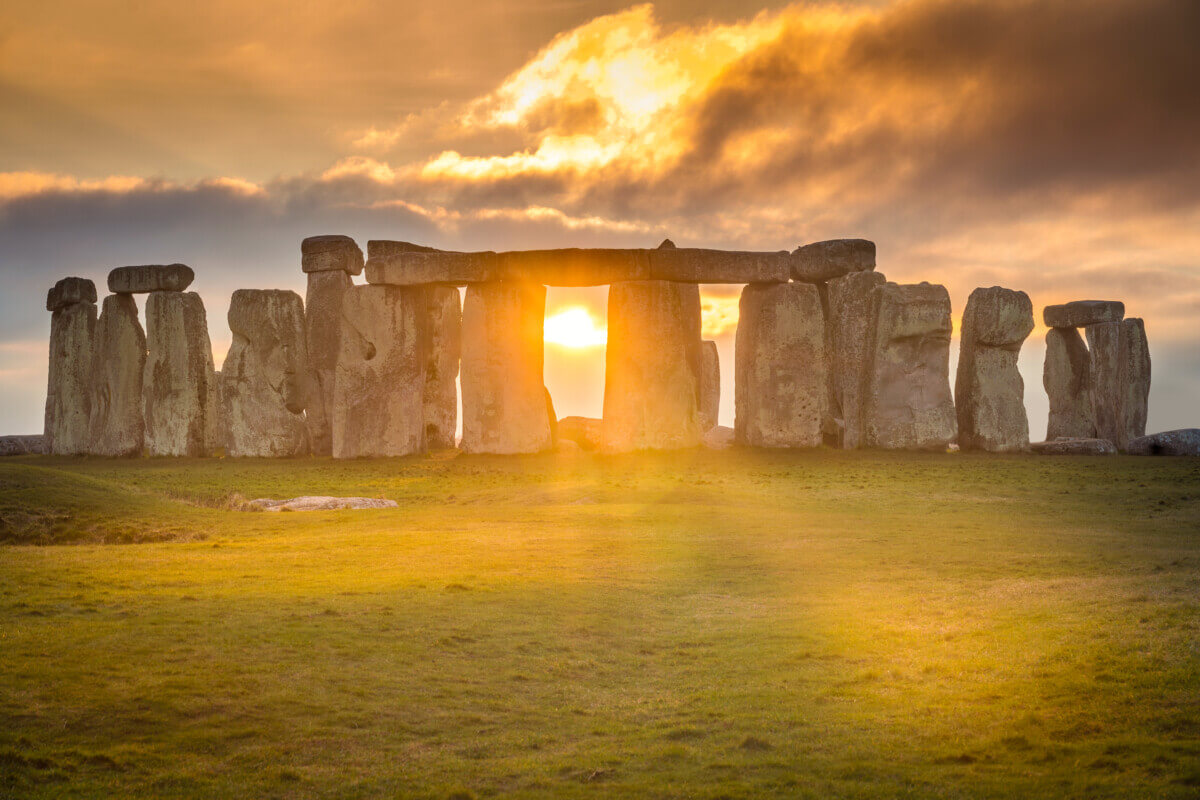
Stonehenge during sunset winter solstice (Chuta Kooanantkul/Shutterstock)
Scientists Think They Know Where Stonehenge’s Altar Stone Came From, and the Journey Is Even Wilder Than Expected
In A Nutshell
- Stonehenge’s six-ton Altar Stone most likely originated in Caithness or the Inverness-Black Isle area of northeastern Scotland, about 700 kilometers away.
- A new study used mineral fingerprinting and glacier modeling to trace the stone’s possible journey south.
- An ice age glacier may have carried the stone partway to a now-submerged landmass called Dogger Bank, but this remains unproven and would require a narrow set of circumstances to have occurred.
- No matter what, prehistoric people had to haul the stone hundreds of kilometers on their own, a feat pointing to remarkable large-scale organization in ancient Britain.
Stonehenge has stumped researchers for generations. One of the biggest unanswered questions has always been how did prehistoric people move multi-ton slabs of rock across hundreds of miles to build one of humanity’s most iconic monuments? A new study zeroes in on the site’s most central stone, a six-ton sandstone slab lying flat at the heart of the circle, and the answer may involve a frozen highway, a sunken landmass, and a level of human organization genuinely hard to fathom.
Sitting at the center of Stonehenge on Salisbury Plain in southern England, the Altar Stone is a rectangular slab measuring roughly 16 feet long. Previous research established that it likely came from northeastern Scotland, about 700 kilometers, or roughly 435 miles, away. This new study, published in the Journal of Quaternary Science, asked a follow-up question: could a glacier have done some of the heavy lifting? The answer raises the possibility of an intermediate stop at a now-underwater landmass in the North Sea called Dogger Bank, a place that thousands of years ago was dry land.
Reading the Altar Stone’s Geological Fingerprint
To trace the Altar Stone’s origins, the research team compared the stone’s mineral signature to samples from across Scotland. Scientists focused on tiny crystals called zircons, minerals found in sandstone that carry a geological timestamp recording when and where they formed. By comparing age patterns in the Altar Stone against rocks from various Scottish outcrops, the team identified the closest match.
Evidence points most strongly to mainland northeast Scotland, especially Caithness or the Inverness-Black Isle area. Among tested samples, Sarclet in Caithness was the closest zircon match. Three other candidate areas farther south were ruled out because their crystal age patterns didn’t line up. Mineral fingerprinting works much like forensic trace evidence: match the signature to the source.
Pinpointing the origin precisely is, as the authors write, “a formidable task.” Caithness’s sandstone formation stretches thousands of square miles, and the rock type comes in many varieties.

Could a Glacier Have Moved Stonehenge’s Altar Stone?
Once the most likely source was identified, the team asked whether the ice sheets of the last ice age, blanketing much of Britain roughly 30,000 to 15,000 years ago, could have carried the stone southward at least partway.
Ice sheets don’t move rocks in a straight line. Over thousands of years, as they grow and shrink, a boulder picked up in one era might travel in a completely different direction centuries later. Researchers used a computer model tracking how a rock embedded in a glacier would move as ice flow directions shifted over time.
From Caithness, the ice sheet mostly pushed material north and east. Under certain modeled conditions, a narrower corridor did push southeastward, potentially carrying rocks as far as Dogger Bank, a raised area of the North Sea floor that sat above water for thousands of years after the ice age.
Dogger Bank sits roughly 400 kilometers, about 250 miles, northeast of Stonehenge. If the glacier deposited the Altar Stone there, it could have reduced the human transport distance substantially, from about 700 kilometers to around 400. Still a serious undertaking, but shorter than a direct haul from Scotland. Even so, the scenario requires a narrow coincidence between the stone’s precise origin and the path the ice happened to take.
Dogger Bank Was Underwater Before the Altar Stone Reached Stonehenge
Dogger Bank was dry land for thousands of years after the glaciers retreated, and archaeological evidence suggests people lived there. Large glacier-deposited boulders would have stood out in that flat, bedrock-free landscape and may have held significance to nearby communities.
Rising sea levels began flooding Dogger Bank roughly 8,000 to 7,000 years ago. Since the Altar Stone is believed to have arrived at Stonehenge several thousand years after that, anyone retrieving it would have had to move it to higher ground, preserve it for millennia, and eventually haul it to Salisbury Plain. Not one journey. A chain of events spanning thousands of years.
“Such a scenario requires prolonged cultural significance or multiple-phase activity, across an exceptionally large temporal gap,” the authors write. That long chain of events, they acknowledge, strains the plausibility of the Dogger Bank theory considerably.
Ancient Humans Were Still Doing the Heavy Lifting
No matter how the modeling is interpreted, the study finds no pathway by which glaciers alone could have delivered the Altar Stone to Stonehenge. Human effort was always required for the final, substantial leg.
Possible routes include maritime pathways along the southeastern coast of England, or an overland passage along the Berkshire Ridgeway, a prehistoric high-ground track in use since at least the Neolithic, connecting the Thames corridor with the Wessex chalklands where Stonehenge stands.
Moving a six-ton slab over hundreds of miles demanded something modern society rarely credits ancient peoples with: sustained, large-scale coordination across vast distances. Prehistoric Britain, the researchers argue, was far more connected than once assumed, with people sharing traditions, rock art styles, and materials across enormous stretches of landscape.
Glaciation may have provided, at most, a partial assist. What moved the Altar Stone the rest of the way was human will, organizational capacity, and a determination to place a particular rock at a particular place that remains, after all this, genuinely hard to explain.
Disclaimer: The findings of this study are based on mineral analysis and computer modeling and have not been independently replicated. The glacial transport scenario described remains speculative and is presented by the researchers as one possible, unconfirmed pathway. Readers should consider this research in the context of ongoing scientific debate about how Stonehenge was built.
Paper Notes
Limitations
The study acknowledges several important constraints. Mineral fingerprint data for the Orcadian Basin is currently limited to mainland exposures, meaning rock outcrops on Orkney couldn’t be compared using the same approach. Ice sheet modeling is constrained by the resolution of available simulations, which operate at 2.5-kilometer spatial resolution and 1,000-year time steps. No high-resolution simulations exist for the older Anglian glaciation, roughly 450,000 years ago, which extended much farther south, making it impossible to test whether that earlier event could have moved the stone closer to Stonehenge. Large boulders on Dogger Bank are also poorly documented in available geological records, largely because offshore surveys there have focused on engineering concerns rather than geological study.
Funding and Disclosures
No conflicts of interest were declared. Open-access publishing was facilitated by Curtin University through an agreement between Wiley and Curtin University via the Council of Australasian University Libraries. No specific grant or funding sources are identified in the paper.
Publication Details
Authors Anthony J.I. Clarke and Remy L.J. Veness served as co-first authors, alongside Christopher L. Kirkland, Chris D. Clark, Niall Gandy, Andy Emery, Sarah L. Bradley, Jeremy C. Ely, and Ignéczi Ádám. Affiliations include Curtin University in Perth, Australia; Sheffield Hallam University; the University of Sheffield; Wessex Archaeology in Salisbury; and the University of Bristol. Published in the Journal of Quaternary Science (2026), pages 1–8. Paper title: “From Highlands to Henge: Refining the Provenance and Transport Pathways of Stonehenge’s Altar Stone.” DOI: 10.1002/jqs.70080. Received November 11, 2025; revised April 20, 2026; accepted May 2, 2026.


