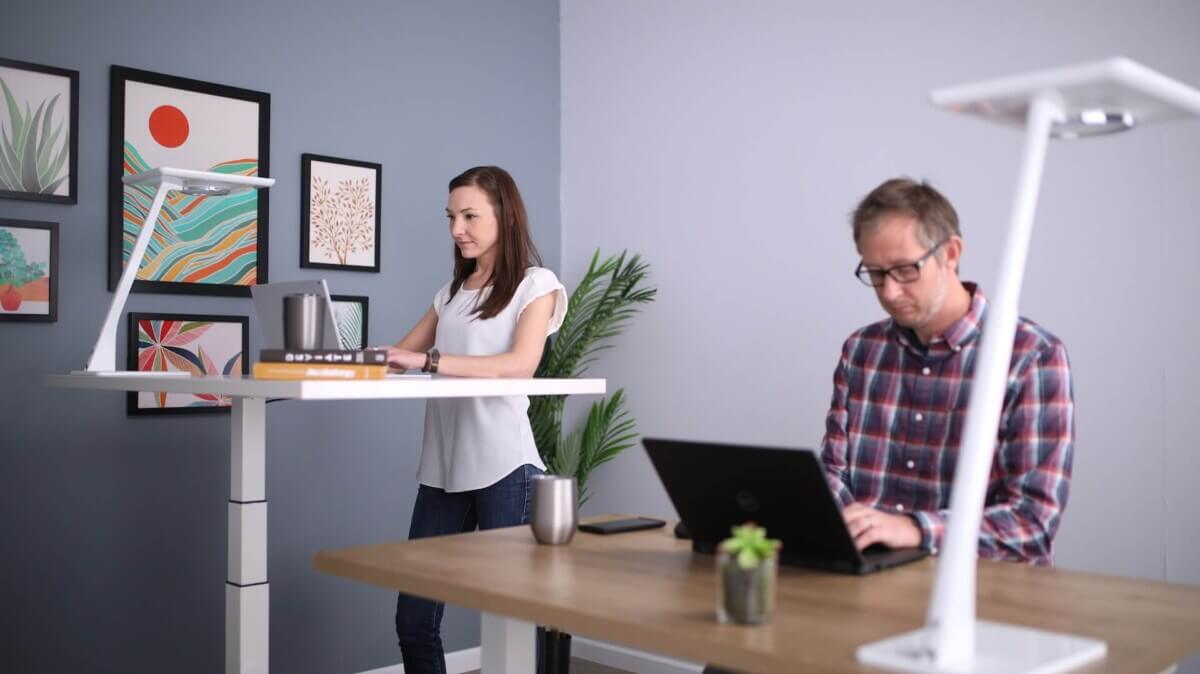
Standing desk (Photo by TheStandingDesk on Unsplash)
Standing Desks Remain an Unproven Bet on Comfort and Output
In A Nutshell
- Workers with sit-stand desks logged 43 more active computer minutes a day than coworkers at traditional desks.
- Reported discomfort was similar between the two groups after a year.
- Only a link, not a cause, was found, and nobody tracked how often workers actually stood.
- A payoff of about $8,900 per worker each year is a hypothetical estimate, not a measured gain.
Standing desks come with a big promise: less aching, less sitting, a healthier workday. A year of data from more than 10,000 office workers delivered a narrower result. Employees with sit-stand desks spent 43 more minutes a day actively using their computers than coworkers at fixed desks, yet their reported discomfort looked about the same by the end of the year.
Researchers at Texas A&M University and Indiana University dug into computer activity logs and employee surveys from a large California energy company, then reported the results in the journal Theoretical and Applied Ergonomics. The edge showed up in typing and keystrokes too, and held up at both the one-month and twelve-month checkpoints.
A catch comes before anyone shops for a desk. Company records did not say why some workers had sit-stand desks and others did not. This was a look back at existing company data, so it can reveal a link but not a cause. Workers who ended up with sit-stand desks may also have had different jobs or habits, and any of those could explain part of the gap.
Standing Desk Users Logged 43 More Active Minutes a Day
Records came from a wellness program at a company with about 24,000 employees in many kinds of jobs. Staff answered surveys about their desks and discomfort, while tracking software logged mouse and keyboard use. A computer counted as active only if the mouse or keyboard was used within a 30-second window, so a screen left glowing did not count. The paper highlights two earlier sit-stand studies that ran three and four months, so a full year is a longer look.
To be included, workers had to keep the same desk all year. That left 10,145 people, 6,741 at traditional desks and 3,404 at sit-stand desks. Being in the sit-stand group only meant a desk was available. Nobody tracked how often anyone stood, and the paper cites other research finding that fewer than 10 percent of workers choose to stand at such desks. Many in the sit-stand group may have mostly sat.
Group makeup differed too. Sit-stand users averaged 43 years old versus 49 for traditional desk users, and 51 percent were men versus 65 percent. The analysis did not adjust for those differences.
After a year, sit-stand users averaged about 3 hours 40 minutes of active computer time a day, compared with about 2 hours 57 minutes for traditional desk users. They also typed more words, pressed roughly 860 more keys a day, and made more typos, though the authors said the typo gap may be negligible in practice.

Standing Desk Users Reported Similar Discomfort After One Year
Discomfort meant soreness, muscle fatigue, or eye strain, and workers rated how often it hit, from never to four or more days a week. Only how often discomfort occurred was analyzed, not how bad it was or where it hurt.
At the one-month mark, sit-stand users were less likely to report no discomfort at all, 30 percent versus 36 percent. The authors say that early gap could reflect poor desk setups before workers joined the program, unresolved medical issues, or desks requested as medical accommodations. By the end of the year, the gap had shrunk to under two points, with the share of sit-stand users reporting none edging up and the share of traditional desk users drifting down.
Statisticians call the discomfort gap significant, meaning chance is an unlikely explanation, but with 10,000 people even tiny differences earn that label. The authors themselves said the practical difference in discomfort “may be negligible by industry standards.”
Researchers Estimate Standing Desks Could Pay for Themselves in Under Three Months
Researchers also turned the extra computer time into money. Using the federal government’s standard count of workdays and an average pay rate of $52.04 an hour, they put the added computer time at roughly 170 hours per worker each year, worth close to $8,900. A fully adjustable desk runs about $2,200 with setup and delivery, so that gain could, on paper, cover that bill in under three months.
That math is a back-of-the-envelope estimate, not a measured payoff. It treats active computer time as a stand-in for productivity, and more mouse clicks do not automatically mean better work. Engineers reviewing documents, for example, may spend time at a computer without much clicking or typing.

Standing Desks Are Tied to Computer Activity, Not Proven to Cause It
One possible twist comes from the authors themselves. The computer-time gap may owe more to a desk that fits a worker’s body, seated or standing, than to standing itself. That could explain why the desks showed a difference even though other research finds few workers stand at them much.
Workers hoping a sit-stand desk will ease workplace discomfort have little evidence here that switching desks alone will make a meaningful difference. Until studies track how often people actually stand, a sit-stand desk is best treated as an unproven bet on both comfort and output.
Paper Notes
Limitations
This was a retrospective, observational analysis of one company’s existing wellness program data, so it can show associations but not cause and effect. Data arrived as averages at one, three, and twelve months rather than 364 daily readings, which limited analysis of seasonal patterns and stretches when employees were out of the office. Neither original dataset included demographics such as occupation, so researchers relied on a company-provided summary of group totals. Age and gender differed between the groups, and the analysis did not adjust for them. Researchers also could not determine why workers had a given desk, when they received it, which type of adjustable desk it was, how much time they spent sitting versus standing, or whether they used footrests or anti-fatigue mats. Discomfort was reported by frequency, and researchers received no data on which body part was affected. Employees who changed desk types during the year, about 15 percent of the data, were excluded, and all participants came from a single company.
Funding and Disclosures
The paper states that the research received no external funding, and the authors declared no conflicts of interest. The study was approved by the Institutional Review Board of Texas A&M University (protocol code TAMU 2018-0874). Consent for data collection was obtained by the company at program enrollment, and data were de-identified before researchers used them.
Publication Details
The paper is titled “Improved Computer Utilization Associated with Height Adjustable Workstations in a Large Office Population” and was written by Tricia Lynn Salzar, Matthew Lee Smith, Adam Pickens, Gang Han, and Mark Edward Benden. Salzar, Pickens, and Benden are affiliated with the Department of Environmental & Occupational Health, School of Public Health, Texas A&M University. Smith is affiliated with the Department of Applied Health Science, School of Public Health in Bloomington, Indiana University. Han is affiliated with the Department of Epidemiology and Biostatistics, School of Public Health, Texas A&M University. It was published on September 19, 2026, in Theoretical and Applied Ergonomics (MDPI, open access), volume 2, issue 3, article 21. DOI: https://doi.org/10.3390/tae2030021. The underlying dataset is available through FigShare at https://doi.org/10.6084/m9.figshare.12753545.


