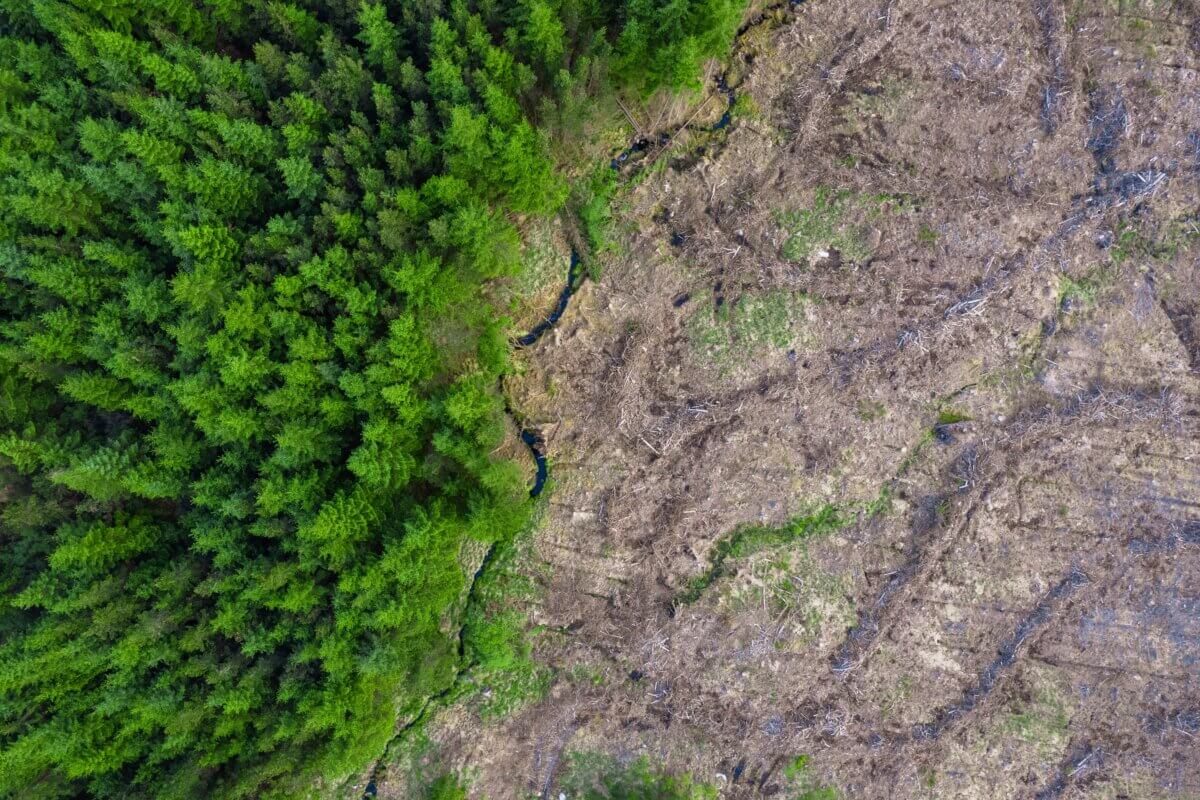
(Credit: mark gusev/Shutterstock)
Millions of Americans’ Drinking Water Depends on a Rule the Trump Administration Wants Gone
In A Nutshell
- At least 25 million Americans get public drinking water from watersheds in or downstream of roadless National Forest areas the Trump administration wants to open to logging and roads.
- The 2001 Roadless Rule protects more than 81,500 miles of streams and rivers, and for much of that mileage, it’s the strongest legal safeguard those waterways have.
- Forests act as a natural water filter; cities that invested in protecting them have saved hundreds of thousands to hundreds of millions of dollars a year in treatment costs.
- The rule also supports hunting, fishing, and freshwater wildlife, and areas near roads see wildfires ignite nearly four times more often than roadless areas do.
Turn on the tap in Denver, Salt Lake City, or Charlotte, and there’s a good chance the water started as snowmelt in a remote, roadless forest. For decades, a federal rule has kept logging trucks and bulldozers out of these places. All that protection may be going away.
In June 2025, the Trump administration signaled that it intends to rescind the 2001 Roadless Area Conservation Rule, which shields roughly 60 million acres of National Forest land from road building and logging. A formal notice followed in August 2025, drawing more than 625,000 public comments. A new study in PLOS Water puts numbers behind what’s at stake.
At least 25 million Americans get their public drinking water from watersheds sitting in or downstream of these roadless forests. In Colorado, that’s nearly 59% of the entire state. In New Mexico, about 39%. Because National Forests sit near so many cities, even states with small patches of roadless land can have a surprising share of their population relying on that water.
What the Roadless Rule Actually Does
Passed in the final days of the Clinton administration, the rule set aside stretches of National Forest free of roads since the 1970s. It designated these areas to protect water quality, wildlife habitat, and recreation, the same benefits now at stake.
Crucially, however, it’s never carried the weight of an actual law. A federal agency created it, not Congress, making it a target for 25 years of court fights. A draft environmental review is expected in mid-2026, and if the rescission goes through, these forests could open to logging companies and the roads that come with them.
Mapping What’s at Risk for Rivers and Drinking Water
To figure out what losing this protection would mean, researchers analyzed 2,488 roadless areas, an area roughly the size of Washington State, cross-referencing them with river data, drinking water records, hunting and fishing surveys, and wildlife databases.
This rule turns out to be a bigger deal for rivers than most people would guess. It protects more than 81,500 miles of streams and rivers, and for much of that mileage, it’s the strongest safeguard in place. Lose it, and those stretches fall back on weaker protections, even though other environmental laws would still apply elsewhere.
That protection isn’t evenly spread. Out west, it covers close to a fifth of all protected river miles in Idaho, plus a meaningful chunk in Utah and Colorado. Back east, Virginia, West Virginia, and North Carolina have long river stretches protected almost entirely by this one rule, despite having far less public land overall.

Your Water Bill, Your Forests
Here’s the part that connects to people’s wallets. Forests are basically a free water filter. Tree roots and soil catch sediment, soak up pollutants, and slow water down. Cut the trees and build roads, and that filter breaks, sending dirt straight into reservoirs and driving up treatment bills.
Researchers point to real-world proof. Seven U.S. cities that invested in protecting their watersheds, instead of building new treatment plants, saved anywhere from hundreds of thousands to hundreds of millions of dollars a year. One analysis found treatment costs drop by about 20% for every 10% increase in forest cover, up to a point.
Add it up, and the numbers get big fast. California alone has about 9.5 million people whose water comes from these watersheds; Colorado has 3.3 million. Angeles National Forest above Los Angeles supplies drinking water to more than 4 million people on its own, one of nine National Forests that each serve over a million Americans.
Water doesn’t stay put. Rivers run downhill, and cities often pipe water in from outside their borders. Water from Pisgah National Forest in North Carolina reaches Charlotte and even Huntsville, Alabama. Ashley National Forest in Utah serves systems in Salt Lake City, Las Vegas, Los Angeles, and San Diego.
Hunting, Fishing, and the Wildlife Few Talk About
Water isn’t the only thing at stake. In 2022, close to 40 million Americans fished and more than 14 million hunted, worth nearly $400 billion to the economy. Almost a third of the watersheds tied to roadless areas rank among the busiest in their states for hunting and fishing, with forests in California, Texas, Oregon, and Colorado standing out.
These same rivers quietly shelter fish, frogs, crayfish, freshwater mussels, and turtles, drawing on data covering more than 1,500 species. About one in five of these watersheds ranks among the most biodiverse in its state. The best wildlife spots usually aren’t the same as the popular hunting and fishing spots, so the rule ends up protecting two different things in two different places.
There’s also a wildfire angle rarely mentioned in this debate. Over three decades, fires started far less often in wilderness and roadless areas than near existing roads, where ignition rates run nearly four times higher. That doesn’t prove new roads would cause a specific number of new fires, but it’s a pattern worth watching.
The Bottom Line on the Roadless Rule
This rule will never have the star power of the Clean Air Act or the Endangered Species Act. It’s quiet and easy to overlook, right up until it’s gone. Rescinding it wouldn’t be a minor bureaucratic tweak. Researchers say it would be a real trade-off, one that could hit water bills, fishing trips, and river health across 38 states.
Disclaimer: This article is based on a single peer-reviewed study and reflects that study’s methods and estimates, which rely on 2017 public water system data and modeled projections rather than a real-time survey of every water user. The research assesses potential vulnerability if the Roadless Rule is rescinded; it does not predict specific logging projects, where roads would be built, or how water bills would actually change.
Paper Notes
Limitations
The study’s authors note several boundaries to their analysis. The research focused exclusively on the continental United States, excluding Alaska, meaning the Tongass National Forest and its roadless protections were not part of the assessment. The drinking water analysis relied on public water system data from 2017, the most recent comprehensive dataset available, which may not fully reflect current population distributions or water system configurations. The study also excluded water systems serving fewer than 25 people and certain non-community systems such as those at schools or factories. Additionally, the researchers note that while they tracked downstream watershed effects up to 160 river kilometers (100 miles) from roadless area boundaries, the true downstream reach of any future land-use changes could extend further. The biodiversity analysis reflects species range data from the IUCN Red List rather than on-the-ground species counts, which introduces uncertainty at the local level. The researchers also acknowledge that recreational demand metrics are based on modeled survey data rather than direct counts of visitors. The study evaluates exposure and potential vulnerability; it does not model specific logging projects, predict where roads would actually be built, or calculate future changes in water bills.
Funding and Disclosures
According to the published paper, this work was supported by funding from the University of Washington and by a contract from American Rivers to Conservation Science Partners. No funding sources are reported for co-authors Sandra L. Postel and Michael P. Dombeck. The authors state that funders had no role in study design, data collection and analysis, the decision to publish, or preparation of the manuscript. The authors have declared that no competing interests exist.
Publication Details
Authors: Julian D. Olden, Sandra L. Postel, Michael P. Dombeck, Helen Kesting, Patrick Freeman, and Lise Comte. Olden and Kesting are affiliated with the School of Aquatic and Fishery Sciences at the University of Washington and Conservation Science Partners, Inc. Postel is affiliated with the Global Water Policy Project. Dombeck is an Emeritus Professor at UW-Stevens Point and Chief Emeritus of the United States Forest Service. Freeman and Comte are affiliated with Conservation Science Partners, Inc. | Journal: PLOS Water | Paper Title: “Assessing the value of the U.S. Roadless Rule for people and nature” | Published: July 15, 2026 | DOI: https://doi.org/10.1371/journal.pwat.0000538


