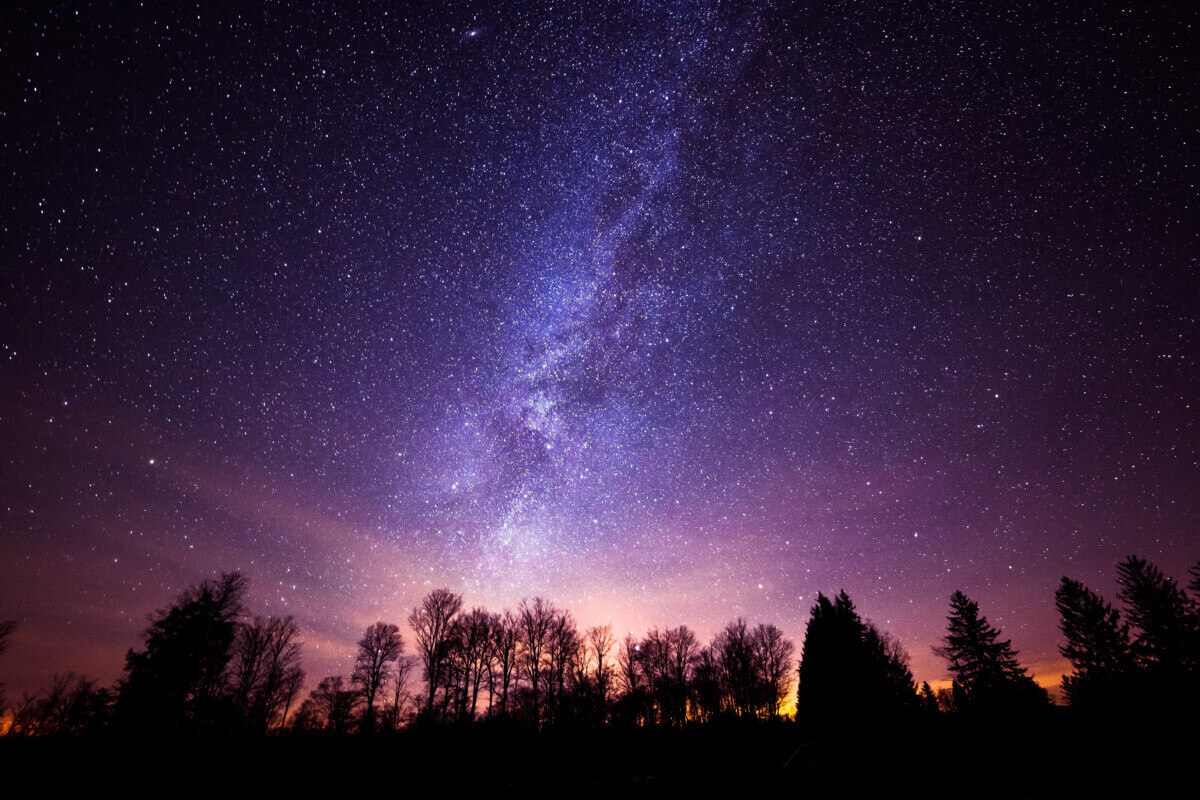
View of the Milky Way galaxy from Cherry Springs State Park in Pennsylvania. (© Ridall Photography - stock.adobe.com)
Gravity Passes a 750-Million-Light-Year Test
In A Nutshell
- For the first time, scientists directly measured how gravity behaves across cosmic distances, up to roughly 750 million light-years, and found it consistent with the standard inverse square law.
- Using the faint afterglow of the Big Bang to clock the motion of galaxy clusters, the Atacama Cosmology Telescope produced a more independent test of gravity than earlier large-scale attempts.
- A popular alternative to dark matter called MOND, which predicts gravity behaves differently at very low accelerations, failed to match the data by a statistically meaningful margin.
- Upcoming telescopes and galaxy surveys could push the test to an even higher level of certainty, potentially settling the large-scale MOND question within the next decade.
Gravity is one of the most familiar forces in the universe. It holds the moon in orbit, keeps feet on the ground, and pulls raindrops toward Earth. But for all its familiarity, physicists had never been able to directly measure how gravity behaves across the truly vast distances of deep space. A new study finally changes that. Using the faint afterglow of the Big Bang as a kind of cosmic speedometer, researchers clocked how galaxy clusters move toward one another across hundreds of millions of light-years and found that gravity behaves very close to the way standard physics predicts, even at those scales.
Directly measuring something is very different from assuming it, especially when that something is the fundamental force holding the universe together. Published in Physical Review Letters, the study is the first to directly test the gravitational force law at these scales without depending on the detailed assumptions about cosmic expansion history that many earlier large-scale tests require. And its conclusions are clear: gravity, stretched across 750 million light-years of space, does not waver.
There is a sharper edge to the result. A rival framework called Modified Newtonian Dynamics, or MOND, has spent four decades as the most prominent scientific alternative to dark matter. MOND proposes that gravity behaves differently at very low accelerations, getting stronger than expected over large distances. At the scales this study probed, MOND predicts galaxy clusters should be moving toward one another faster than standard physics would expect. They are not. The simple large-scale MOND prediction tested here failed to match the data by a statistically meaningful margin, though the result does not settle every possible MOND variant.
Using the Big Bang’s Afterglow to Test the Gravitational Force Law
To make this measurement, the team turned to something called the kinematic Sunyaev-Zeldovich, or kSZ, effect. All of space is filled with a faint glow of ancient microwave radiation, the leftover light from the Big Bang. When that light passes through a galaxy cluster that is moving toward or away from us, the cluster’s motion leaves a subtle imprint on the radiation, a tiny shift in its temperature. ACT, a precision telescope operating high in the Chilean Andes, is sensitive enough to detect those shifts.
Working from an SDSS galaxy catalog of 343,647 galaxies, the team restricted the main kSZ analysis to 227,837 galaxies in the selected redshift range, then used ACT temperature maps to measure how fast pairs of clusters at different separations are moving toward one another. That speed, at each distance, is a direct signature of how gravity is behaving. A force that weakens faster with distance would produce slower cluster motion. A force that weakens more slowly would produce faster motion. What the team measured matched the standard expectation, the classical inverse square law, all the way out to about 750 million light-years.

Gravity Holds Steady Across 750 Million Light-Years of Space
Most people know the inverse square law even if they have never heard the name. It is why a flashlight beam spreads and dims with distance. Gravity works the same way. Double the distance between two objects and the pull drops to one quarter. That relationship has been confirmed within our solar system countless times, but verifying it across cosmic distances requires measuring something that had never been directly measured: how fast galaxy clusters are actually moving relative to one another.
That is what this study did. Using ACT’s latest data release, which combines the telescope’s own observations with data from the Planck satellite, the team measured the gravitational force law across separations of roughly 100 million to 750 million light-years. Translated into the mathematical index physicists use to describe the rate at which gravity weakens with distance, the measurement came out to 2.1, well within range of the value of 2 that standard physics predicts. Importantly, this measurement was anchored in the observed motions and clustering patterns of real galaxies, rather than the detailed cosmic-expansion assumptions used in many earlier tests.
Why This Cosmic Gravity Test Is Bad News for MOND
MOND requires that same index to be 1 at large scales, not 2, meaning gravity would weaken much more slowly over vast distances and pull clusters toward one another faster than standard physics predicts. When the researchers compared MOND’s predictions against the actual measurements, the mismatch was large enough that it is unlikely to be a fluke, a level of statistical tension that physicists consider a serious result. That is a bruising outcome for the simple large-scale version of MOND tested here. Variants that invoke different mechanisms, such as the so-called external field effect, were not directly addressed and remain open questions.
Upcoming surveys could deliver a more definitive verdict. Researchers project that sharper CMB maps from the Simons Observatory, paired with galaxy catalogs from surveys like the Dark Energy Spectroscopic Instrument, could push that test to around 10 sigma, a bar that would essentially close the case on this particular question.
Dark matter remains undetected in any laboratory, and the mystery of what makes up the universe’s missing mass is unsolved. But the argument that gravity simply works differently at large scales just got much harder to make. Across three quarters of a billion light-years, gravity is behaving the way the standard cosmological model predicts.
Paper Notes
Limitations
The analysis assumes the galaxy correlation function changes slowly over the redshift range studied, roughly 0.44 to 0.66, a window the authors note is consistent with a change of only about 2% and is supported by the standard cosmological model. The study does not account for the “external field effect,” a specific MOND mechanism that could in principle alter gravitational behavior in certain environments, though the authors argue it is unlikely to affect their findings at the large separations probed. Galaxy bias, the offset between where visible galaxies sit and where the full matter distribution lies, introduces a small correction that is absorbed into the analysis and represents a minor source of uncertainty.
Funding and Disclosures
Support for the Atacama Cosmology Telescope came primarily from the U.S. National Science Foundation through multiple awards. Additional funding was provided by Princeton University, the University of Pennsylvania, NASA, the Canada Foundation for Innovation, and national science agencies from South Africa, Canada, Chile, and Europe. Individual researchers received support from the Kavli Institute for Cosmological Physics, the Simons Foundation, NSF grant AST-2206088, NASA ROSES grant 12-EUCLID12-0004, the Natural Sciences and Engineering Research Council of Canada, and the National Research Foundation of South Africa, among others. ACT operated in the Atacama Desert of northern Chile. No conflicts of interest are noted.
Publication Details
Authors: P. A. Gallardo, K. Pardo, O. H. E. Philcox, N. Battaglia, and 39 additional co-authors from institutions including the University of Pennsylvania, Columbia University, Cornell University, Princeton University, the University of Chicago, and others. | Journal: Physical Review Letters | Title: “The Atacama Cosmology Telescope: A Test of the Gravitational Force Law on Cosmological Scales Using the Kinematic Sunyaev-Zeldovich Effect” | DOI: https://doi.org/10.1103/rk8v-rcm3 | Published: February 2, 2026


