
Credit: Curated Lifestyle For Unsplash+
Pet Parrots Don’t Just Mimic Names. Many Use Them to Talk to Specific People.
In A Nutshell
- Nearly half of nearly 900 parrots studied were reported to use human names, with many doing so in contextually appropriate ways rather than as mindless mimicry.
- Some parrots used names in ways that suggest they understood a name belongs to one specific individual, including calling for absent people and correcting humans who used the wrong name.
- Grey parrots showed the strongest name use, but appropriate name use was documented across 30 species.
- Researchers stop short of claiming parrots truly “understand” names the way humans do, but say the findings are a meaningful first step toward answering that question.
When a parrot calls out “Hi, Sarah!” as someone walks through the door, most people assume it’s a clever trick with no real understanding behind it. But a sweeping new study of nearly 900 companion parrots tells a different story. Many of these birds aren’t just repeating names like recordings on a loop. Some appear to use names in ways that may be consistent with understanding that a name belongs to a specific individual, greeting the right person, calling for someone who’s left the room, or even telling the correct dog to be quiet by name.
Out of 884 birds for which survey-takers provided word and phrase data, 47%, or 413 individual parrots across 63 species, were reported to use names. A research team spanning institutions in the United States and Austria analyzed that survey data, collected over nearly four years. What caught their attention was evidence that many birds weren’t merely mimicking. Dozens used names in ways that resemble how humans do: as labels tied to specific individuals, deployed in the right situation, sometimes adjusted for who was present or absent.
Scientists have explored whether animals use name-like sounds before. Dolphins produce “signature whistles” that function a bit like names, and research on elephants and marmosets has shown they can target specific individuals with their calls. Parrots offer a unique window into this question because they can produce human words, making it easier to tell whether a name is used correctly. As the authors write, no previous research has provided evidence that such a large and diverse group of species “can produce and appropriately use names that are recognized as such according to human linguistic conventions.”
How Researchers Tracked Parrot Name Use Across 63 Species
Published in PLOS ONE, the study drew data from an online survey called “What Does Polly Say?” that ran from October 2020 through August 2024. Researchers collected reports on 1,202 parrots representing 89 species, though detailed data were available for 884 birds across 78 species. From those responses, the team pulled every phrase containing a recognizable name for a person, the parrot itself, another bird, or a non-bird pet, excluding names for objects or brands. In total, 802 name-containing phrases came from those 413 birds, with multiple trained observers scoring each for name type and context.
What Parrots Were Doing With Names
Most name phrases involved the bird’s own name: 280 parrots across 55 species did this. But 124 used the names of people, 43 used the names of companion birds, and 39 used the names of non-bird pets. Not every parrot that said a name seemed to understand it. Many appeared to treat a name as part of a memorized phrase. A parrot that says “Hi, Polly!” to every visitor isn’t really labeling anyone. Only about half of the phrases with context information met the team’s criteria for “appropriate” use, meaning the bird directed the name toward the correct individual rather than deploying it indiscriminately.
The cases of appropriate use were compelling. Researchers identified 131 examples from 88 parrots across 30 species. Among those, 69 examples from 42 parrots showed “individualized” name use, the strongest sign that a bird understood a name as a label for one specific being. One bird said “goodnight” followed by the correct name to each flock mate as they were put to bed, regardless of order. Another told different dogs to be quiet, using the right name for each. At least ten birds asked for specific people by name only when those people weren’t in the room, a behavior that may suggest an awareness that the named individual existed somewhere else, a concept researchers describe as “individual permanence.” One parrot even corrected people who called it the wrong name by telling them its actual name.
Species Differences and What They Reveal About Parrot Name Use
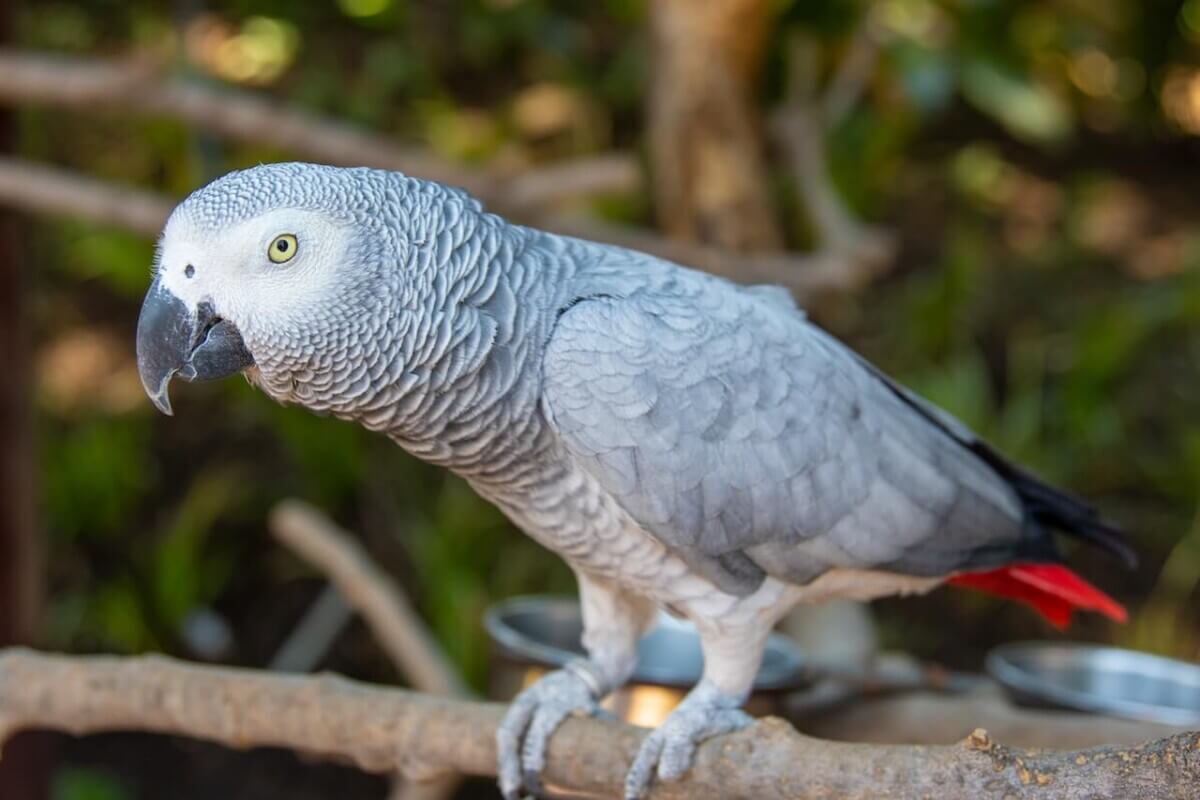
Grey parrots stood out as the strongest name users, with 67% showing appropriate name use and 38% showing individualized name use. Other species trailed, with yellow-headed amazons and monk parakeets each landing around 40%. At least 26 parrots across 19 species used nicknames, and some learned names entirely by eavesdropping. A bird that says “Quiet, Rufus!” when the dog barks almost certainly picked that up from listening to a person scold the dog. No parrot in the study learned a place name, which researchers suspect reflects how rarely humans announce geographic locations in ways a bird would register.

More Than Just a Party Trick
Parrots that used their own names to get attention mirror a familiar behavior in toddlers, who often refer to themselves in the third person before mastering pronouns. Researchers note this also resembles how wild parrots and dolphins use individually distinct vocal signatures, most often produced by the animal they identify.
Survey data from pet owners carries limits. Respondents may read meaning into well-timed mimicry, and they likely reported the most impressive examples rather than a full picture. Still, the scale of the data is hard to dismiss. As the authors acknowledge, reports of individualized name use “do not unequivocally demonstrate that parrots understand names as vocal labels, but they offer a first step towards assessing this ability across a wide range of parrots.”
Paper Notes
Limitations
This study relied entirely on survey responses from parrot owners, which introduces several important caveats. Survey-takers were not asked to provide complete vocabularies for their birds, meaning the 47% rate of name use is a minimum estimate. Respondents may have been biased toward reporting the most impressive or human-like examples of name use, and their descriptions of context may reflect human interpretation rather than the bird’s actual intent. Researchers could not control for the social or learning environments of the parrots studied, making it difficult to know why certain birds learned names and others did not. The scoring of “appropriate” and “individualized” name use was subjective, though the team used multiple coders to improve reliability. As the authors acknowledge, reports of correct, individualized name use “do not unequivocally demonstrate that parrots understand names as vocal labels, but they offer a first step towards assessing this ability across a wide range of parrots.”
Funding and Disclosures
This work was funded in part by the Vienna Science and Technology Fund (WWTF) project ANIML (LS23-014) to Marisa Hoeschele. The funders had no role in study design, data collection and analysis, decision to publish, or preparation of the manuscript. The authors declared no competing interests.
Publication Details
Title: Name use by companion parrots | Authors: Lauryn Benedict (Department of Biological Sciences, University of Northern Colorado), Viktoria Groiss (Department of Linguistics, University of Vienna), Marisa Hoeschele (Acoustics Research Institute, Austrian Academy of Sciences), Eva Reinisch (Acoustics Research Institute, Austrian Academy of Sciences), Christine R. Dahlin (Department of Biology, University of Pittsburgh at Johnstown) | Journal: PLOS ONE | Published: April 17, 2026 | DOI: 10.1371/journal.pone.0346830 | Editor: Javed Iqbal, University of Sahiwal, Pakistan | Received: November 12, 2025 | Accepted: March 24, 2026


