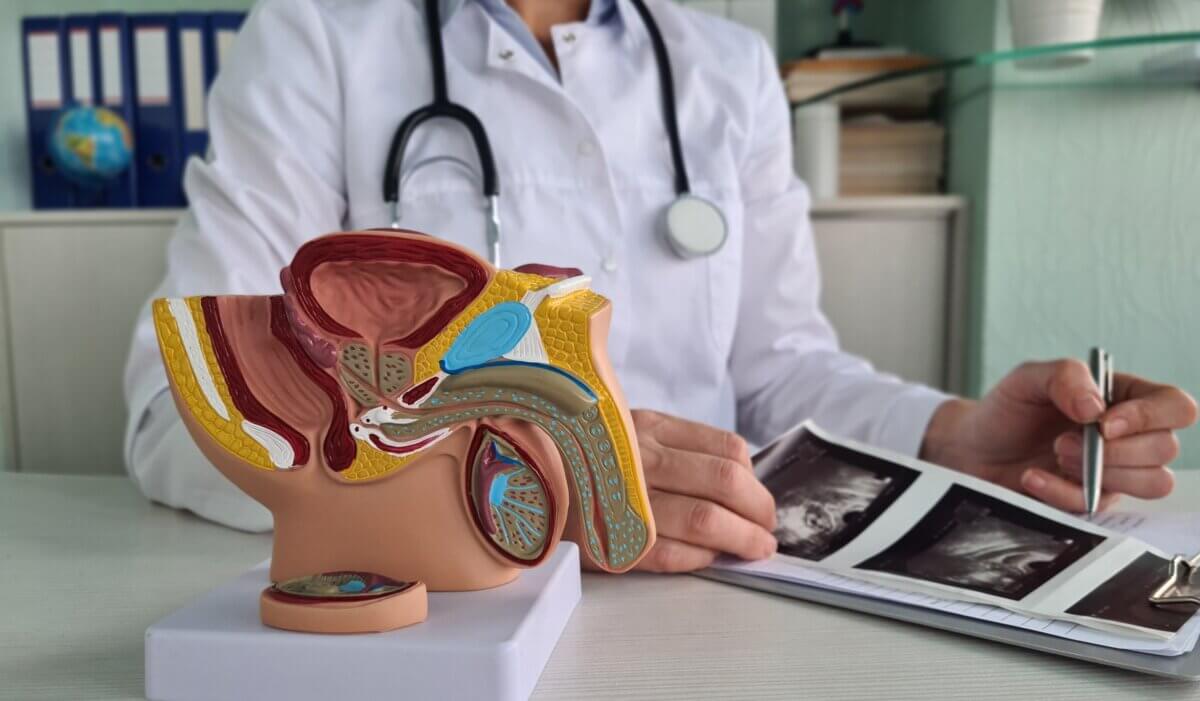
Male reproductive system model. (Photo by NMK-Studio on Shutterstock)
A Drug Combo Already in Medicine Cabinets May Help Peyronie’s Disease Patients
In A Nutshell
- Men in the early stage of Peyronie’s disease who took an off-label combination of two repurposed oral medications, one from the Viagra drug family and the other tamoxifen, saw meaningful reductions in penile curvature.
- Nearly all patients on the drug combination who had painful erections before treatment no longer reported pain afterward.
- Earlier research had shown tamoxifen alone helped men in the early stage of Peyronie’s disease but not those in the later, stable stage, reinforcing that timing of treatment matters.
- This is the first clinical evidence supporting this specific two-drug combination, without any additional medications or devices, for early-stage Peyronie’s disease. Larger, more rigorous trials are still needed before any conclusions can be drawn.
For men dealing with a little-known but deeply distressing condition that causes the penis to bend painfully during erections, there has long been a frustrating gap in medicine: no approved pill to take when the disease first strikes. New research suggests that two existing, repurposed medications taken together may change that.
A clinical audit found that men in the early stages of Peyronie’s disease, a condition where scar-like tissue builds up inside the penis causing painful curvature, who were given an off-label combination of two oral medications showed meaningful improvement in both their degree of curvature and their pain levels. Patients who received standard care, by contrast, saw little to no change, and nearly one in three got worse.
Peyronie’s disease affects somewhere between less than half a percent and more than one in ten men, depending on the study. Despite how much it can affect quality of life and sexual health, treatments currently recommended by international medical guidelines, such as surgery or injections directly into the affected tissue, are reserved almost entirely for patients already in the advanced stage of the disease. For men in the early phase, when the condition is still developing, there has been essentially nothing proven to slow or reverse it. That’s the gap this research, published in The Journal of Sexual Medicine, is trying to fill.
Two Old Drugs, a New Purpose for Peyronie’s Disease
Neither medication at the center of this study is new. One belongs to the same drug family as Viagra, a class of medications commonly prescribed for erectile dysfunction that work by increasing blood flow. The other is tamoxifen, widely known for its use in breast cancer treatment, a drug that works by blocking certain hormonal signals in the body. Researchers had previously screened nearly 2,000 existing FDA-approved drugs and found that these two drug classes appeared to work together to fight the kind of internal scarring that drives Peyronie’s disease, at least in lab and animal studies.
This new study is the first to examine that specific two-drug pairing, without any additional medications or devices, in patients presenting with early-stage Peyronie’s disease.
Researchers conducted a clinical audit, a structured review of patient treatment and outcomes, rather than a formal randomized trial. One group of 133 patients diagnosed with early-stage Peyronie’s disease, meaning their symptoms had been present for less than 12 months, was prescribed the off-label two-drug combination at a specific hospital. These patients took the medications daily for three months. A separate group of 26 patients from a different hospital received what was considered standard care at the time: either no treatment at all or a daily dose of vitamin E.
Before the audit began, researchers confirmed there were no meaningful differences between the two groups in age, how long they’d had the disease, the degree of penile curvature, or how many were experiencing pain during erections.

What the Results Showed
After three months, the numbers told a clear story. Among patients who received the drug combination, curvature worsened in 9%, stayed the same in about 48%, and improved in nearly 43%. In the standard care group, roughly 31% got worse, about 54% saw no change, and only about 15% improved. That gap between the two groups was statistically meaningful, not the kind of difference likely to occur by chance.
Pain followed a similar pattern. Before treatment, about 65% of patients in the drug combination group reported painful erections. After three months, that number dropped to just 1.5%. In the standard care group, about half reported pain before treatment, and that figure dropped to about 27% afterward. Pain did decrease in both groups, which doctors note can happen naturally as Peyronie’s disease progresses, but the drop was far greater among those who received the drug combination. Researchers suggested that the larger pain reduction in the treatment group may reflect an actual slowing or reversal of the disease itself, since curvature also improved in that same group.
No patients in either group reported any side effects or adverse reactions during the three-month period.
A Promising Signal, But Not the Last Word on Peyronie’s Disease Treatment
Researchers are careful to frame these findings as preliminary. Because this was a clinical audit rather than a randomized controlled trial, patients weren’t randomly assigned to groups, and there was no placebo. Neither patients nor doctors were blinded to which treatment was being received, meaning both groups knew whether they were getting the drug combination or standard care. The two patient groups also came from different hospital settings, which could mean differences in socioeconomic background or other health factors played a role.
Curvature measurements were not taken using a standardized, blinded method, meaning some variation in how curvature was assessed could have influenced results. Patients who already had erectile dysfunction were also excluded, which limits how broadly these findings can be applied, since erectile dysfunction is actually quite common among men with Peyronie’s disease.
Earlier research had shown that tamoxifen on its own appeared to help men in the early stage of Peyronie’s disease, but not those in the later, stable stage, a pattern that reinforces the idea that timing matters when treating this condition.
For the estimated millions of men who develop Peyronie’s disease and find themselves with no proven pill-based option during that critical early window, this research points toward a direction that deserves a much closer look. A rigorous clinical trial is the logical next step, and based on these early numbers, there’s a real reason to run one.
Disclaimer: This article is intended for general informational purposes only and does not constitute medical advice. Neither of the medications discussed in this article is approved for the treatment of Peyronie’s disease. Patients should not start, stop, or modify any medication without first consulting a qualified healthcare provider.
Paper Notes
Limitations
The authors acknowledge several important limitations. This was a clinical audit, not a randomized controlled trial, meaning patients were not randomly assigned to treatment groups. The two patient cohorts came from different hospital settings, raising the possibility that differences in socioeconomic status or other unmeasured factors may have influenced outcomes. The study also lacked blinding, a placebo control group, and a standardized or blinded method for measuring penile curvature and calcification. Patients with erectile dysfunction were excluded from the analysis, which the authors note limits the generalizability of the findings, since erectile dysfunction is common in men with Peyronie’s disease. A longer follow-up period would also be needed to determine whether improvements seen in the treatment group are lasting or whether disease relapse occurs.
Funding and Disclosures
According to the published paper, no funding was declared and no conflicts of interest were declared by any of the authors.
Publication Details
Authors: Mohammad Shah, Matthew Megson, Abdullah Al-Mitwalli, Roberta Fratangelo, Partap Shergill, Rohaan Shahzad, Angelo Di Giovanni, Jufen Zhang, W.G. Lee, David J. Ralph, and Selim Cellek. Authors are affiliated with the Department of Andrology at University College London Hospitals; the Fibrosis Research Group at Anglia Ruskin University; the Division of Surgery & Interventional Sciences at University College London; and the Clinical Trials Unit at Anglia Ruskin University. | Journal: The Journal of Sexual Medicine, 2026, Volume 23, Issue 6 | Paper Title: “Evaluation of a combination of off-label PDE5 inhibitor and tamoxifen in acute Peyronie’s disease” | DOI: 10.1093/jsxmed/qdag120 | Published: April 20, 2026


