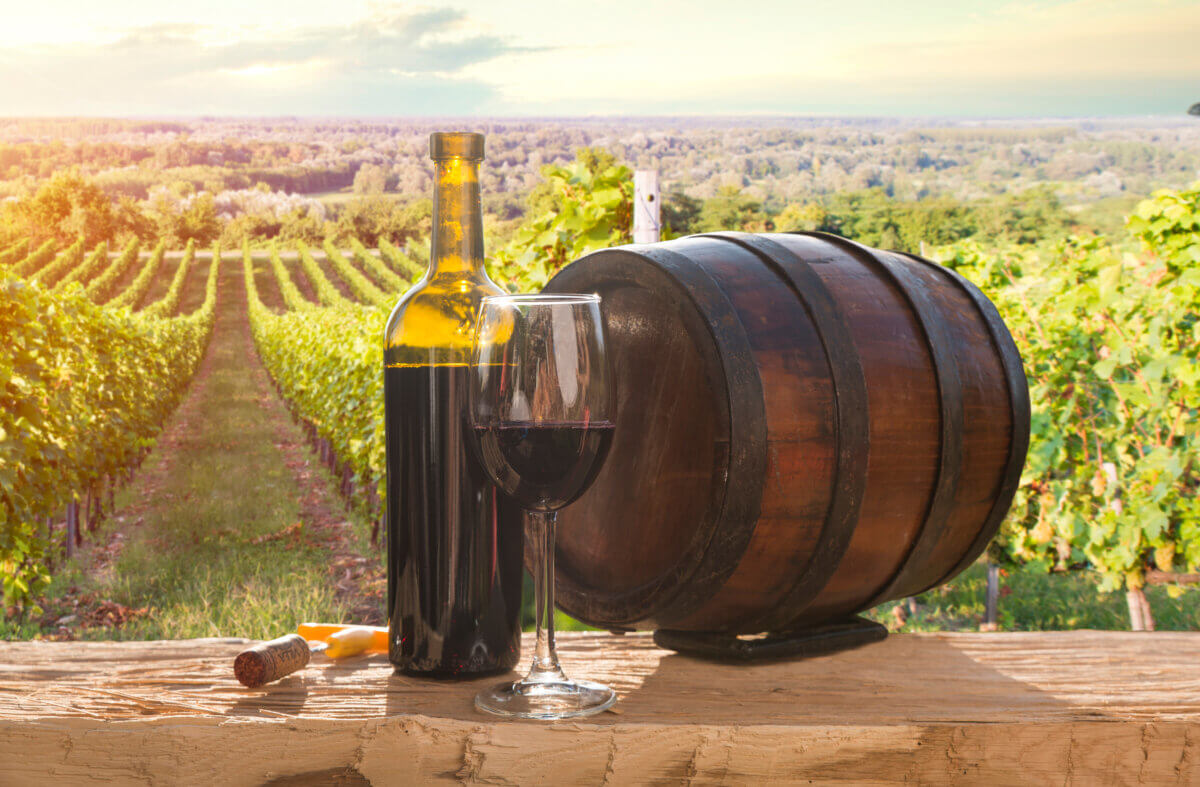
A bottle of Chianti at a vineyard in Tuscany, Italy (Kishivan/Shutterstock)
In A Nutshell
- Scientists analyzed ancient grape seeds from two sealed wells at a Tuscan archaeological site and traced the genetic origins of winemaking back at least 362 years of continuous cultivation.
- DNA testing revealed the dominant ancient vine most likely produced white grapes, a surprising find given that the same region is now world-famous for its rich red Sangiovese wines.
- Genetic ties between the Tuscan seeds and a first-century Roman farm in southern France point to a sophisticated, wide-reaching agricultural trading network built by the Romans.
- One ancient seed belongs to a grape family that includes what is officially recognized as the oldest living grapevine in the world, still producing fruit today in Maribor, Slovenia.
Two ancient wells, sealed for nearly two millennia beneath a hilltop in Tuscany, held a secret worth waiting for. Inside them, scientists found grape seeds now helping rewrite what we know about the origins of modern wine.
Researchers analyzed waterlogged grape seeds recovered from Cetamura del Chianti, an archaeological site in Italy’s famed Chianti winemaking region, and mapped the most extensive genetic history of ancient grapevines ever recovered from a single site. What they found was not just a record of survival, but evidence that ancient vineyards were part of a highly sophisticated agricultural network that laid the foundation for the wine we drink today.
“It is incredible to think that the wine grapes enjoyed by the ancient Romans are mere steps away from the varieties we pour into our glasses today,” said Dr. Nathan Wales, from the University of York’s Department of Archaeology. “When you drink wine made from these relic varieties, you are tasting history that is just a stone’s throw from what was served at Roman dinner tables thousands of years ago.”
Ancient Wells in Tuscany Preserved 2,000 Years of Wine History
Cetamura del Chianti sits on a hilltop in Siena province in Tuscany’s Chianti region. Between 300 BCE and 300 CE, local residents dropped grape seeds into deep wells, where oxygen-free mud preserved them for millennia. Excavations uncovered two of those wells packed with seeds, pollen, wood, and animal bones, and from them researchers recovered 310 grape seeds spanning from roughly 300 BCE to approximately 1200 CE.
For this study, researchers focused on 80 of those seeds, extracting ancient DNA and applying shape analysis, light-scanning, and radiocarbon dating to cross-check results. Seeds from deeper layers yielded better DNA than shallower ones, suggesting the mud created a stable environment that slowed genetic degradation over time.

Chianti’s Famous Wine Region Was Once Dominated by White Grapes
When researchers ran the genetic data through a relatedness analysis, asking which seeds were genetically identical to each other, the results upended expectations. Out of 32 seeds with high enough data quality for the test, 27 belonged to a single clonal group, meaning they came from the same grapevine lineage, likely maintained for generations by taking cuttings from valued vines. Copying a grapevine through cuttings produces a plant genetically identical to the original, and it is how farmers have always preserved prized varieties.
Radiocarbon dating confirmed this lineage spanned a minimum of 362 years, from ancient times through the Roman era. But the bigger surprise was what those grapes actually were. Genetic markers indicated the dominant variety most likely produced white grapes, with a 92.2% likelihood based on a model trained on modern varieties.
That finding lands with particular irony given that Chianti is one of the most celebrated red wine regions in the world today. “What a delightful surprise to learn that the world-famous red wine of today was actually preceded by a white vintage that was curated and maintained for centuries,” said Professor Nancy De Grummond of Florida State University. Two other seeds showed signals consistent with dark-berry varieties, suggesting red wine was probably not entirely absent from the site.
Ancient DNA Links Tuscan Vines to France and the World’s Oldest Living Grapevine
Beyond the locally maintained variety, the genetic data told a broader story about how wine spread across the ancient world. The dominant Cetamura clonal group, along with one transitional-period seed, showed close genetic ties to grape seeds from a first-century Roman farm at Mont Ferrier in southern France. Finding genetically related vines in Tuscany and southern France during the same era points to a deliberate, wide-reaching agricultural trading network built by the Romans to standardize wine production across the empire.
One Cetamura seed also belonged to a grape family with a living descendant. Its closest modern relative is a rare Hungarian variety called ‘Baratcsuha szurke,’ which belongs to the same broader clonal family as ‘Žametovka,’ a Slovenian grape whose oldest specimen is officially recognized as the oldest living grapevine in the world, still producing fruit after more than 400 years in the city of Maribor.
During the later period of Roman control, new grape varieties with distinct genetic profiles appeared at the site, including one genetically closer to varieties from the Balkans, suggesting vines being brought in from eastern parts of the expanding empire. At Cetamura del Chianti, the genetic record published in the Journal of Archaeological Science shows something more human than conquest and replacement: a vine worth keeping, passed from hand to hand across centuries of change, and still echoed in the grapes grown across Europe today.
Paper Notes
Limitations
Several important constraints apply to this study’s conclusions. The radiocarbon date for the earliest clonal seed, placing it between 818 and 674 BCE, is considered potentially anomalous, as no other archaeological evidence supports human habitation at Cetamura that far back. Excluding that date, the minimum confirmed continuity span drops to 362 years. Shape-based seed analysis has known limitations, since some domesticated vines retain physical features resembling wild plants. The modern reference panel contains 783 domesticated and 112 wild grape varieties but may not capture all relevant ancient diversity. Near-infrared spectroscopy is treated as exploratory, with the authors recommending further testing before it is used as a reliable predictive tool. Whether the genetic connections between Italy and France reflect frequent trade or occasional isolated transfers cannot be determined from the current data.
Funding and Disclosures
Funding was provided by the European Union’s Horizon 2020 research and innovation programme through the Marie Sklodowska Curie Actions under grant agreement no. 956351 (MSCA-EJD ChemArch) and Marie Sklodowska Curie Fellowship grant agreement no. 842577 (DREGS). Radiocarbon dating was funded by the Kenneth and Charlotte Orth Reckford Classics Fund for Research and Archives at Florida State University. Authors declare no competing financial interests or personal relationships that could have influenced the work.
Publication Details
Authors: Oya Inanli, Laurent Bouby, Vincent Bonhomme, Nancy de Grummond, Lara González Carretero, Roberto Bacilieri, Hannes Schroeder, Jazmín Ramos-Madrigal, Nathan Wales | Institutional affiliations include: BioArCh, Department of Archaeology, University of York (UK); Globe Institute, University of Copenhagen (Denmark); ISEM, Montpellier University (France); Department of Classics, Florida State University (USA); UMR Amélioration Génétique et Adaptation de plantes Institut, Université de Montpellier (France) | Journal: Journal of Archaeological Science | Paper title: “Grapevine cultivation at Cetamura del Chianti: multiproxy evidence for centuries of continuity from the Etruscans to the Romans” | DOI: https://doi.org/10.1016/j.jas.2026.106605


