
(Credit: © Kurhan - stock.adobe.com)
In a Nutshell
- An oral compound called TOFA caused significant weight and fat loss in obese mice without reducing food intake or causing muscle loss, setting it apart from current obesity drugs.
- TOFA worked by boosting how much energy cells burn, rather than suppressing appetite, and it also improved blood sugar, harmful blood fats, and fatty liver disease.
- When combined with semaglutide or tirzepatide, TOFA outperformed either drug alone, and animals maintained their weight loss longer after TOFA treatment ended compared to semaglutide.
Millions of Americans struggling with obesity have placed their hopes in a new generation of injectable weight-loss drugs. But those medications come with a frustrating catch: muscle loss, stomach problems, and weight that often rushes back once people stop taking them. Now, a team of researchers has identified a decades-old oral compound that attacks obesity through a completely different approach, burning more energy from within cells rather than simply telling the brain to eat less, and it may actually make drugs like Ozempic work better when used together.
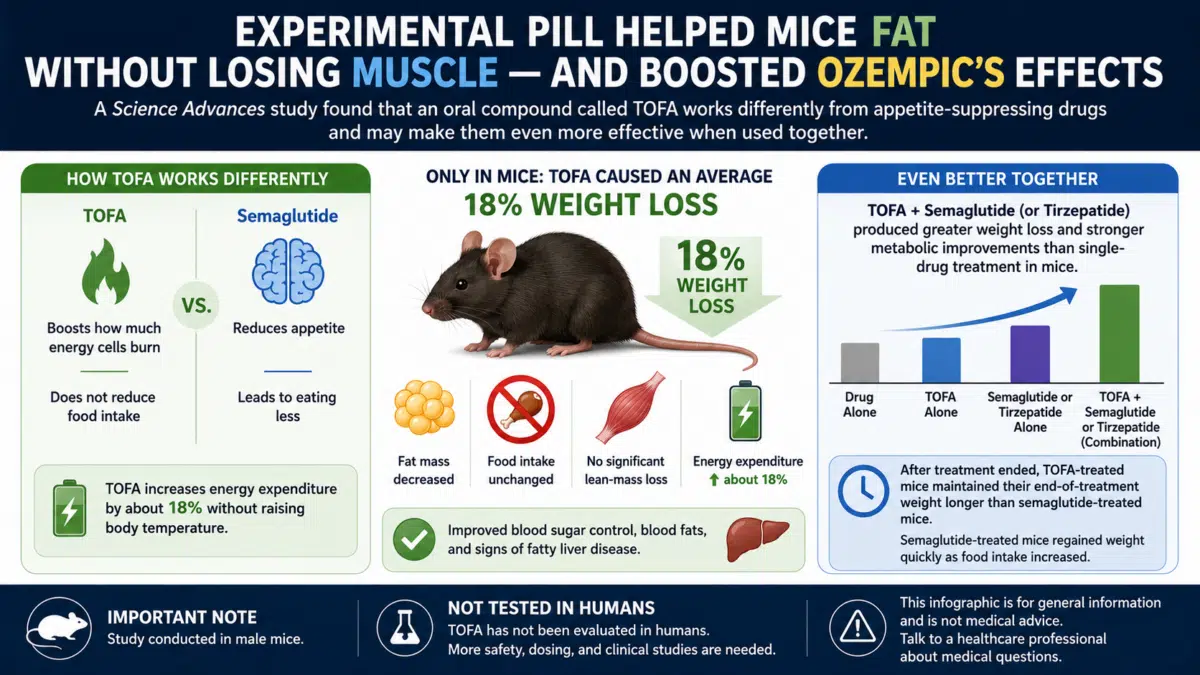
Published in the journal Science Advances, the study centers on a molecule called TOFA, short for 5-tetradecyloxy-2-furoic acid. When given to obese mice, TOFA produced an average 18% reduction in body weight without changing how much the animals ate or stripping away muscle mass. That combination of outcomes is nearly the opposite of what current blockbuster obesity drugs typically deliver, and it has researchers arguing the compound could fill a serious gap in how metabolic disease is treated.
When TOFA was paired with semaglutide (the active ingredient in Ozempic and Wegovy) or tirzepatide (sold as Mounjaro and Zepbound), the combination outperformed either drug alone on virtually every measure tested, including fat loss, blood sugar control, and harmful blood fats. Mice treated with TOFA also held onto their weight loss long after treatment ended, while animals on semaglutide alone rebounded rapidly once the drug was stopped.
How TOFA Works Differently From Ozempic
Drugs like semaglutide work by mimicking a hormone that signals fullness, convincing the brain to eat less. They are remarkably effective, but their weight-loss effect comes largely from reducing food intake. TOFA takes a separate path.
Inside cells, TOFA does two things at once. First, it blocks specific enzymes the body uses to manufacture fat from scratch, slowing the production of new fat. Second, it activates a pair of molecular switches that act like master volume controls for genes involved in burning fat for energy. Together, these actions shift the body’s metabolic balance: less fat gets made, and more energy gets spent.
Researchers confirmed this energy-burning effect by placing treated mice in specialized metabolic chambers. TOFA-treated mice consistently burned more energy, even at room temperature and in warm conditions where the body is not being pushed to generate heat. That distinction mattered to the team because it suggests TOFA is broadly increasing how cells burn energy, not just triggering a narrow temperature-regulating response. Energy expenditure increased by roughly 18% in TOFA-treated mice under mild conditions, and body temperature did not rise, an important point given that compounds that try to boost metabolism can sometimes dangerously overheat the body.
Fatty Liver Disease Also Improved
Beyond obesity and blood sugar, TOFA showed measurable effects on fatty liver disease, a condition closely linked to obesity that can silently progress to serious liver damage and scarring. Mice fed diets specifically designed to induce severe liver disease were treated with TOFA for four weeks. Treated animals showed significantly reduced liver fat, lower levels of liver inflammation markers, and reduced scarring in liver tissue. Signs of oxidative damage, essentially cellular rust caused by harmful chemical reactions, were also significantly decreased.
Researchers compared TOFA head-to-head against another ACC inhibitor, Firsocostat, which has been studied in human trials for fatty liver disease. TOFA achieved similar or better results on multiple disease markers. Critically, it did this without triggering a side effect that other drugs in the same class consistently cause: a rise in triglycerides that can raise cardiovascular risk. That side effect has been a roadblock for the broader class of fat-production-blocking drugs, and TOFA appears to sidestep it because of its second action on those molecular switches.
Why Pairing TOFA With Ozempic Could Beat Either Drug Alone
Among the most clinically relevant results is what happened when researchers combined TOFA with existing obesity medications. In obese mice treated for 24 days, all single-drug treatments produced roughly similar degrees of weight loss, around 10% compared to untreated controls. Combination groups did considerably better, with greater fat mass reduction and stronger improvements in blood sugar and harmful blood fats. Lean muscle mass was preserved across all TOFA-treated groups, including combination groups.
Durability of results also differed sharply. After treatment stopped, semaglutide-treated mice regained weight rapidly, driven by an immediate surge in food intake. TOFA-treated mice, whose weight loss was never driven by appetite suppression in the first place, maintained their end-of-treatment body weight for a considerably longer period before any rebound. Researchers believe this difference reflects the fundamentally distinct ways the two approaches work. Because TOFA changes how cells process and burn energy rather than altering hunger signals, the body does not appear to compensate as aggressively when the drug is removed.
All experiments were conducted in mice using multiple established models of obesity and metabolic disease, including animals fed a high-fat diet with 60% of calories from fat, as well as specialized diet models designed to induce severe fatty liver disease. Male mice were used throughout all animal experiments. Female animals were not studied because female hormones affect obesity-related metabolic disease in mice, and the researchers note that follow-up studies in female animals are needed.
TOFA was delivered orally, typically twice daily, at doses that would translate by standard scaling methods to roughly 500 to 1,600 milligrams per day for a 100-kilogram person, though the researchers caution that human dosing has not been determined or tested. TOFA has not been evaluated in humans. Its safety profile at doses used in the current study was not fully characterized for subtle toxicity, though previously published animal studies showed no obvious signs of toxicity at high doses across several months of treatment in rats.
Some of the researchers involved in the study are co-founders of a company called ReRx Therapeutics, which develops drugs related to this work, and are inventors on pending patent applications covering TOFA’s therapeutic use in metabolic disease. Novo Nordisk, the manufacturer of Ozempic, provided the semaglutide used in the study as a resource-sharing gift. These relationships represent financial interests that readers should weigh when considering the findings.
Human testing still lies ahead, and significant safety evaluation remains. But as the global obesity crisis deepens and current medications leave millions without adequate long-term solutions, a pill that burns fat instead of blunting hunger, protects muscle, improves the liver, and makes existing drugs work better is worth watching. The study’s authors put it plainly, describing TOFA as “a promising candidate and strategy for weight loss and metabolic disease management.”
Disclaimer: This article describes findings from a preclinical study conducted entirely in mice. TOFA has not been tested in humans, and results in animals often do not translate to people. Nothing here is medical advice. Anyone considering weight-loss medication or changing a current treatment should consult a qualified healthcare provider. Several of the study’s authors have financial interests in a company developing TOFA-related compounds.
Paper Notes
Limitations
All experiments in this study were performed in mice, and the findings have not been tested in humans. The authors used only male mice for in vivo experiments, which they acknowledge as a limitation, noting that estrogen’s protective effects in female mice against obesity-related metabolic disease make female animals a distinct and necessary subject for future study. The authors did not determine a minimal effective dose for weight loss in animals. While previous rat studies showed no obvious signs of toxicity at high doses across six months of treatment, the safety profile of TOFA at doses used in the current studies was not fully characterized for subtle or long-term toxicity. Researchers also note that additional unknown metabolic targets or tissue-specific effects of TOFA cannot be ruled out. Pharmacokinetic and safety data in higher species, including non-human primates and humans, will be required before clinical translation can be considered. Researchers further acknowledged that molecular mechanisms linking TOFA to metabolic effects may require additional investigation.
Funding and Disclosures
This work was supported by discretionary funds from the University of California, Berkeley, with assistance from the UCSF Liver Center (P30 DK026743) and the University of Michigan Animal Phenotyping Core (1U2CDK135066; MMPC-Live). Ruslan I. Sadreyev is supported by NIH/NIDDK P30 DK040561. Novo Nordisk provided semaglutide as a resource-sharing gift. Anders M. Näär, Justin Y. Lee, and Prabha Ibrahim are co-founders of ReRx Therapeutics, Inc., which develops drugs related to this work. Näär, Lee, and Chi Zhu are inventors on pending patent applications covering the therapeutic use of TOFA in metabolic disease, held by the Regents of the University of California. All other authors declared no competing interests.
Publication Details
Title: A multi-functional oral small molecule targeting energy and lipid metabolism to treat obesity and related metabolic disorders
Authors: Justin Y. Lee, Chi Zhu, Melissa A. Boldridge, Rachelle L. Stark, Gracia Bonilla, Kosuke Watari, Christina Papa, Lei Xu, Federico Gonzalez, Xin Tang, Kaitlyn T. Dang, Kook Son, Kashish Chetal, Prabha Ibrahim, Ruslan I. Sadreyev, Bilal N. Sheikh, Michael Karin, and Anders M. Näär
Journal: Science Advances, Vol. 12 (2026)
Publication Date: August 21, 2026
RNA-seq Data: GEO Series accession number GSE302447


